


A weekly round-up of tanker and dry bulk market (Oct 23, 2026)
The Baltic Exchange, a wholly-owned subsidiary of Singapore Exchange, is the world's only independent source of maritime market information for the trading and settlement of physical and derivative contracts.
Its international community of over 650 members encompasses the majority of world shipping interests and commits to a code of business conduct overseen by the Baltic.
For daily freight market reports and assessments, please visit www.balticexchange.com.
Capesize
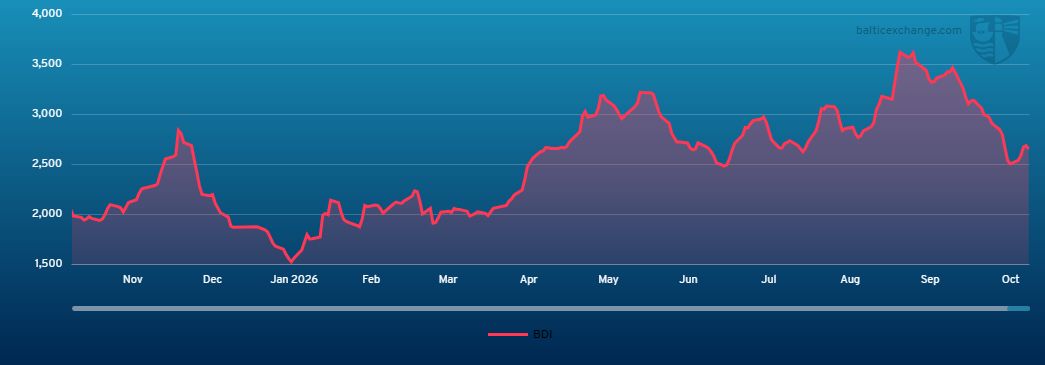
The Capesize market recovered steadily through the week, with improving sentiment across both basins lifting the BCI 182 5TC from US$30,518 on Monday to US$34,380 by Friday. The Pacific led the initial recovery, supported by renewed operator demand, increased miner participation and talk of potential weather-related delays in China. C5 rates advanced from the low US$12s to the US$14.15–14.25 range by midweek. While activity eased towards Thursday, underlying support remained evident, with miners continuing to cover early-November requirements. The South Brazil and West Africa to China markets also gathered momentum, with C3 rates advancing from the low US$31s to the US$34.00–34.50 range as bids for forward dates moved progressively higher amid limited offers. However, towards the close of the week, rumours of a US$33.25 fixture for 15–20 November weighed on sentiment. Demand became increasingly concentrated on end-November and some November–December split dates. In contrast, the North Atlantic remained comparatively subdued, with limited transatlantic enquiry and a slight softening towards the end of the week, despite earlier activity on the Fronthaul route.
Panamax-Kamsarmax
The week was characterised by persistent downward pressure across both basins, with the P5TC declining consistently as the week progressed. The Atlantic remained the weaker region by a significant margin, as limited cargo replenishment, subdued grain and mineral demand, and an oversupply of tonnage continued to favour charterers. Reflecting these conditions, an 82,000-dwt open in the North Continent fixed a transatlantic round at US$22,500, while a 75,000-dwt secured a similar trip basis delivery East Coast South America at US$33,000. Transatlantic activity steadily lost momentum, while fronthaul business came under increasing pressure as owners repeatedly reduced expectations to secure employment. A 93,000-dwt fixed a US East Coast trip to India basis delivery passing Gibraltar at US$31,000. Conditions in East Coast South America were particularly challenging, with abundant vessel availability and insufficient enquiry weighing heavily on rates. An 82,000-dwt fixed basis delivery Singapore for an East Coast South America fronthaul at US$21,000 early in the week, although levels deteriorated noticeably as the week progressed. The Pacific proved comparatively more resilient throughout the week. Healthy demand from Australia and broadly balanced conditions in Indonesia helped underpin sentiment, although North Pacific activity was more subdued. An 85,000-dwt fixed an East Coast Australia round at US$24,000, while an 82,000-dwt secured a similar run at comparable levels. Elsewhere, an 85,000-dwt fixed a North Pacific round voyage at US$26,000, while a 76,000-dwt fixed a short Indonesia trip at US$21,500.
Ultramax/Supramax
A week of rather muted activity, however the index finished the week above last week’s close. Rates in the US Gulf softened as new enquiries were insufficient to satisfy a lengthening tonnage list, with rates varying during the week from US$34,000 to US$31,000 for a 64,000-dwt from US Gulf to the West Mediterranean with grains and longer trips to the Far East below these levels. The south fared slightly better due to limited availability, but was lacking much direction, whilst the Continent and Mediterranean markets had quiet weeks. Asia was again the main driver, although NoPac grain trades slowed, the backhaul market took up the slack and rates climbed with a 63,000-dwt fixed from North China to West Africa at US$27,500 and a 55,000-dwt fixed for clinker from North China to Chittagong at a strong US$32,000. Due to the continued firm spot market, Operators were keen to take period tonnage to cover backhauls, with a 64,000-dwt open Busan fixed for minimum 4 to about 6 months at US$24,250.
Handysize
The market strengthened modestly over the week. The South Atlantic was the strongest region, supported by healthy demand and tight prompt tonnage. Reported fixtures included a 38,000-dwt open Santos on 30 October, placed on subjects for a trip from Recalada to the West Coast of South America at US$36,000. Meanwhile, the Continent and Mediterranean remained broadly balanced around last-done levels. A 39,000-dwt was fixed for a trip from Antwerp to the US Gulf at US$19,500. The US Gulf remained under pressure, as limited demand struggled to absorb a growing tonnage list. A 40,000-dwt open Houston on 21 October was fixed for a trip from Dos Bocas to India with petcoke at US$19,000. The Pacific was generally positive despite periods of limited activity, with tight tonnage supporting firm backhaul and round-trip rates. A 40,000-dwt open CJK spot was fixed for a trip to the East Coast of India at US$22,000. Period activity was also evident, highlighted by a 37,000-dwt fixed from Recalada for five to seven months, with worldwide redelivery, at US$19,500.
Clean
LR2
The TC1 75kt MEG/Japan index climbed by 92 points this week to WS1075, with the corresponding Baltic round-trip TCE rising by US$28,600 to US$313,200/day. For the TC20 90kt MEG/UK-Continent run, the index edged up by US$168,800 to US$21.51 million, corresponding to US$336,400/day on Baltic round trip. The TC15 80kt Mediterranean/East index dropped by US$4.24 million to US$12.00 million, with the Baltic round-trip TCE falling by US$57,900 to US$115,100/day.
LR1
The TC5 55kt MEG/Japan index jumped by 121 points this week to WS1105, translating to US$229,900/day on Baltic round trip. For a trip westward, the TC8 65kt MEG/UK-Continent index gained US$392,900 to reach US$16.28 million, while the Baltic round-trip TCE return increased by US$6,500 to US$250,500/day.
MR
The TC17 35kt MEG/East Africa index edged up by around 2 points this week to WS896, although the TCE slipped by US$200 to US$113,200/day. On the UK-Continent, the TC2 37kt ARA/US Atlantic Coast index climbed by 12 points to WS207, with the corresponding Baltic round-trip TCE gaining US$1,800 to US$12,900/day. In the US Gulf, the TC14 38kt US Gulf/UK-Continent index rose by 8 points to WS399 and the round-trip TCE increased by US$1,100 to US$53,900/day. The TC21 38kt US Gulf/Caribbean run added US$246,400 to finish at US$1.50 million, with the corresponding Baltic TCE climbing by US$14,000 to US$61,500/day. The MR Atlantic Triangulation Basket TCE increased from US$63,400/day to US$65,800/day.
Handymax
In the Mediterranean, the TC6 30kt Cross-Mediterranean index climbed by 72 points to WS526 this week. The corresponding Baltic round-trip TCE rose by US$20,700 to US$109,600/day. The TC23 30kt Cross UK-Continent index gained 71 points to WS390, with the run’s TCE increasing by US$20,900 to US$67,900/day.
VLCC
VLCC rates on the Baltic Exchange routes fell back further this week. The TD3C route (270,000mt Middle East Gulf/China) dropped 88 points to WS1,208.13, giving a daily round-trip TCE of US$1,287,851 for the standard Baltic VLCC. TD34 (Gulf of Oman/China) fell more sharply, down 146 points to WS620, giving a round-trip TCE of US$656,587/day.
In the Atlantic market, the rate for the 260,000mt West Africa/China route (TD15) fell 147 points to WS556.13, giving a round-trip TCE of US$550,946/day. Meanwhile, the US Gulf/China route (TD22) tumbled by US$11.4 million to US$58.22 million, giving a daily round-trip TCE of US$451,905.
Suezmax
In the Suezmax sector, the market was weaker again across the Baltic Exchange routes. The rate for the 130,000mt Nigeria/UK Continent voyage (TD20) fell 170 points to WS731.11, which gives a daily round-trip TCE of about US$406,769. The TD27 route (Guyana to UK Continent basis 130,000mt) dropped by 180 points to WS740.56, giving a daily round-trip TCE of just under US$148,500. The 145,000mt USG/UKC (TD33) fell by about 137 points to WS666.11, which gives a round-trip TCE of just over US$444,100/day.
In the Black Sea, the 135,000mt CPC/Augusta route (TD6) fell back 20 points to WS1072.78, which gives a daily round-trip TCE of about US$870,600.
Aframax
In the North Sea, the rate for the 80,000mt Cross-UK Continent route (TD7) rose by 7.5 points to WS585.83, giving a daily round-trip TCE of just under US$481,500 basis Hound Point to Wilhelmshaven.
In the Mediterranean, the rate for 80,000mt Cross-Mediterranean (TD19) climbed about 86 points to almost the WS810 mark. Basis Ceyhan to Lavera, this gives a daily round-trip TCE of US$382,816.
Across the Atlantic, rates continued heading downwards. The 70,000mt East Coast Mexico/US Gulf route (TD26) fell 36 points to WS672, giving a daily round-trip TCE of over US$231,500. The 70,000mt Covenas/US Gulf route (TD9) fell by 31 points to WS666, giving a daily round-trip TCE of under US$210,400.
The rate for the transatlantic route of 70,000mt US Gulf/UK Continent (TD25) eased 2 points to just over WS651, which gives a round-trip TCE basis Houston/Rotterdam of just under US$197,000.
On the Vancouver export routes, rates have fallen. The TD28 route (80,000mt crude oil Vancouver to China) fell by US$1.23m to US$14.26m, which gives a round-trip TCE of under US$301,900/day. The TD29 route (80,000mt crude oil Vancouver to Pacific Area Lightering point off the USWC) fell 35 points to WS911.
LNG
The LNG market showed some signs of recovery this week, with increased fixing activity absorbing some of the available tonnage across both basins. Despite this, competition for cargoes remains high and charterers continue to hold negotiating leverage, limiting the extent of upward movement in spot rates.
On the BLNG1 Australia–Japan route, rates increased by US$4,800 week-on-week to settle at US$32,800/day. The Pacific market firmed gradually as vessel availability tightened slightly and several late November and early December requirements emerged.
The BLNG2 US Gulf–Continent route increased by US$4,000 to close at US$25,400/day. Increased fixing activity helped absorb some of the available Atlantic tonnage, although continued competition between owners kept the recovery in rates measured.
Similarly, the BLNG3 US Gulf–Japan route gained US$10,300 week-on-week to settle at US$58,900/day. Eastbound cargoes continue to command a premium, although limited arbitrage economics are restricting further upside.
In the time charter market, sentiment was mixed. The six-month rate fell by US$1,800 to US$40,700/day, while the one-year term increased by US$700 to US$51,800/day. Further out the curve, the three-year period rose by US$600 to US$70,500/day.
LPG
The LPG market softened this week as the arbitrage narrowed and the position list lengthened slightly. With more tonnage becoming available, charterers regained some negotiating leverage, although vessel supply remains broadly balanced and sentiment remains firm.
On the BLPG1 Ras Tanura–Chiba route, rates settled at US$252.40/tonne, with TCE earnings closing at US$242,380/day.
The BLPG2 Houston–Flushing route declined by US$11.33 week-on-week to settle at US$171.67/tonne, with TCE earnings falling by US$17,332 to US$197,244/day. The softer arbitrage and slight increase in vessel availability weighed on rates through the week.
Similarly, the BLPG3 Houston–Chiba route fell US$29.14 to close at US$305.71/tonne, while TCE returns decreased by US$24,396 to US$181,218/day. The route saw the larger correction as eastbound economics softened, and charterers gained some negotiating leverage.
Container
Container freight markets were a mixed picture over the past week, with the FBX Weighted Average decreasing from 3,577 at the start of the week to 3,513 by the end of the week. The most notable movement was seen on the Asia to US East Coast trade, where rates dropped from US$10,754 to US$9,927/FEU over the week. This drop accounted for most of the decrease in the composite index. The main trade into the US West Coast from Asia FBX01 saw rates stable, dropping only slightly from US$8,391 to US$8,342. Meanwhile, Asia to North Europe rates decreased over the week from US$3,692 to US$3,516, but rates are still strong on the main Europe-bound corridor. Asia to Mediterranean rates gained nicely up from US$4,001 to US$4,421. Rates from the Mediterranean to East coast South America saw a notable increase over the week from US$1,205 to US$1,578.
Disclaimer:
While reasonable care has been taken by the Baltic Exchange Information Services Limited (BEISL) and The Baltic Exchange (Asia) Pte. Ltd. (BEA, and together with BEISL being Baltic) in providing this information, all such information is for general use, provided without warranty or representation, is not designed to be used for or relied upon for any specific purpose, and does not infringe upon the legitimate rights and interests of any third party including intellectual property. The Baltic will not accept any liability for any loss incurred in any way whatsoever by any person who seeks to rely on the information contained herein.
All intellectual property and related rights in this information are owned by the Baltic. Any form of copying, distribution, extraction or re-utilisation of this information by any means, whether electronic or otherwise, is expressly prohibited. Persons wishing to do so must first obtain a licence to do so from the Baltic.