


(Oct 23): More than three-quarters of data centres set to be built around Australia’s biggest cities are at risk from stretched power grids and local opposition, threatening the country’s ambition to become an artificial intelligence (AI) hub for the Asia Pacific region.
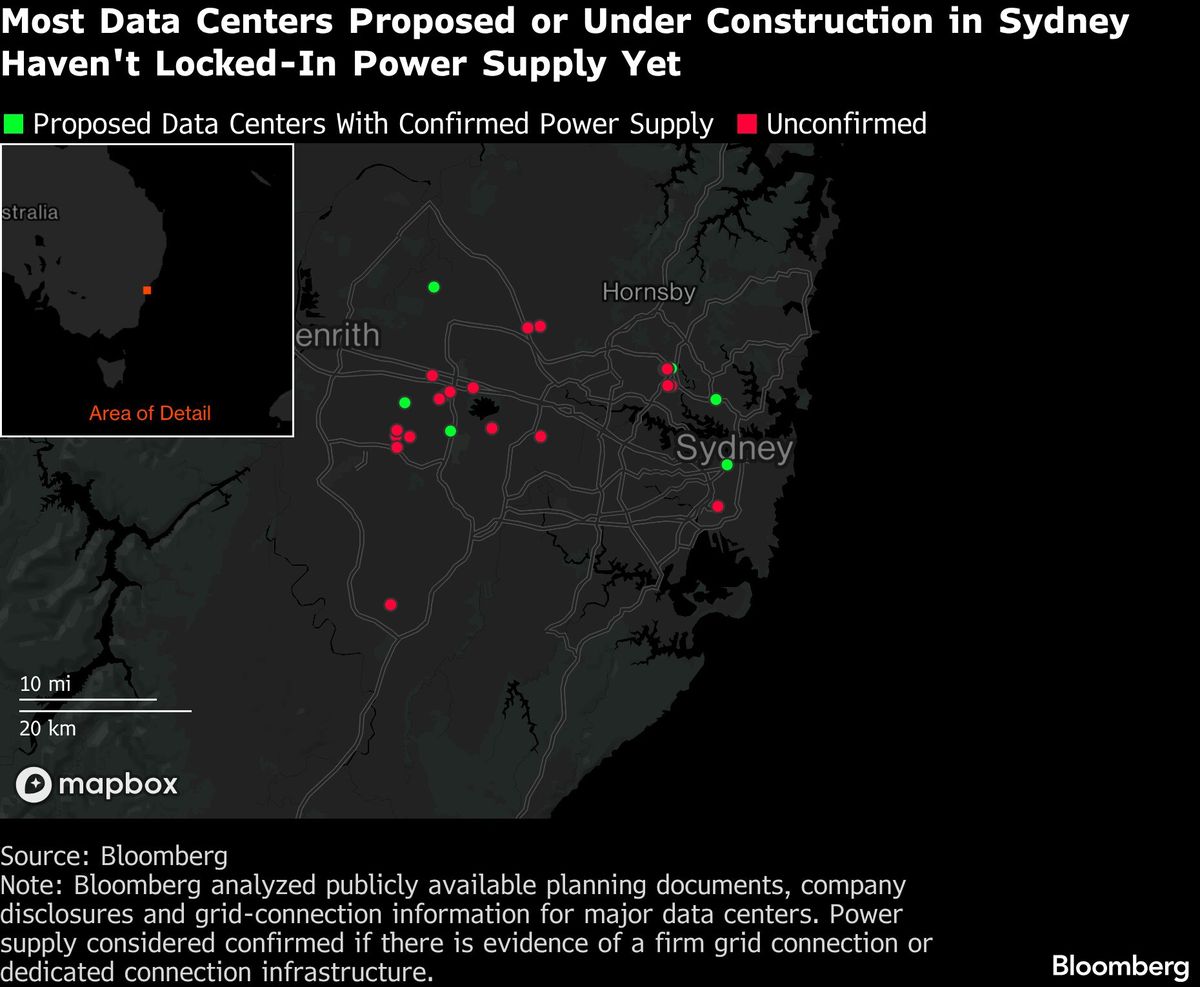
Of the 40-plus large centres planned or under construction in Sydney and Melbourne — representing more than A$100 billion (US$70 billion or RM286 billion) of projected investment — just 23% have confirmed publicly that they have secured electricity supply or grid connections, according to a Bloomberg review of company disclosure. Those agreements, a gauge of whether or not a project is advancing, suggest significant setbacks and potential delays.
Australia has bet heavily on a data-centre boom that is intended to capitalise on its vast open spaces as well as clean-energy potential. To date, though, most of the project pipeline is clustered around Sydney and Melbourne — where almost two in five of its inhabitants live — in order to harness existing fiber networks and reliable power. Those operations put more strain on already stretched infrastructure, and leave developers on a collision course with residents.
In Sydney, seven of 28 active projects have confirmed power, according to Bloomberg’s analysis. In Melbourne, the figure drops to three out of 15.
Bloomberg contacted 25 developers to verify public disclosure on power supply and the status of more than 40 projects. Operator GreenSquare declined to comment on its power arrangements but said it was “working closely with relevant authorities and infrastructure partners to support long-term operational performance”. CDC Data Centres said it had “robust delivery plans in place for all sites currently under construction” with power delivery timelines as anticipated.
Nine others declined to comment or didn’t directly answer queries on future projects. The rest did not respond.
The consequences of friction and delays are already apparent. Operator Nextdc Ltd slashed its profit forecast this week after Melbourne residents blocked the installation of towering transmission lines, almost halving the value of its shares.
In Sydney, Goodman Group abandoned its A$1.2 billion Project Mars development last month. The proposed 90-megawatt facility would have been built about 20 metres from the nearest home and 160 metres from a public school, prompting hundreds of objections to be submitted during the planning process.
“The social licence for Australian data centres is becoming an increasingly significant headwind,” Morgans Financial Ltd analyst Nick Harris wrote this week. “Investors are becoming concerned more delays could occur and question what the knock-on effect might be.”
The gulf between announced projects and those that will be built is also beginning to emerge in official data. Over a third of proposed data centres that would tap Australia’s main grid were cancelled last year, according to the Australian Energy Market Operator.
Part of the issue is the sheer scale of the build out. The country has more than 20 gigawatts of capacity in announced and early-stage data centre projects compared to an operational fleet of just 1.5 gigawatts, according to BloombergNEF.
“Access to energy is already a major issue,” said BNEF analyst Tushna Mehta. “Data centre capacity is being built much faster than the new generation needed to supply it.”
These hurdles are raising questions about the government’s push to make Australia a hub for the wider region, courting investors and seeking to streamline approvals even as practical constraints remain. Land may be plentiful, but data centres need access to high-voltage electricity lines and other infrastructure. Building further from the major cities can have advantages, but also means hefty investment in new transmission lines and telecommunications.
Sydney’s electricity grid is already struggling to accommodate the scale of the boom. Transgrid, which operates the statewide power network, said in August the city doesn’t have enough transmission capacity to connect any of the 20 gigawatts of inquiries it’s received from large new power users.
Half of that proposed demand has emerged within a 12km radius of its Sydney West substation, Transgrid said — equivalent to the peak winter electricity load of the entire state of New South Wales, in one small area.
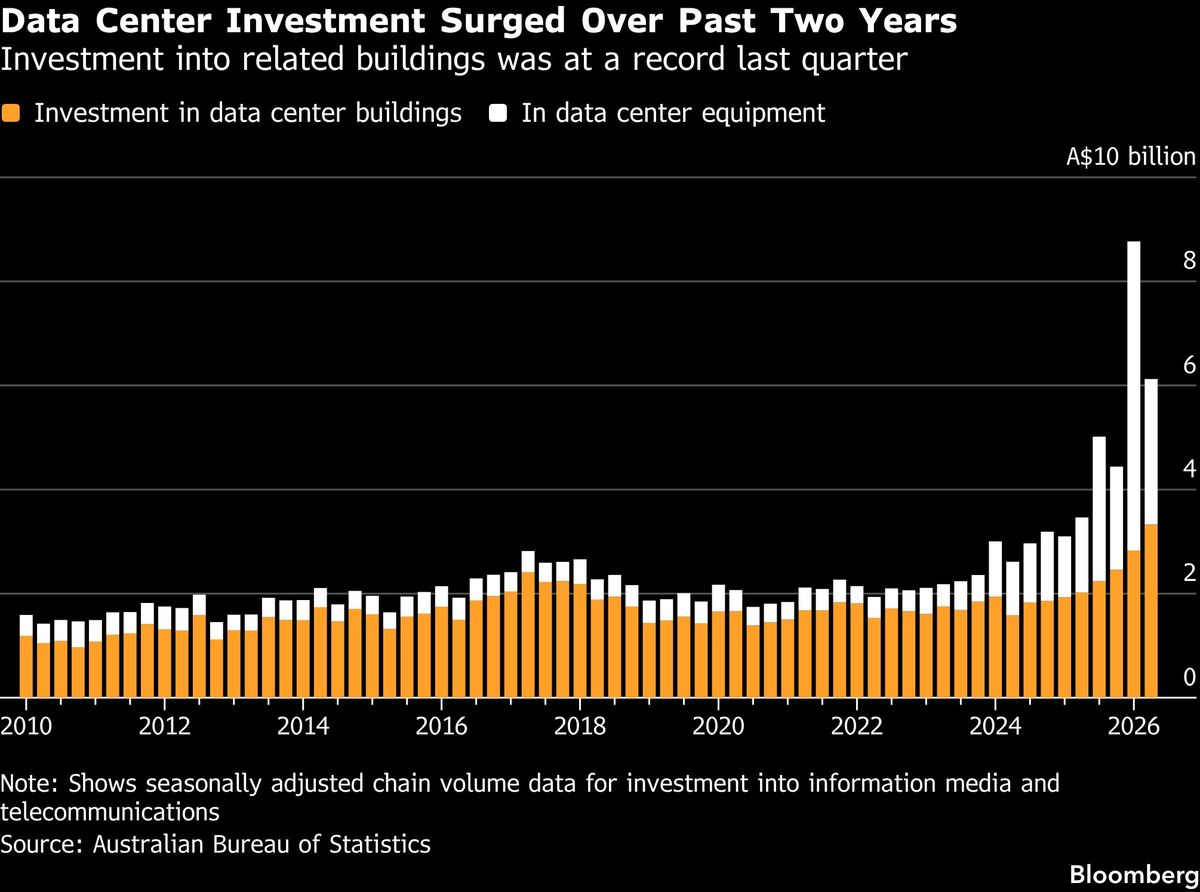
That strain is expected to intensify, and quickly. Australia already has more than 160 operating data centres, concentrated mainly in Sydney and Melbourne, which consume about 2% of electricity supplied by the country’s grids. AEMO has projected this could rise by a quarter each year to roughly 6% by 2030, and 13% by 2036.
Another hurdle is access to water. Industry-commissioned analysis estimates Australian data centres use about 5.5 gigalitres of water each year, largely for cooling — equivalent to roughly 0.04% of national consumption. But the local impact could be far greater when projects are clustered together, including in growth corridors already facing stress from drought.
Residents living near Nextdc’s facility in Melbourne’s West Footscray — about 15 metres from it, in some cases — told a parliamentary inquiry last month they wanted compensation for noise, pollution and potential fire risks.
“What we are seeing is rising public resistance to AI, particularly generative AI,” said Bronwyn Cumbo, who researches data centres at the University of Technology Sydney. “Many are planned to be built near homes, schools, farmland and natural areas, and alter the experience and livability of these places.”
Uploaded by Tham Yek Lee