

(Oct 22): The Singapore dollar is gaining favour as a funding currency for carry trades as cheap borrowing costs and fading expectations for appreciation make it increasingly attractive relative to the Japanese yen, strategists said.
The Monetary Authority of Singapore (MAS) kept policy settings unchanged last week in a surprise move, reinforcing expectations for more limited currency gains after tightening in April and July. At the same time, strong safe-haven inflows into Singapore have flooded local money markets, pushing down forward-implied yields, a measure of short-term borrowing costs.
That combination of cheap funding and low currency volatility is burnishing the Singapore dollar’s appeal for investors looking to borrow in one currency and buy higher-yielding assets elsewhere. It also offers an alternative to the yen, the traditional carry-trade funding currency, as Bank of Japan (BOJ) rate hikes raise borrowing costs and increase the risk of further currency appreciation.
“Funding in the Singapore dollar is attractive due to the negative carry, as Singapore’s foreign exchange implied yields are lower relative to most peers, and from limited upside for the currency,” said Abbas Keshvani, an Asian macro strategist at RBC Capital Markets. In comparison, the funding in the yen is at the risk of further policy normalisation from the BOJ, he added.
The divergence between the two central banks highlights the shift.
The BOJ raised policy rates by 25 basis points in September, with swap markets pricing an 80% probability of another quarter-point hike by December. A Bloomberg survey of economists showed 67% of respondents expect the BOJ to raise rates every three months, up from 46% in the last survey. That hawkish backdrop has supported a 3.3% gain in the yen against the greenback in the second half of the year, compared with a 1.3% rise in the Singapore dollar.
Meanwhile, the Singapore dollar’s three-month forward-implied yield hovers around 1.65%, placing it among the cheapest funding currencies alongside the yen and Swiss franc in a group of 38 developed and emerging-market currencies, according to data compiled by Bloomberg.
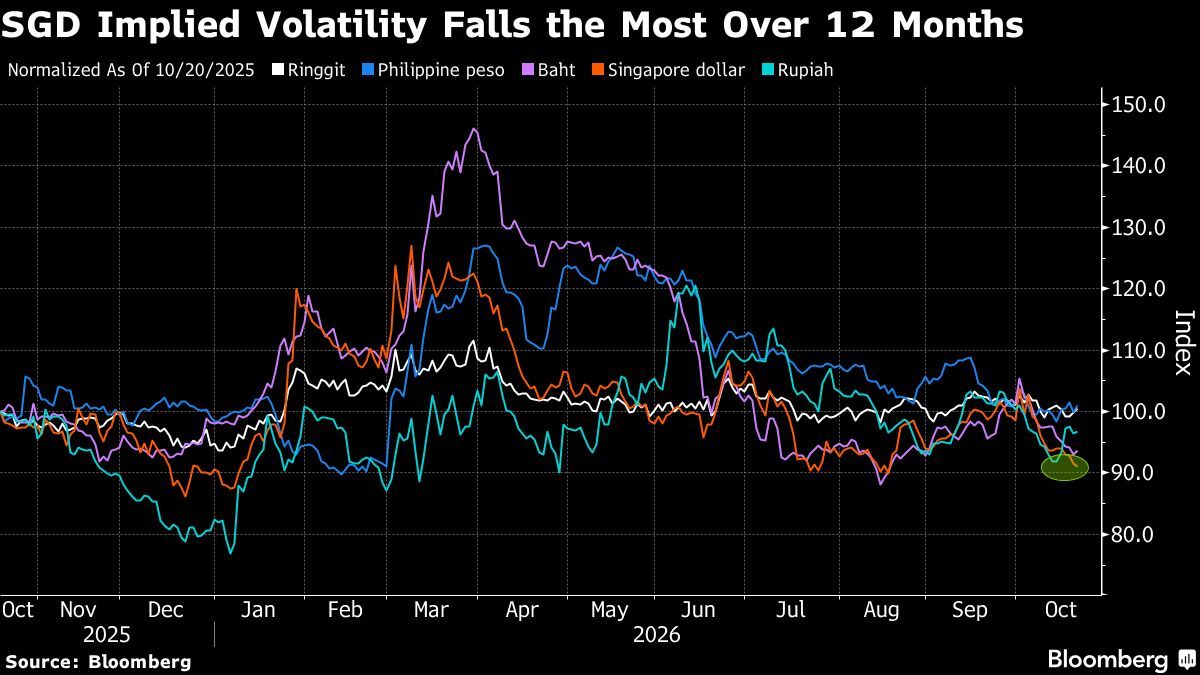
The Singapore dollar has also become less volatile, reducing the risk that exchange-rate moves wipe out extra yield investors earn from a carry trade. Three-month option-implied volatility for the dollar-Singapore dollar pair has dropped to 3.55%, posting the biggest decline over the past year among Southeast Asian peers.
“Singapore dollar rates are low compared to typical high-yielding currencies, so it can function as a carry funder,” said Dwyfor Evans, the head of Asia-Pacific macro strategy at State Street Markets.
The MAS decision may reinforce that appeal. The Singapore central bank uses the exchange rate as its main policy tool rather than interest rates. Its decision this month to leave the band’s slope unchanged marked a pause after consecutive rounds of tightening.
“We suspect the market will go back to seeing the Singapore dollar as a potential funding currency in the region,” HSBC Holdings plc strategist Joey Chew wrote in an Oct 14 note following the decision. “There has been downward pressure on the Singapore dollar, likely stemming from its low interest rates.”
Uploaded by Tham Yek Lee