

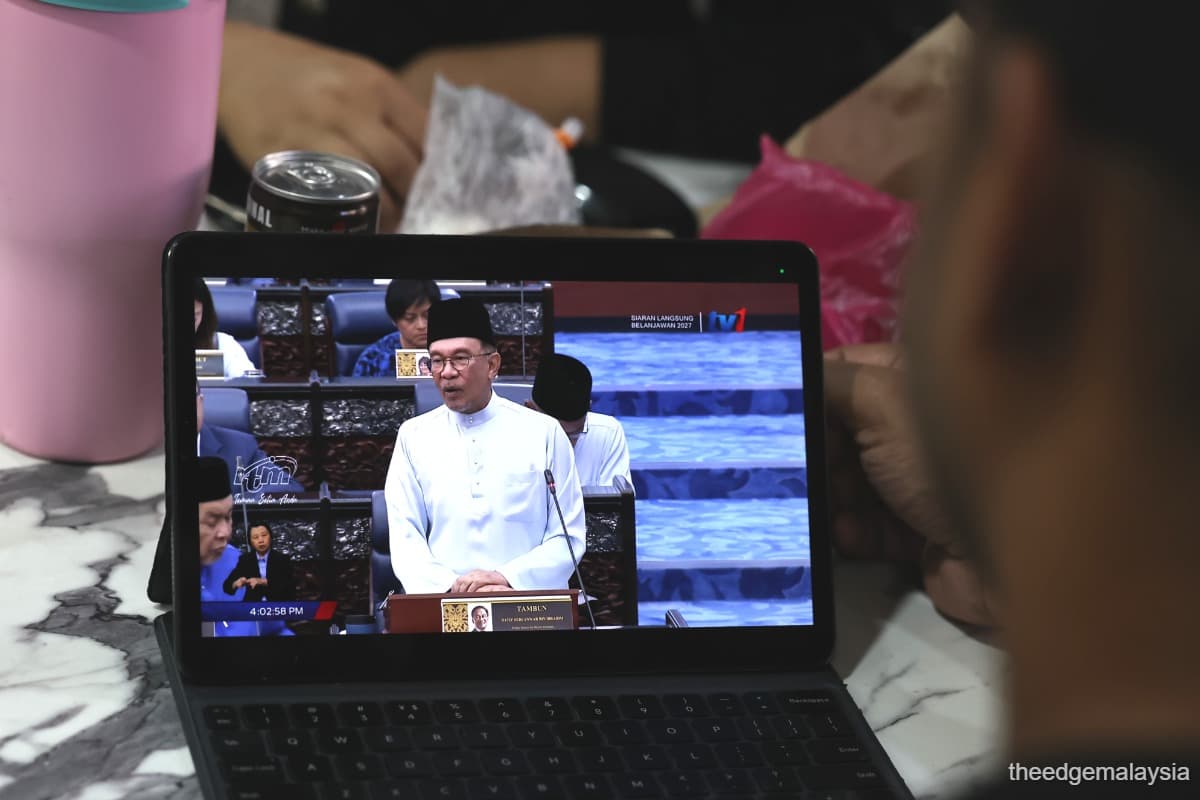
(Oct 21): Every year, Malaysia’s federal budget announcement tends to draw the most attention to cash handouts, wage adjustments and personal income tax cuts. Yet beyond these immediate cost-of-living reliefs lie deeper messages on the kind of nation we aspire to build that often go unnoticed. In the recent Budget 2027 announcement, Prime Minister Datuk Seri Anwar Ibrahim invoked several philosophers and thinkers, offering a less conventional lens through which to understand the government’s broader vision.
This commentary aims to unpack the takeaways from the philosophers cited in the PM’s speech and explore their significance to Malaysia today.
The first philosopher, whose ideas Anwar cited more than once in his speech, was John Rawls, an American political philosopher best known for his seminal work, A Theory of Justice. Rawls introduced a thought experiment known as “Original position”, in which principles of justice are chosen from behind a “veil of ignorance”, where people are unaware of their own race, gender, class, natural talents or socio-economic positions. According to Rawls, in this hypothetical position, rational individuals would choose principles that ensure equal basic liberties, fair equality of opportunity, and permit socio-economic inequalities only when they work to the greatest benefit of the most disadvantaged.
Anwar drew on Rawls’ principles to underscore the government’s commitment to distributive justice, particularly in ensuring that the benefits of economic development reach those who need them most. This commitment is reflected in measures such as targeted assistance to flood victims in the Klang Valley and Kelantan, targeted subsidies under initiatives such as Budi95, Sumbangan Tunai Rahmah (STR) and Sumbangan Asas Rahman (Sara), as well as the reservation of 70% of Belfield’s Rumah Madani units and the allocation of RM1 billion worth of land to Yayasan Pelaburan Bumiputera.
Through Rawls’ philosophy, the PM offers a reminder that a just society must pay particular attention to those who are most disadvantaged. Nonetheless, applying Rawls’ principles to Malaysia is far from straightforward. Our distinctive sociopolitical landscape is shaped by historical inequalities, communal interests and affirmative action policies designed to address longstanding group-based disadvantages. Balancing the interests of bumiputera and other communities remains an ongoing challenge. Nevertheless, Anwar’s invocation of Rawls invites Malaysians to engage in meaningful deliberation about the kind of just society we aspire to build and how competing claims to justice can and should be reconciled.
The second philosopher cited by Anwar was Isaiah Berlin, a British political philosopher renowned for his work on liberty and pluralism. The work referenced in Budget 2027 was The Hedgehog and the Fox, an essay inspired by a Greek aphorism attributed to the poet Archilochus: “The fox knows many things, but the hedgehog knows one big thing.” Berlin uses this metaphor to distinguish between two ways of understanding the world. Hedgehogs view the world through a single, overarching idea, while foxes draw on multiple, sometimes even clashing perspectives. Anwar emphasised that both ways of thinking have a place in society.
In reality, the world is far too complex to be fully understood through any single theory or ideological framework. Yet this does not mean we should abandon grand moral ambitions. Openness without a unifying vision risks losing a sense of purpose, while the opposite risks becoming dogmatic. For Malaysia, this tension is particularly relevant in navigating a diverse society with competing interests, values and aspirations. The PM’s reference to Berlin can thus be read as a reminder that leadership requires both conviction and intellectual humility: the courage to stand for something, and the wisdom to recognise when our understanding may be incomplete.
The third philosopher highlighted was al-Mawardi, a Sunni polymath and Shafi’i jurist. His ideas offer a reminder that political power cannot be exercised in a vacuum, detached from law, order and moral responsibility. The legitimacy of government rests not merely on its possession of authority, but that the authority is exercised fairly and whether it serves the public interest.
Anwar invoked cases such as 1MDB, Tabung Haji and Felda to demonstrate how unchecked power can harm not only the nation’s economic well-being, but also the rights and dignity of the rakyat. Al-Mawardi’s teachings underscore the importance of completing structural reforms, including setting term limits and the separation of the roles of Attorney General and the Public Prosecutor.
The fourth thinker mentioned was Raja Ali Haji, a Bugis-Malay historian, poet and scholar. In Gurindam Dua Belas, he wrote: Raja mufakat dengan menteri, seperti kebun berpagarkan duri (A ruler who consults with his ministers is like a garden protected by a fence of thorn”). This verse suggests that power alone never sustains a ruler. Just as a garden is fenced with thorns, good governance depends on consultation and is anchored in a “waad,” a ruler-people covenant in which loyalty must be reciprocated with justice, trust and accountability.
Raja Ali Haji’s message complements al-Mawardi’s emphasis on responsible governance, while placing particular importance on covenant and counsel. The PM’s Budget 2027 illustrates how these principles can be put into practice through several forms of reforms and consultation. These include an allocation of RM1.1 billion for enforcement agencies such as Malaysia Anti-Corruption Commission (MACC) and the police; parliamentary scrutiny via special select committees and “Waktu Pertanyaan Perdana Menteri” (PMQT) which allows MPs to question the prime minister directly; engagement with affected groups, including the gig workers and small traders; and intergovernmental negotiations over outstanding commitments under the Malaysia Agreement 1963 (MA63).
The fifth thinker highlighted was Huangbo Xiyun, a Tang dynasty Chan (Zen) master. He wrote: “Without enduring a bone-piercing cold, how could the plum blossom exude such fragrance?” This verse emphasises that meaningful change and reform require perseverance and a willingness to endure hardship. It is also a reminder of the importance of trust and moral responsibility, which may require choosing the longer and more difficult path over the temptation of immediate gains.
The final philosopher mentioned was the Indian poet and philosopher Thiruvalluvar. In his work “Thirukkural,” he suggests that a great nation is defined not just by abundant natural resources and physical development, but also by the knowledge, virtue and moral integrity of its people. This message is especially pertinent in the current age of artificial intelligence (AI) and rising polarisation. Some scholars describe our current era as a “post-truth” or “post-normal” era, lenses that have informed the thinking behind the Madani values. In such times, objective facts can carry less weight in shaping public opinion than personal beliefs, emotions and political loyalties. Traditional arbiters of knowledge and truth, such as scientists, journalists and academic institutions, increasingly find themselves competing with viral misinformation, algorithmically amplified narratives and AI-generated content. These developments also raise broader concerns about the erosion of intellectualism in society.
The implications extend beyond public discourse. The economy of the country is tightly linked to the quality of its human capital. Without a critical and virtuous populace, vulnerability to manipulation, misinformation and divisive rhetoric can undermine social stability and collective confidence for economic growth and investment. As such, Anwar’s reference to Thiruvalluvar serves as a reminder that the nation’s greatest asset lies not merely in its wealth, but also the people it cultivates.
Beyond the individual insights these philosophers and thinkers offer, a broader message emerges from the PM’s choice of drawing on thinkers from diverse intellectual traditions. His selection suggests an aspiration for a Malaysia that bridges Islamic, Asian and Western thought, while embracing pluralism and tolerance.
More fundamentally, it is a call for Malaysians to become more reflective and wisdom-loving citizens who are willing to think critically beyond numbers and political allegiances, question assumptions, listen to perspectives that challenge our own, and reflect on the values that should guide our collective future. One platform for such conversations is the Malaysian Philosophy Society’s Think Big Summit 2026: The Malaysian Dilemma, supported by the Ministry of Unity, where Malaysians come together to have respectful philosophical dialogue about our identities, differences and shared aspirations for the nation’s future. Interested readers can register at www.myphilsoc.com/think-big-summit-2026.
Chew Zhun Yee is a co-founder of the Malaysian Philosophy Society