

(Oct 21): Top finance and investing executives pushed back against suggestions of a bubble in artificial intelligence (AI), after billionaire Ken Griffin warned that investors in the industry should be prepared for setbacks.
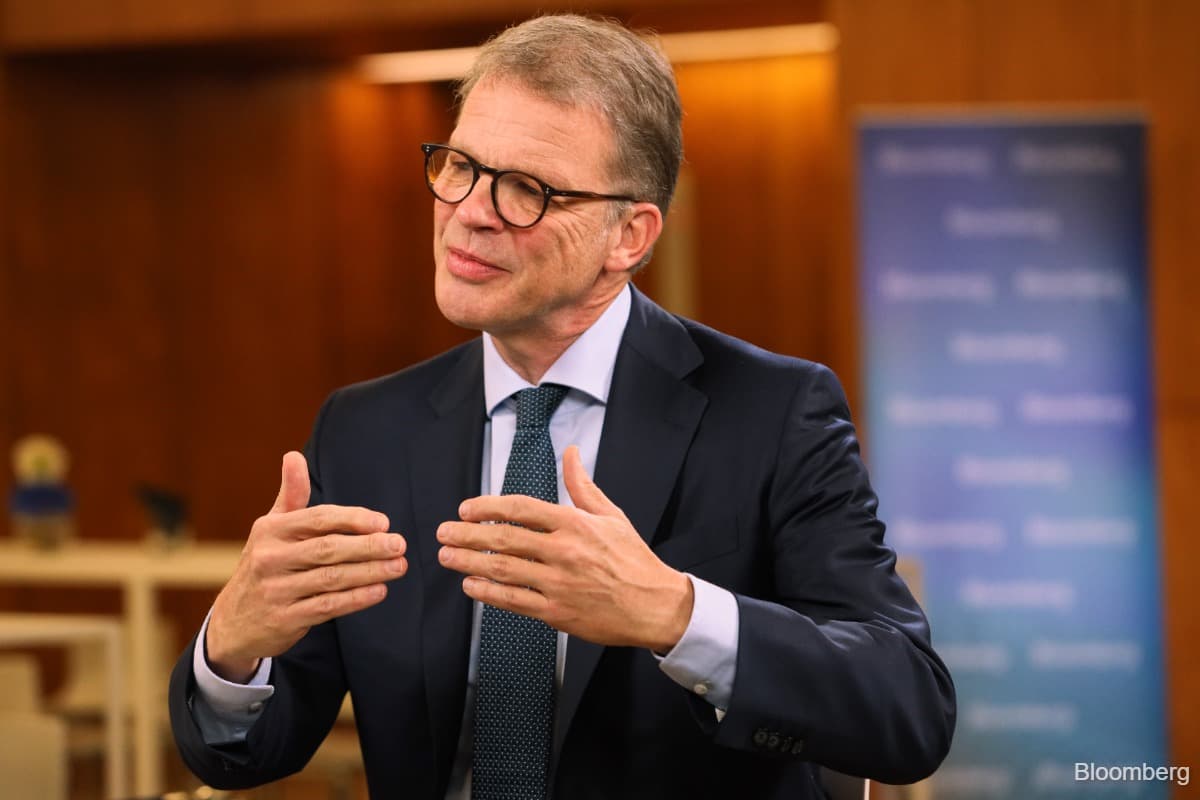
Deutsche Bank AG chief executive officer Christian Sewing, speaking in an interview at the Berlin Global Dialogue, said he sees no reason to worry about a sharp reversal in asset prices any time soon. BlackRock Inc CEO Larry Fink argued in favour of pushing ahead with the rapid build-out of AI data centres, saying any delays could threaten economic growth and stoke inflation by driving up computing costs.
“Overall, I don’t think that we are living in a bubble which is bursting,” Sewing said on Bloomberg Television on Wednesday. “Do we see the one or the other setback, also with individual companies? That can happen.”
Investor anxiety over the durability of the AI boom surged in recent weeks amid fears that the substantial upfront capital spending the technology needs will take longer than expected to translate into profits and productivity gains. Anthropic PBC, one of the leading AI developers, could spend US$750 billion (RM3.06 trillion) on additional computing power in the coming years, according to a Wall Street Journal report.
Griffin, whose empire includes hedge fund Citadel and market-maker Citadel Securities, warned on Tuesday that investors are “almost certainly” in a bubble as corporations are grappling with how much they want to spend on the technology.
Fink has previously waved off concerns about an AI bubble, pointing instead to supply shortages and saying demand growth has exceeded expectations. He has also warned delays in the technology’s build-out could ultimately limit access.
“If we don’t build out these data centres, it is actually more inflationary because the cost of compute is so high right now,” he said on Wednesday. “And the faster we can build out more data centres, the more compute we have, the faster we can bring down the cost.”
Sewing, who has emerged as one of the most influential business leaders in Germany, said the industrial application of AI is “the chance of the century” for his home country, if it gets the regulatory framework right. Deutsche Bank itself uses the technology to increase efficiency but also to improve controls, he said.
“The fear that we are in front of a bubble is not a justified one,” Sewing said. “But what is different from a bubble is ongoing volatility,” he said, pointing to continued geopolitical tensions.
The CEO, who has turned around Germany’s largest lender since taking over eight years ago, is one of a handful of top executives who regularly speak with Chancellor Friedrich Merz, people familiar with the matter have said. Merz hosted the German government’s first investor conference in Berlin this week, a fresh push by the embattled chancellor to revive growth in Europe’s biggest economy.
Rather than AI, Fink and Sewing both pointed to fiscal deficits as a more immediate area of concern, particularly as the AI industry competes with governments for investor money. US Treasury yields have hit multi-decade highs as markets grapple with a nearly US$2 trillion US fiscal deficit.
“We’re at a time now where we’re finally unlocking private capital, and so the competition for capital is as large as I’ve ever seen in my professional career,” Fink said.
In France, months of debate over the budget have pushed the extra yield investors demand to hold French government debt over German bonds into territory associated with the euro-area debt crisis.
“I wouldn’t call it a debt crisis at this point in time, but I think it’s a wake up call in particular for all public financing that budget disciplinary is key,” Sewing said.
Uploaded by Felyx Teoh