


KUALA LUMPUR (Oct 21): Bursa Malaysia's telecommunications and media stocks extended their decline on Wednesday, bringing the sector's losses to nearly 20% so far this year, amid steep falls in Axiata Group Bhd (KL:AXIATA), CelcomDigi Bhd (KL:CDB) and Reach Ten Holdings Bhd (KL:REACHTEN).
The Bursa Malaysia Telecommunications and Media Index fell 3.55 points or 0.93% to 377.77 as at 4.20pm on Wednesday, bringing its year-to-date decline to 19.62% decline from the end of 2025's 469.96 points.
The latest drop extends the sector's losses from last Friday, when the index stood at 382.61 points at the noon market break.
The major decliners among telcos are Axiata, which has lost 34.92% year-to-date, followed by Reach Ten losing 33.01% and CelcomDigi shedding 21.94%, according to Bloomberg data.
Media stocks were not spared, with Media Chinese International Ltd (KL:MEDIAC) declining 31.58%, while Media Prima Bhd (KL:MEDIA) has shed 29.41%.
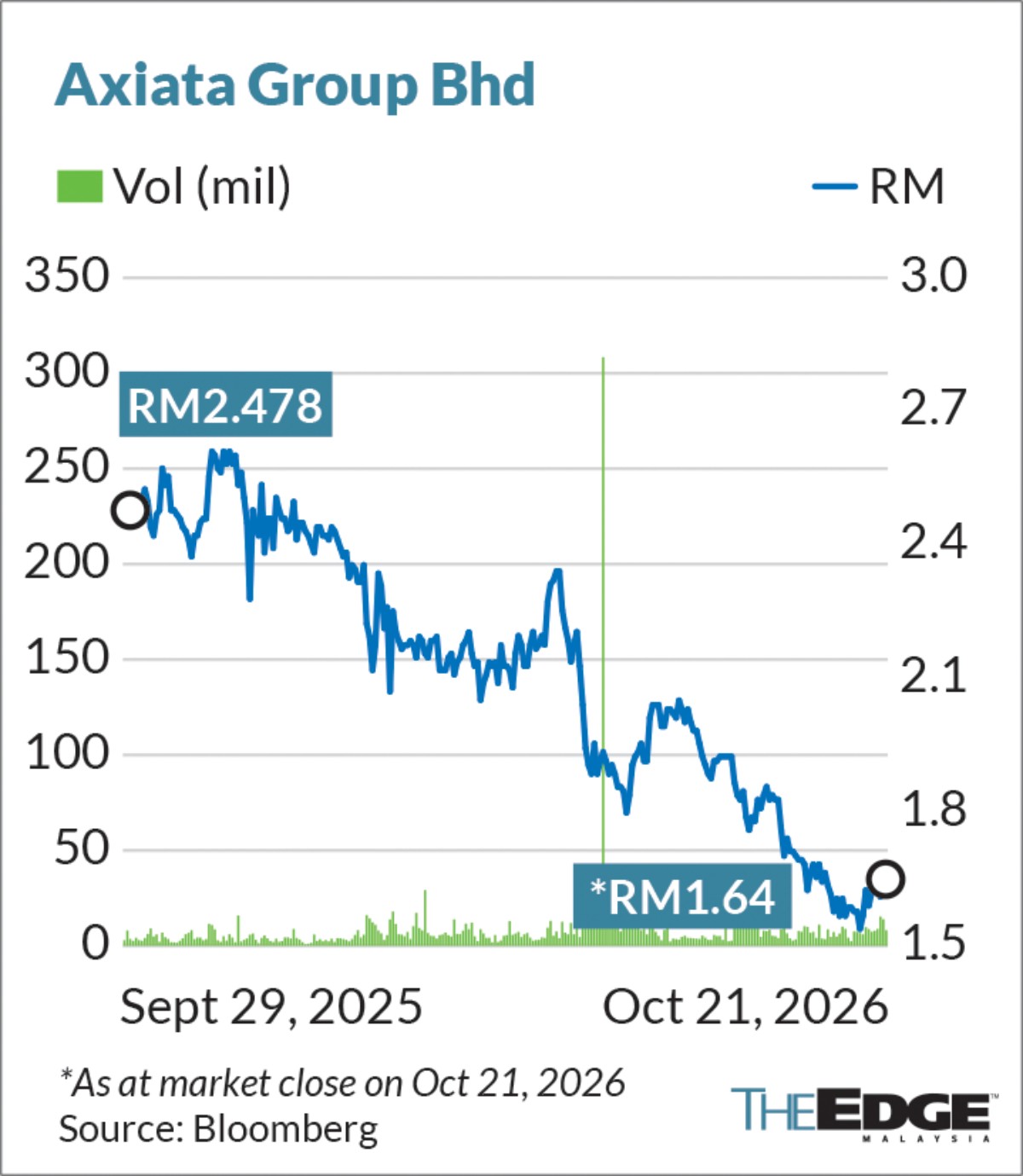
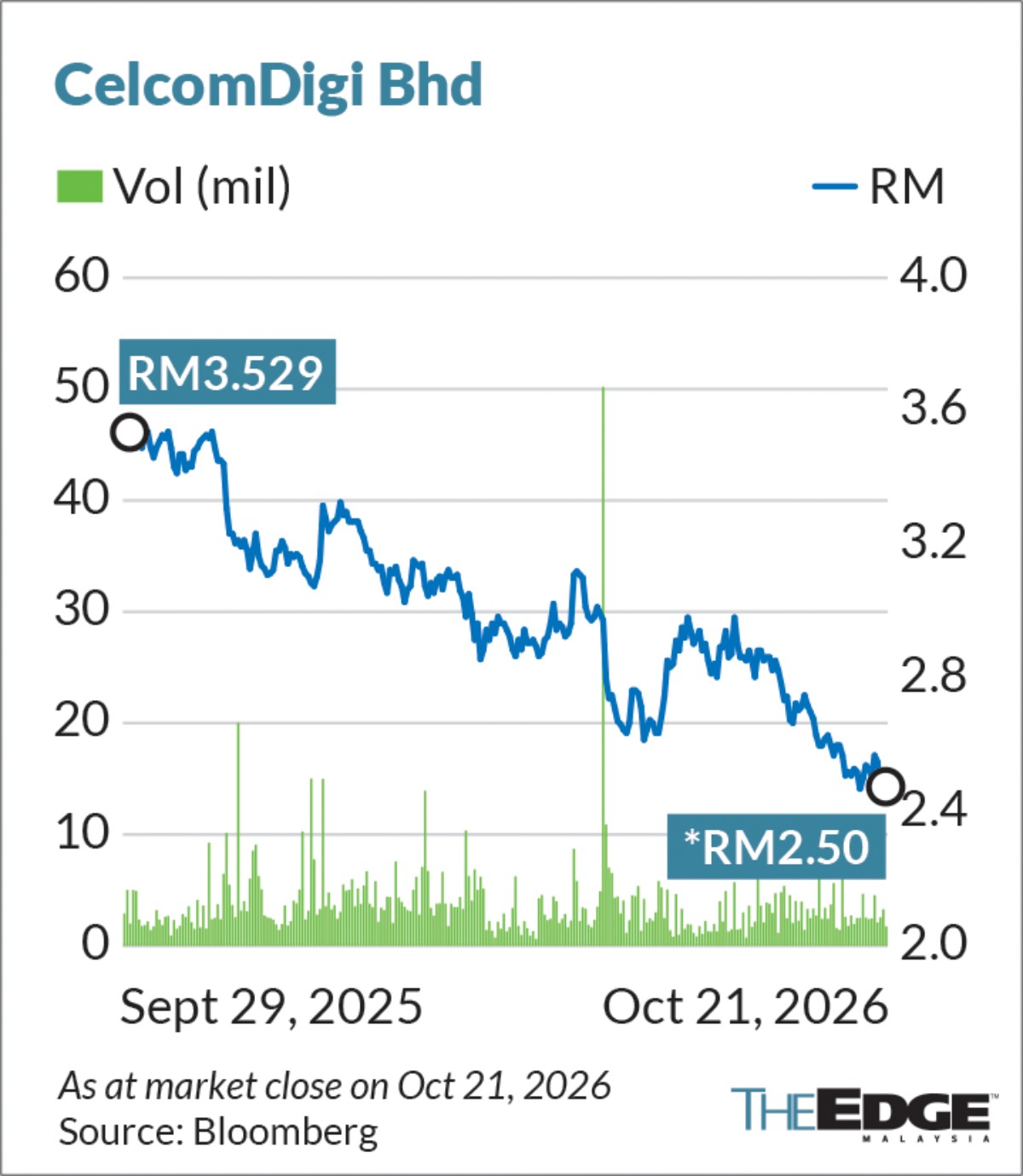
An analyst who declined to be named said broader market sentiment, rather than company-specific developments, was driving down telco stocks.
"Not just the telcos, just overall market sentiment has turned," the analyst said, citing prolonged geopolitical tensions, persistent inflation and elevated bond yields.
But the analyst maintained a “buy” call on CelcomDigi, saying merger-related cost savings could materialise from 2027 onwards. The analyst retained a “neutral” call on Axiata, with foreign exchange fluctuations seen as a near-term risk.
The analyst added that greater clarity on Digital Nasional Bhd's (DNB) outlook "would possibly be one of the positives" for the sector, particularly for CelcomDigi and Maxis.
Lower expectations for Axiata, CelcomDigi
Analysts have lowered their expectations for Axiata and CelcomDigi since the beginning of the year, despite maintaining broadly positive recommendations on both stocks.
According to Bloomberg consensus data, Axiata's 12-month target price has been cut by 12.24% to RM2.51 from RM2.86 on Jan 2, while CelcomDigi's has been reduced by 9.54% to RM3.51 from RM3.88 over the same period.
But the reduced target prices still suggest potential upside of more than 40% for both stocks.
For Axiata, 12 analysts have “buy” recommendations, seven recommend "hold" and three advise “sell”. CelcomDigi has stronger analyst support, with 17 “buy” calls, five “hold” and two “sell”.
5G concerns
Concerns over the sector's earnings outlook have persisted amid changes to Malaysia's 5G network structure and intensifying competition.
In May, CGS International warned that the second 5G network to be run by U Mobile could intensify competition for established operators, particularly CelcomDigi and Maxis Bhd (KL:MAXIS), as the new network expands.
The research house said greater pricing pressure could weigh on earnings, while market sentiment had been affected by uncertainty surrounding the financial performance of DNB, the operator of the first 5G network.
In January, BIMB Securities cautioned that the transition of DNB's ownership from the government to telecommunications operators could dilute earnings once the companies began recognising their share of the national 5G network operator's losses.
Meanwhile, Axiata's second-quarter revenue fell 3.2% year-on-year to RM2.87 billion, affected by the depreciation of its foreign subsidiaries' currencies against the ringgit.
CelcomDigi also reported weaker second-quarter earnings, with net profit declining 9.3% year-on-year to RM398 million due to higher expenses, a share of joint-venture losses and the absence of an asset disposal gain.
Reach Ten, however, nearly doubled its second-quarter net profit to RM18.57 million, mainly driven by an unrealised fair value gain of RM10.3 million on its investment in SpaceX.
Despite the sector's weakness, Hong Leong Investment Bank Research maintained a positive stance on most telecommunications stocks earlier this month, citing potential savings from network investments and improving prospects as uncertainty surrounding DNB eases.
The research house also highlighted opportunities for fixed-line operators Telekom Malaysia Bhd (KL:TM) and TIME dotCom Bhd (KL:TIMECOM), supported by demand for broadband infrastructure and data centre expansion.
Read also:
CelcomDigi, Maxis spectrum costs to be offset by capex and network savings — HLIB
CGS International warns tougher competition for mobile players from U Mobile’s 5G push
Unresolved 5G structure, DNB ownership shift cloud Malaysian telco outlook in 2026 — BIMB
Digital Nasional no longer needs state support, govt exposure reduced to nil — Fahmi