

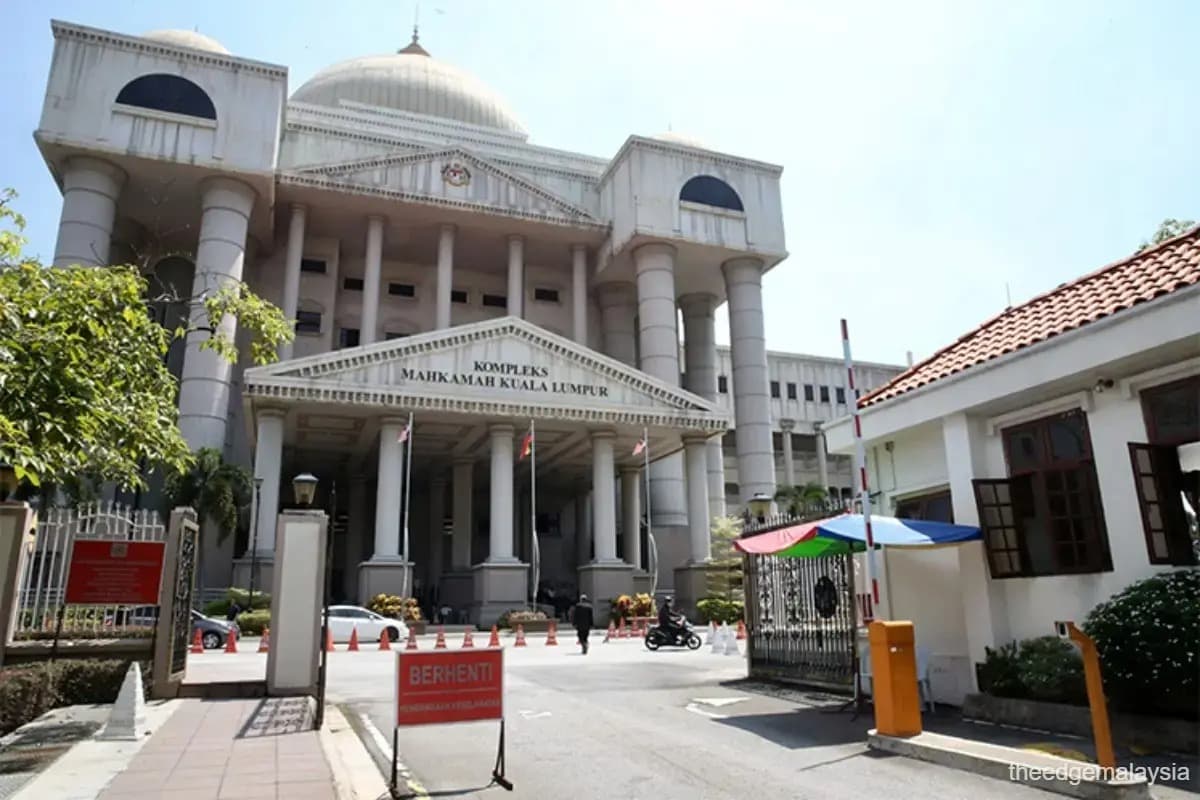
KUALA LUMPUR (Oct 21): Nineteen out of the original 36 ex-superior court judges are continuing with their bid to recover interest on their pension arrears via a court challenge against the the prime minister, Public Services Department director general, the government and Cabinet.
If successful, they also want all former judges serving in Peninsular Malaysia who retired before July 2015 to get the arrears.
The number of claimants was reduced to 19 as the others had withdrawn. Prior to this, there were settlement talks between the ex-judges and the government.
During proceedings at the High Court on Wednesday, counsel Christopher Leong argued before judge S Indra Nehru that the challenge is not academic despite the decision in the case of former Sabah High Court judge Datuk Ian Chin, where the High Court found that 2014 amendments to the Judges Remuneration Act (JRA) to be unconstitutional and null and void.
The Chin decision, Leong said, had been upheld by the Court of Appeal and Federal Court, and this court was bound by the ruling (stare decisis).
He added that although the judges have been getting their pensions since October 2024, after the Federal Court had dismissed the government and PSD’s bid to challenge the appellate court's decision in the Chin case, the judges should be entitled to interests on their payment arrears pre- and post-judgement from 2024.
“There are about eight years of interest which should have been paid to ex-judges. Furthermore, there is a concern that following the Chin case decision, the matter would only be applicable to Sabah and Sarawak judges, and not those who had served in Peninsular Malaysia,” Leong said.
“In addition, there are concerns that the judgement may only apply to those who had filed this challenge,” he said, adding that the former judges are also seeking costs of the action.
Leong said the plaintiffs disagreed that their challenge was academic, as claimed by the government, as although their pension had been restored, the declaratory relief included in the judicial review application was still pending.
The senior lawyer said at the core of the issue was Articles 125(7) and 125(9) of the Federal Constitution, which stipulate that remuneration and other terms of office — including pensions — of federal judges shall not be altered to their disadvantage after they are appointed.
Prior to this, The Edge had reported in December 2024, that judges who retired prior to July 2015 would receive salary revisions.
Appellate and apex court decisions
A majority appellate court decision in May 2024 held that the JRA amendment is unconstitutional for judges who retired before 2015.
The Federal Court in October that year, upheld the Court of Appeal decision. Apex court judge Tan Sri Nallini Pathmanathan said it was evident that amendments to the JRA resulted in a reduced monthly pension for Chin, as well as the retired judges he represented.
“This in itself amounts to a contravention of the constitutionally protected rights of a judge under Article 125(7) and Article 125(9) of the Federal Constitution. Such a contravention attracts Article 4(1) and the courts below have correctly applied the very trite law in relation to the application of that article.”
“Our (the judges’) role is to protect the sanctity of the Federal Constitution for the benefit of the citizenry. Who then is to protect the judges? Surely it must fall back on the Federal Constitution, and indeed, the Federal Constitution does provide such constitutional guarantees.
“The clear provisions there must be adhered to,” she said in referring to Article 125(7) and Article 25(9) of the Federal Constitution. The judge added that when a law has been contravened, it has to be put right.
Government says no right to interest on arrears
Senior federal counsel Mohammad Salehuddin Md Ali argued that the government had complied with the Federal Court’s October 2024 decision and the matter should be considered academic as it governs and protects the ex-judges' pension rights.
The unconstitutionality of the JRA amendment has been confirmed by the appellate and apex courts and there is no necessity for this court to do so again.
Salehuddin said there should not be pre- and post-judgement interests awarded, and the pension payments should be calculated from the date of the Federal Court judgement as stipulated in the court order.
“This court should exercise its right not to grant interests prior to Chin’s decision as this is a legal position. The government implemented the pension immediately after the decision. There was no delay in the payment,” he said.
In January 2022, a former Court of Appeal president, two former chief judges of Malaya, and several former Federal Court, COA and High Court judges and seven dependents of former judges went to court claiming that they entitled to a pension increment higher than 2% as set out in the JRA amendment.
They claim, through their lawyers from Messrs Chooi & Company, that the 2% adjustment violated Articles 125(7) and 125(9) of the Federal Constitution.
Indra Nehru fixed Jan 28 next year to deliver her decision.
Read also:
Top court blocks govt’s bid to challenge decision over retired Sabah and Sarawak judges' pension adjustment
Judges Remuneration Act 2014 unconstitutional for judges who retired before 2015, rules COA majority
Ex-judges who retired prior to July 2015 have received pension arrears, while rest received salary revision and arrears
Former Fed Court judge, widow of COA court judge join ex-judges' suit against govt over pensions