

This article first appeared in Capital, The Edge Malaysia Weekly on October 19, 2026 - October 25, 2026
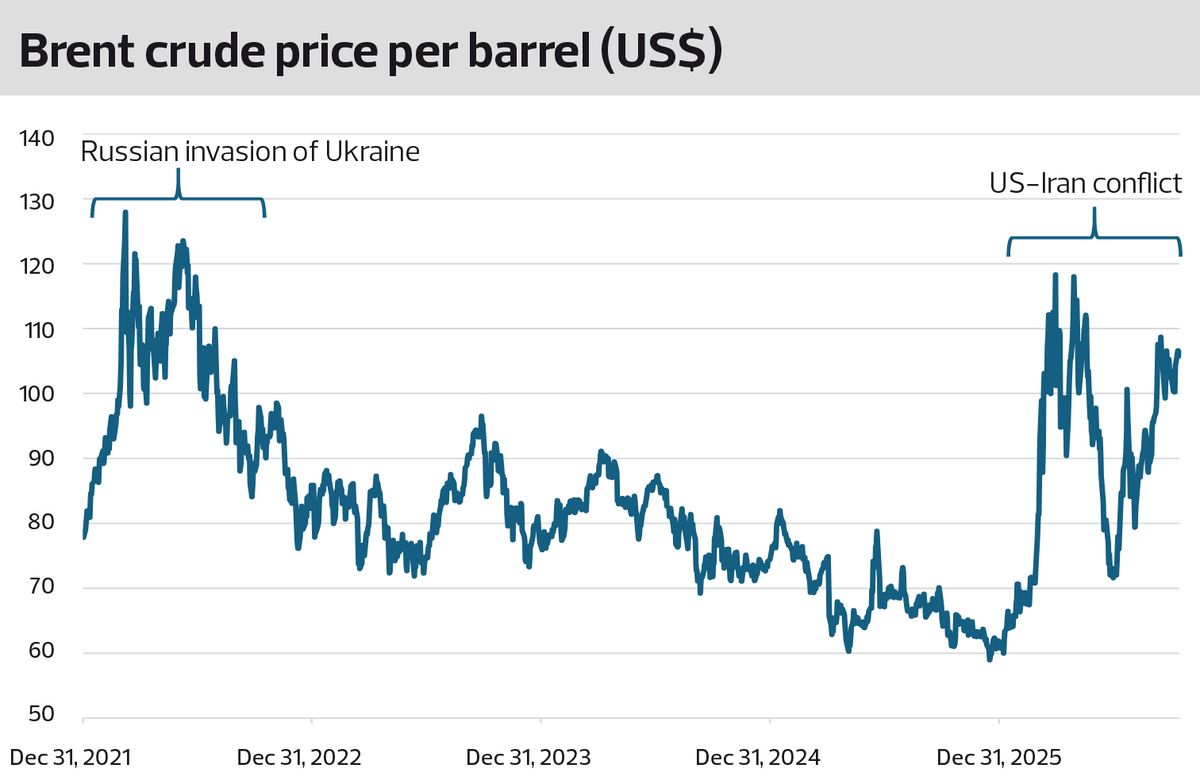
MORE than seven months into the US-Iran conflict, Brent crude continues to trade above US$100 per barrel. At the time of writing, it was trading at US$106 per barrel, averaging US$95.30 over the last seven months.
Middle East crude exports have, however, recovered from their lows. JPMorgan estimated in a Sept 29 note that the region’s crude shipments were back to 98% of pre-war levels, though fuel exports were at 58%. The strait itself remains dangerous: two Singapore-registered ships were struck there last week and one was sunk. An end to the conflict remains indeterminable.
On Oct 11, Iran’s security chief, Mohsen Rezaei, described the US response to Tehran’s seven conditions for reopening the Strait of Hormuz as “insufficient”, according to Reuters. Attacks by Yemen’s Houthis on Saudi Arabia have also intensified, as a Saudi Aramco headquarters in Dhahran was struck, causing extensive damage, Reuters reported, citing sources.
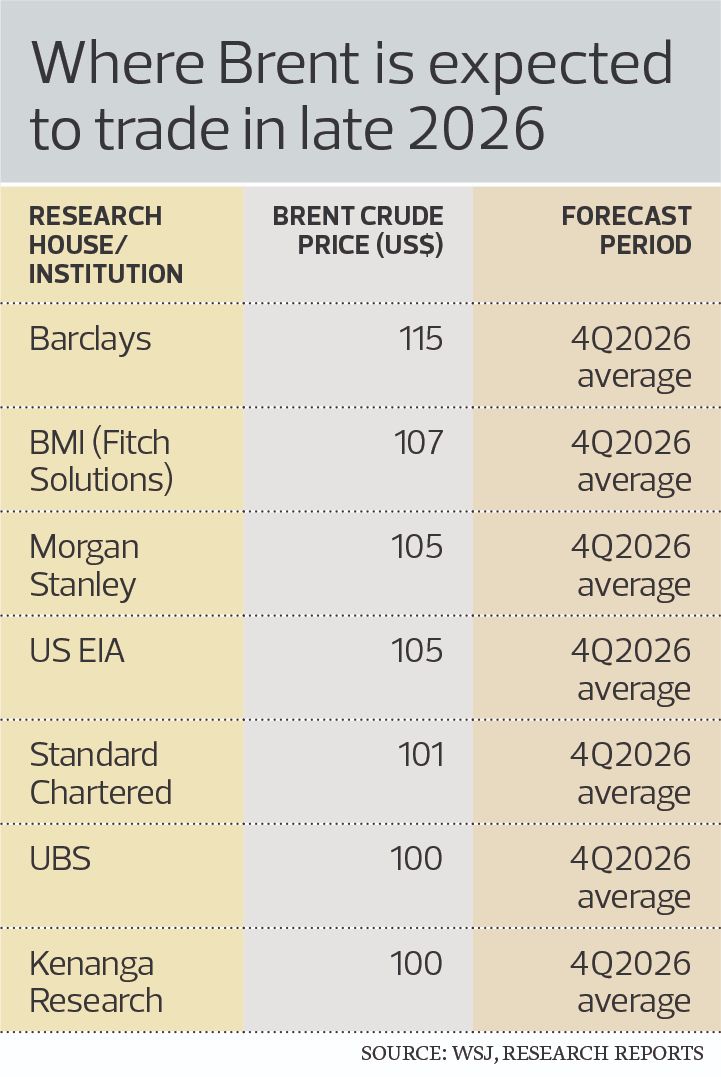
Against this uncertain backdrop, forecasts for Brent through the end of 2026 vary considerably (see table). Meanwhile, the federal government is budgeting for lower oil prices, with its medium-term fiscal projections assuming crude will average US$78 a barrel between 2027 and 2029. Malaysia’s fuel subsidy bill for this year has also been revised upward to RM40 billion, from the RM15 billion originally budgeted.
For Malaysian investors, the more pertinent question is whether sustained high oil prices will trickle down to higher earnings for Bursa-listed oil and gas (O&G) companies. That will ultimately depend on who is being paid, and for what.
Producers such as Hibiscus Petroleum Bhd (KL:HIBISCS) are paid for the barrels they are able to sell. Contractors, meanwhile, such as Dayang Enterprise Holdings Bhd (KL:DAYANG), Deleum Bhd (KL:DELEUM) and many others, are paid for the work required by national oil company Petroliam Nasional Bhd (PETRONAS). As such, their fortunes depend on how much PETRONAS, or other oil producers, choose to spend.
Analysts who answered The Edge’s questions are cautious.
CGS International says it has not yet seen a notable step-up in PETRONAS’ spending on domestic upstream services, and MBSB Research expects high oil prices to de-risk existing plans, rather than prompt aggressive expansion.
Malaysia has been here before. The last time Brent averaged above US$100 in 2022, the government asked PETRONAS for an extra RM25 billion in dividends after the fuel subsidy bill jumped. PETRONAS also lifted its capital spending, although MBSB Research estimates that higher oil prices typically take 12 to 18 months to translate into increased spending and revenue for upstream service contractors.
The question now is how much of this oil-price windfall will reach Malaysian contractors, and whether history could repeat itself.
2022 precedent
The last comparable oil price shock occurred in the same manner: geopolitical turmoil, though it came from Europe rather than the Gulf. Russia’s invasion of Ukraine in February 2022 disrupted global energy markets and sent Brent crude above US$100 per barrel in late February. The world’s most used commodity peaked at about US$128 in March 2022, while oil prices averaged around US$108.6 per barrel from end-February to late August, compared with an average of US$71 in 2021.
PETRONAS was an immediate beneficiary. Revenue surged 51% to RM375.3 billion in 2022, while profit after tax (PAT) nearly doubled to RM101.6 billion from RM50.9 billion a year earlier. Cash flow from operations increased 72% to RM135.3 billion, while its net cash position rose to RM108 billion, allowing the national oil company to increase investments and dividends to the government.
Dividends doubled to RM50 billion from the originally scheduled RM25 billion payout. The extra RM25 billion came at the government’s request, following a higher fuel subsidy bill which jumped with oil prices.
Capex, meanwhile, surged 65% to RM50.1 billion from RM30.4 billion, but most of the increase did not go towards local projects. Of the total, RM31.5 billion was invested internationally, leaving RM18.6 billion for domestic projects, a 24% year-on-year (y-o-y) increase from 2021. In other words, only RM3.6 billion of the RM19.7 billion increase remained in Malaysia. A quarter of total spending went towards new businesses, including overseas acquisitions. Excluding these acquisitions, spending was split almost evenly between Malaysia and overseas markets.
The subsequent two years saw a more pronounced increase in domestic capex. By 2023, PETRONAS’ domestic capex had jumped 41% y-o-y to RM26.2 billion, before rising another 27% y-o-y to RM33.3 billion in 2024. Group capex, by contrast, rose only 5% and then 3%, so the money moved home: domestic spending went from 37% of total capex in 2022 to 50% in 2023 and 61% by 2024.
Of greater relevance to Malaysian upstream contractors, domestic upstream investment rose from RM10.5 billion in 2022 to RM13.7 billion in 2023 and RM15.9 billion in 2024, an increase of 51% over the two years. Domestic downstream spending, meanwhile, remained relatively flat at RM4.2 billion in 2022, RM4.6 billion in 2023 and RM4.1 billion in 2024.
The rise in oil prices benefited producers first. Hibiscus Petroleum’s net profit jumped from RM104 million in FY2021 to RM653 million in FY2022, as oil prices climbed and its January 2022 acquisition of Repsol’s assets was expected to nearly triple its oil-and-gas production. Nearly half of the profit, RM317 million, was a one-off accounting gain on the acquisition. Excluding that gain, profit still more than tripled to about RM336 million, before rising to RM467 million by FY2024.
The earnings windfall was less immediate for contractors. In March 2022, Malaysia Petroleum Resources Corporation (MPRC), an agency under the Ministry of Economy tasked with advancing the domestic oil and gas services and equipment (OGSE) industry, said it did not expect the sector to rebound that year despite oil prices exceeding US$100 a barrel. Higher prices raised operating costs, while most contracts were locked in for several years. MPRC data showed a loss before tax of RM3.5 billion in 2022 for the country’s oil and gas services and equipment industry, despite revenue rising 7% to RM72.7 billion, on higher contracting rates and asset utilisation.
But the loss was largely attributable to RM5.2 billion in impairment charges at several listed companies. Even adjusted, profit before tax (PBT) of RM1.7 billion was well below 2021’s RM4.2 billion, which MPRC attributed partly to lower margins. Profitability improved in the following years. Industry PBT reached RM4.8 billion in 2023, and RM9.4 billion in 2024. Revenue hit a record RM94.5 billion in 2024.
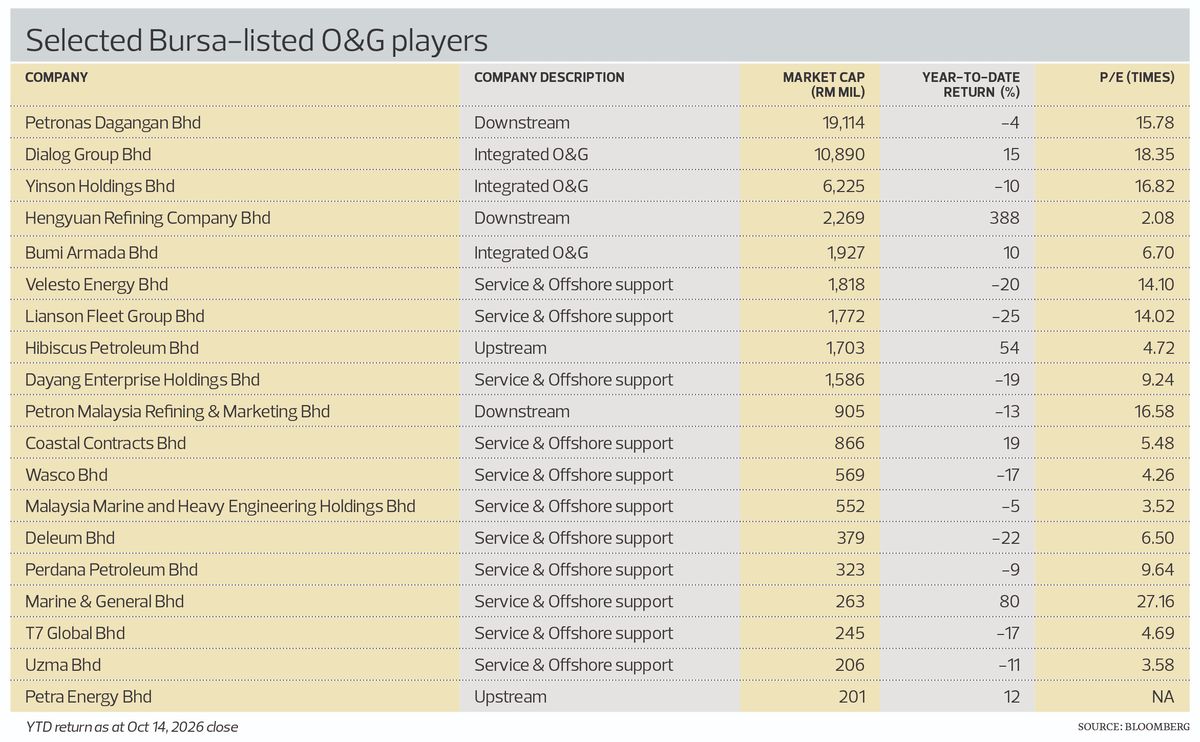
Based on Bloomberg data compiled by The Edge, average reported net profit among 11 selected service and offshore support companies almost tripled to RM123.4 million in FY2024 from RM43.8 million in FY2022. Nine of the 11 reported stronger earnings over the same period, including Velesto Energy Bhd (KL:VELESTO) and Wasco Bhd (KL:WASCO), which swung from losses to profits of RM208 million and RM153 million respectively, and Dayang Enterprise, whose profit more than doubled to RM311 million.
The 11 were drawn from 19 selected Bursa-listed O&G companies in the table on the right. The figures are unadjusted for exceptional items, including a RM196 million disposal gain recorded by Lianson Fleet Group Bhd (KL:LFG) in 2022, while Dayang’s consolidated earnings include Perdana Petroleum Bhd (KL:PERDANA), also among the 11.
The recovery coincided with higher domestic upstream expenditure by PETRONAS, although company-specific operating improvements and other factors also influenced earnings. Spending followed multi-year plans rather than the oil price of the day. PETRONAS’ profit fell to RM80.7 billion in 2023 and RM55.1 billion in 2024, and its dividend to the government eased to RM40 billion and then RM32 billion, yet domestic capex kept rising.
Will history repeat itself?
This time, the starting point is different. In 2023, PETRONAS outlined capex of about RM300 billion over five years, 43% higher than in the preceding five-year period. Its latest guidance calls for capex to average RM45 billion to RM50 billion annually over the next five years, compared with the roughly RM60 billion a year implied by that earlier plan. Spending fell 23% in 2025 to RM41.6 billion.
Kenanga Research expects 2026 to mark the bottom of the current upstream spending cycle, with a recovery in 2027, and a possible peak in 2028. It attributes part of the recent underspending to the unresolved legal dispute between PETRONAS and Petroleum Sarawak Bhd (PETROS), a concern shared by CGS, which identified the dispute as the biggest risk to Malaysian O&G earnings even if oil prices remain elevated.
Yet PETRONAS’ headline capex has already surged in 2026. Spending more than doubled to RM41.4 billion in the first half, largely reflecting an additional capital injection into the PRefChem joint venture. Group upstream investment, by contrast, rose only marginally to about RM9 billion from RM8.6 billion a year earlier.
PETRONAS has also agreed to acquire Aramco’s 50% stake in PRefChem, a deal expected to be completed in the second half of 2026. Kenanga lists that purchase among the reasons service providers’ earnings may stay tepid this year, alongside the prospect of higher dividends.
The domestic activity outlook remains mixed
PublicInvest Research noted that actual hook-up and commissioning man-hours in 2025 were 70% below PETRONAS’ earlier forecast, while maintenance, construction and modification man-hours fell about 16% short. PETRONAS subsequently revised downwards several activity requirements for 2026 and 2027. Some work is returning from a low base: hook-up man-hours are expected to rebound to about four million in 2026 from 1.9 million, and PETRONAS plans to develop and explore 91 wells, up from 79.
The government is also expecting more. The fuel subsidy bill has been pushed to RM40 billion from the RM15 billion budgeted, and PETRONAS is expected to pay RM27 billion in dividends this year, against the RM20 billion announced in February.
An analyst who spoke to The Edge cautioned that higher dividend demands could constrain PETRONAS’ upstream investment, particularly in greenfield projects that take longer to generate returns. The analyst expects any additional spending to reach contractors first through work orders under existing PETRONAS umbrella contracts, particularly for brownfield optimisation and well intervention, rather than new contract awards.
Winners and losers
Analysts The Edge has spoken to largely agree on the order in which the oil price pays out: the closer a company sits to the barrel, the sooner it benefits. CGS says, with no significant increase in PETRONAS’ spending yet, companies with upstream exposure are the clearer beneficiaries. That echoes the 2022 environment, when producers were the first to reap the gains.
Hibiscus is the clearest example. Earnings more than tripled to RM361 million in its financial year ended June 2026, although the previous year was depressed by a one-off UK tax charge. Core profit rose 29% y-o-y according to Hong Leong Investment Bank (HLIB).
One analyst, speaking on condition of anonymity, cites sell-side estimates that a US$10 swing in Brent moves Hibiscus’ earnings by around RM120 million. BIMB Research in its July note separately estimates that every US$5 per barrel change in Brent would move Hibiscus’ FY2027 earnings by about RM52 million, noting that Malaysia’s windfall tax regime limits its upside from higher prices.
The same analyst points to Petra Energy Bhd (KL:PENERGY), estimating that every US$10 per barrel increase in oil prices would generate about RM15 million in additional earnings, based on an annual production target of 600,000 barrels. The estimates assume a full year of output, but the group’s Banang field only restarted in April after a 15-month shutdown, complicating its ability to meet that target. Petra’s net loss widened to RM20.1 million in its first quarter ended March 31, 2026 (1QFY2026), from RM7.5 million a year earlier, while the field was shut.
Shipping may be the second more immediate beneficiary. MBSB Research expects MISC Bhd (KL:MISC) to gain through freight rather than crude, as longer tanker routes lifted charter rates at its petroleum shipping arm, AET. The results so far fit. MISC’s second-quarter profit more than doubled y-o-y to RM1.15 billion, which its chief executive credited partly to favourable tanker conditions, although ship-sale gains also helped. Kenanga Research calls shipping the more durable trade, but it hinges on routes staying disrupted. Kenanga expects tanker rates to stay elevated in 2027, while warning they may be peaking.
Contractors come last, as in 2022. MBSB lists Dayang Enterprise, Velesto Energy and Keyfield International Bhd (KL:KEYFIELD) among potential winners, through work orders, rig rates and vessel charters. The anonymous analyst says Dayang likely has the sparest capacity, so extra PETRONAS spending may reach it first through existing contracts. But the results have yet to reflect it.
Dayang’s profit fell 57% y-o-y in the second quarter ended June 30, 2026 on fewer work orders, and RHB Research says oil majors are postponing shutdowns to keep production running. Velesto’s profit plunged to RM531,000 as average daily charter rates declined to US$103,000 from US$123,000 a year earlier, despite rig utilisation improving to 66% from 57%. Keyfield’s gross margin fell to about 11% in the first half of 2026 from 46% a year earlier, which management blamed on fuel costs, war allowances for crew and weaker accommodation vessel rates.
RHB Research, HLIB and CIMB Securities largely see Dayang’s weakness as a matter of timing, with deferred maintenance potentially shifting into FY2027 or FY2028, while its RM4.7 billion order book remains intact.
Higher oil can also hurt where costs cannot be passed on. The analyst names Muhibbah Engineering (M) Bhd (KL:MUHIBAH), Malaysia Marine and Heavy Engineering Holdings Bhd (KL:MHB) and Wasco as exposed to margin pressure, because their contracts rarely include energy-cost pass-through. MBSB, which counts Wasco among beneficiaries through offshore pipe-coating, names cost inflation as a key risk, saying many contractors work under multi-year fixed day rates or lump-sum frameworks and absorb increases until renewal. Wasco’s net profit for its first quarter ended March 31, 2026 fell 69% y-o-y on Middle East disruption, and Maybank Investment Bank downgraded it, warning that delays could lead to cost overruns.
Despite the near-term weakness, Kenanga Research names Keyfield as its preferred upstream services pick, citing its relatively young fleet and lower depreciation costs from vessels acquired during the 2020–2022 downturn. Dayang is its second choice.
Ultimately, any earnings uplift for companies that are not upstream-heavy may only come in the medium term. For now, the winners are the companies paid for the barrel, or the route.
Save by subscribing to us for your print and/or digital copy.
P/S: The Edge is also available on Apple's App Store and Android's Google Play.