


This article first appeared in The Edge Malaysia Weekly on October 19, 2026 - October 25, 2026
THE Budget 2027 proposal to set a minimum salary of RM2,500 for semi-skilled workers and fresh graduates could help lift the incomes of a sizeable segment of the country’s workforce. However, a uniform increase in the wage floor could put pressure on businesses, particularly small firms outside the country’s employment hot spots.
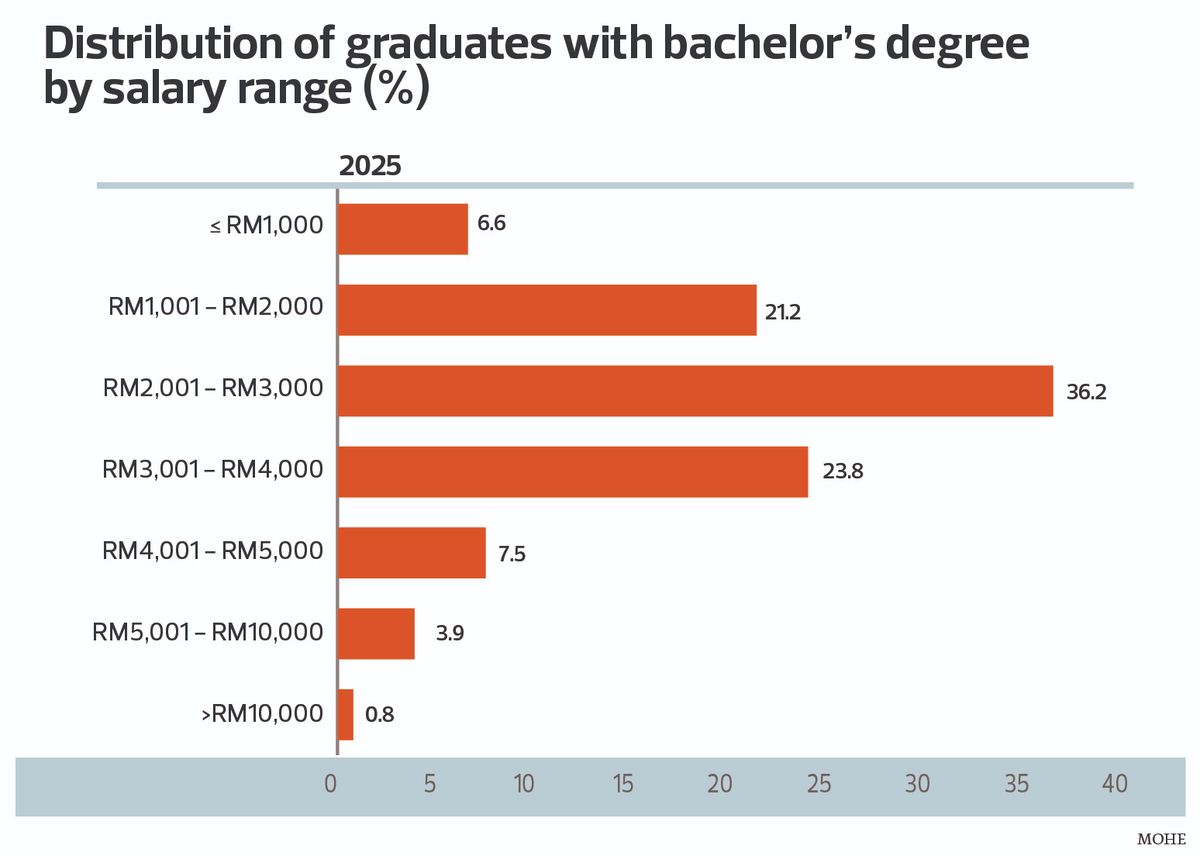
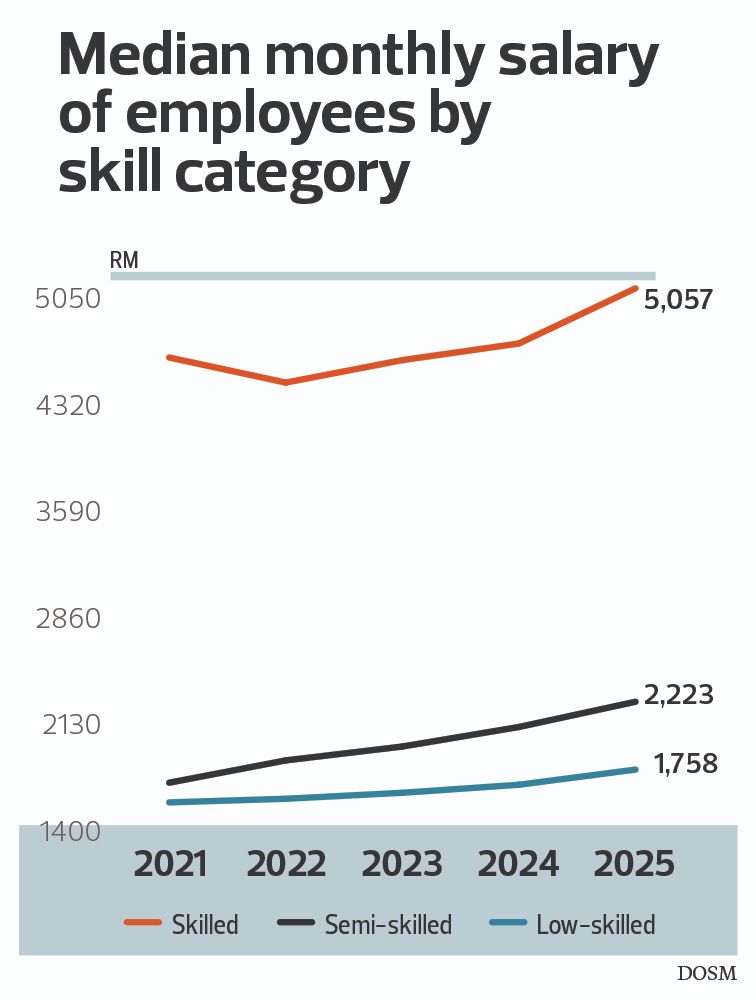
Department of Statistics Malaysia data shows that the median monthly salary for semi-skilled workers stood at RM2,223 in 2025, while Ministry of Higher Education data shows that nearly 30% of degree holders earned less than RM2,500 last year.
Semi-skilled workers accounted for 55.6% of the total employment in 2025, RHB Research points out in an Oct 14 report, with several occupational groups still earning median salaries below the proposed threshold. Service and sales personnel, plant and machine operators and assemblers, craft and related trade employees and skilled agricultural, forestry, livestock and fishery workers are among those whose median salary is below RM2,500.
These occupations are heavily represented in the wholesale and retail trade, accommodation and food services, manufacturing, construction and agriculture sectors, says RHB Research, adding that the proposed wage floor has the potential to extend income support beyond minimum-wage earners to a much larger segment of the workforce.
“Low wages have always been an issue in Malaysia and we know the share of employees’ compensation has been low relative to other countries. The government has introduced many approaches to try to encourage higher wages,” says CGS International Securities head economist Ahmad Nazmi Idrus.
“In Budget 2025, the government announced its intention to come up with salary guidelines, which didn’t go down well. We also have the Progressive Wage Policy (PWP) that seems to be limited in scope and reach. So, I think they are trying a hardline approach.”
Nevertheless, he believes the implementation of this tiered salary system will not be immediate, as stakeholder engagement is needed to see how it can be done without causing much disruption. “But it is a good first step to get the ball rolling,” he adds.
Most graduates today in knowledge-driven sectors are already being paid above the proposed minimum salary of RM2,500, implying that semi-skilled employees are likely to reap the benefits of the government’s proposal.
“A statutory baseline of RM2,500 would primarily serve as a protective floor for graduates entering small local firms, administrative functions or non-specialised regional roles,” says Randstad Malaysia’s director Sueying Chan, who leads the recruitment division for accounting, finance, banking, sales, marketing, human resources (HR), legal and shared services.
The agency’s data indicates that entry-level IT support roles can start from between RM4,500 and RM5,500 a month, while junior analysts in shared services/global business services earn RM3,000 to RM5,000. As for the accounting, HR and engineering industries, the starting pay range is slightly wider, ranging from RM3,000 to RM5,500 a month.
Nonetheless, Chan opines that establishing a minimum salary for graduates is a positive step towards ensuring entry-level pay reflects tertiary qualifications and protects young talent from underemployment.
She points out that in Malaysia, competitive salary and benefits is the top priority in becoming the “employer of choice”, and uncompetitive compensation is the leading cause of attrition in the country. “Setting a fair starting pay gives young workers financial relief early on and supports talent retention,” she adds.
Implementation loopholes need to be plugged
It is noteworthy that starting salaries differ considerably across Malaysian states, not only because of the cost of living but also because of economic density and industry concentration, says Chan.
It should come as no surprise that the Klang Valley commands the highest wage tiers, driven by higher concentration of corporate headquarters, regional global business service hubs and aggressive competition for specialised talent.
The starting pay in secondary economic hubs is typically 10% to 20% lower than the Klang Valley benchmarks, supported by major investments in semiconductor manufacturing, data centres and Malaysia-Singapore cross-border commerce, according to Chan. In non-hub states, the entry-level salaries can be 20% to 40% lower, reflecting lower regional operating costs and a higher proportion of local SMEs.
While details of the proposal are scant at the moment, a uniform increase nationwide may not impact employers in urban areas as they typically pay more than the proposed minimum salary. However, it could be a payroll shock for businesses in non-hub states, says Lee Heng Guie, executive director of the Socio-Economic Research Centre, a think tank of the Associated Chinese Chambers of Commerce and Industry of Malaysia.
CGS’ Nazmi points out that different industries have different levels of productivity while there is also a difference in the cost of living between urban and rural locations. “Using a flat rate nationwide puts unfair advantage or cost on certain industries and locations. That would have an unintended crowding out effect,” he says.
Lee opines that raising the minimum salary of semi-skilled workers and graduates will trigger wage compression as employers will be forced to bump up salaries across the board to maintain a fair pay gap between entry-level staff and experienced employees — leading to a compounding in overall payroll pressure and putting financial strain on businesses.
“The resultant increase in labour costs could constrain cash flow, hiring capacity and business expansion while potentially adding to operating costs and inflationary pressures if businesses pass on part of the increase to consumers,” he adds.
Hiring could also go two ways. Small businesses on tight budgets that struggle with higher wage bills could be forced to cut entry-level hiring or choose experienced diploma holders over fresh graduates with degrees, says Chan.
Meanwhile, some employers may also consider more flexible staffing arrangements if margins are tight, Lee says.
How other countries implement minimum wage policy
Countries around the world implement their minimum wage policy differently. For instance, Singapore utilises the Progressive Wage Model, where rather than setting one fixed minimum wage for all sectors, the model covers Singapore citizens and permanent residents working full-time or part-time under a contract of service (for specific sectors).
“Wage increases are also directly linked to skill upgrading, productivity and career progression. Its Progressive Wage Credit Scheme provides employers with transitional support by co-funding wage increases for eligible low-wage workers,” Chan explains.
Malaysia has done something similar with the PWP, through which it aims to encourage the private sector to raise wages without bearing the full immediate cost, by offering incentives of RM200 to RM300 per employee to support wage progression tied to skills and training.
A few weeks ago, Minister of Economy Akmal Nasrullah Mohd Nasir said the government would be conducting a comprehensive assessment of the PWP at the end of this year to evaluate its effectiveness in raising wages.
In developed countries such as Australia, the government sets a legal national minimum wage as a baseline, alongside industry-specific pay rates, which it calls “awards” that scale minimum pay based on a worker’s job role, industry and qualifications, says Chan.
“Australia and the UK implement statutory minimum wage frameworks alongside industry awards or collective bargaining agreements, ensuring starting wages are aligned with professional qualifications, job complexity and regional living costs,” she adds.
Nazmi says that on a practical basis, there are many loopholes that require plugging. For one, the term “semi-skilled” needs to be properly defined. It is also unclear at this point whether the government’s use of “graduates” includes diploma holders.
There is no arguing that higher starting salaries is a positive step towards improving talent quality and retention, but its implementation should balance employee welfare with business capacity, says Lee. “A phased approach, stronger industry-linked training and clearer skills-based salary structures could help businesses adjust without significantly constraining entry-level opportunities,” he adds.
Save by subscribing to us for your print and/or digital copy.
P/S: The Edge is also available on Apple's App Store and Android's Google Play.