

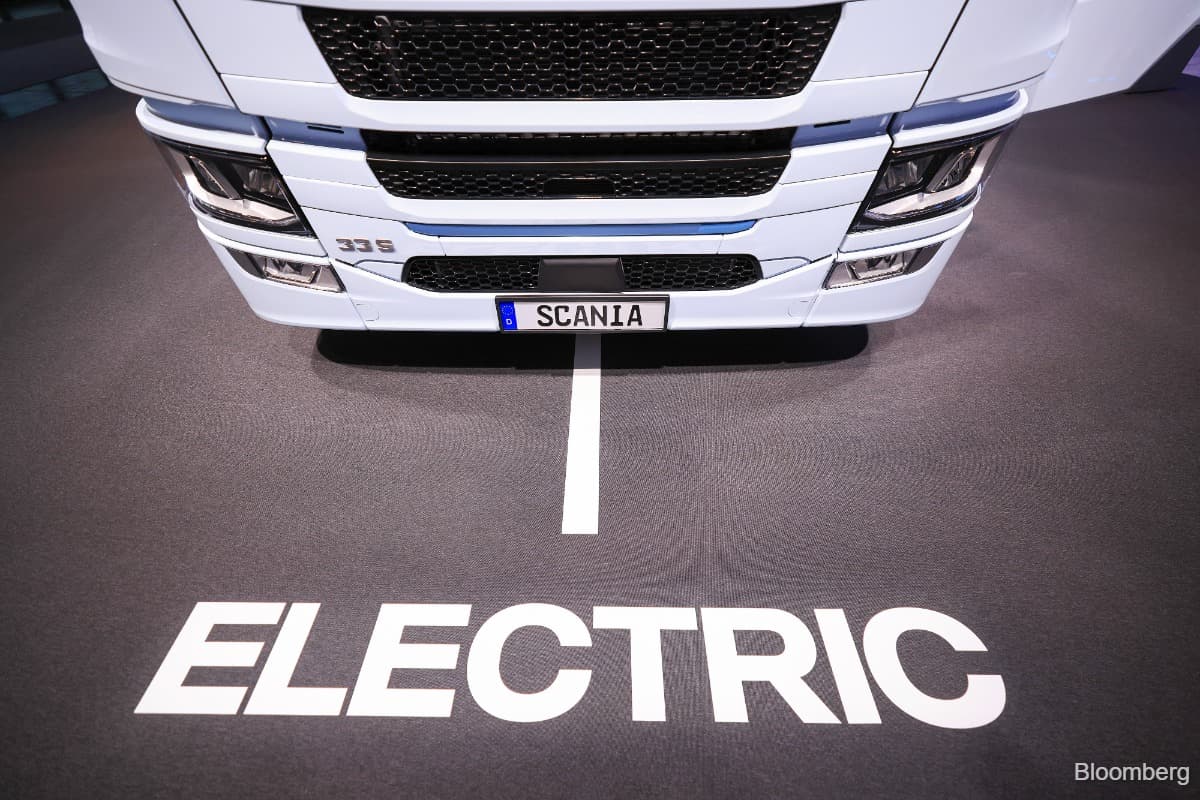
(Oct 20): Volkswagen AG’s truck unit Scania AB is speeding up plans to make electric trucks at its new Chinese factory as record diesel prices fuel a faster-than-expected switch in the world’s biggest market.
The Swedish truckmaker will manufacture battery-powered vehicles at its plant in Rugao, China, as soon as it receives a licence, chief executive officer Christian Levin said in an interview in Södertälje. Levin expects electric trucks to account for half of China’s market by the start of 2027.
“We have had to speed up those plans,” Levin said. “It’s always quite a complicated process in China to get licences to do different things, but I have to say: it has moved much faster than we could have imagined.”
Chinese electric-truck sales jumped almost 80% in the first half from a year earlier, according to BloombergNEF, and are on pace to account for close to a third of all trucks sold this year. That compares with just 8% a couple of years ago.

E-truck demand is getting a boost from trade-in subsidies and elevated diesel prices in the wake of the US-Iran war. Beijing had targeted a 40% market share for such vehicles by 2030, with the current trajectory outpacing this goal. As part of the switch to battery power, China’s consumption of diesel is projected to fall more than 10% this year, according to the Sinopec Economics & Development Research Institute.
Scania, which is part of Traton SE, opened the Rugao plant last year, its first wholly-owned factory in China alongside production in Europe and Latin America. The facility, which serves China and other Asian markets, can make both conventional and battery-powered trucks.
“It is happening quickly and that’s incredibly fascinating,” Levin said. “It means they have found a way to expand charging infrastructure and the power grid, which is the biggest challenge we have in many countries around the world, including Europe.”
Electric big rigs taking off in China will likely ratchet up competitive pressure on Traton, Daimler Truck Holding AG and Volvo AB. German supplier ZF Friedrichshafen AG last month said the “centre of gravity for electric-drive technology” in trucks was in China.
As China’s market pivots, the US is lagging after electrification incentives were cut. Levin said high diesel prices are likely to move the needle now.
“If diesel prices continue to rise, then purely on its own merits, it will become cheaper to drive on electricity even in the US,” he said.
Traton’s conventional truck business has remained resilient despite the burden from record diesel prices, which typically slows investment in new vehicles. Traton’s US-based truck arm posted a 48% jump in third-quarter vehicle sales, helping drive a 10% increase for the group.
“It’s been very much about customers looking for energy-efficient solutions,” he said. Customers are also willing to pay more for fuel efficiency, he added.
In Europe, the backdrop for e-trucks remains tough. Poor charging infrastructure and grid capacity are combining with high operating costs, Levin said. The prevalence of small haulage companies means changes in customers can cancel routes e-trucks can serve.
“Then you’re left with a stranded asset,” Levin said. The average European haulage company operates just seven or eight trucks.
Levin spoke as Scania inaugurated a new 975 million-krona (RM400 million) vehicle testing facility in Södertälje, south of Stockholm. The 850,000-square-metre site includes a high-speed oval and areas for testing vehicle handling, rollover safety and autonomous driving.
Levin said driverless trucks could be used at scale in the US before 2030, while Europe may take longer because of regulatory hurdles, particularly for vehicles crossing national borders.
Traton is due to report third-quarter earnings on Oct 28.
Uploaded by Evelyn Chan