

This article first appeared in The Edge Malaysia Weekly on October 19, 2026 - October 25, 2026
Engineering services and automation solutions provider 3REN Bhd (KL:3REN) is positioning itself to capture multi-year growth opportunities as the artificial intelligence (AI) boom drives investment across Penang’s semiconductor and electronics supply chain.
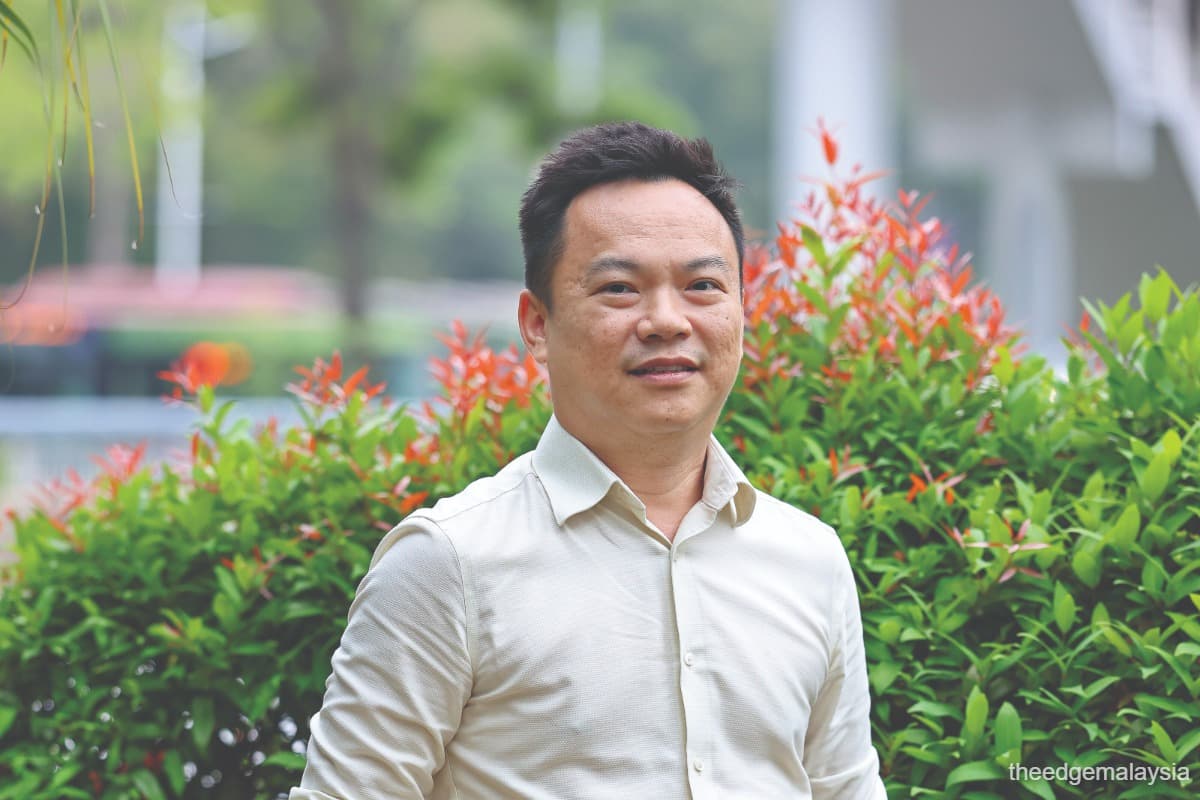
CEO Koh Dim Kuan tells The Edge that the group sees more opportunities as multinational corporations (MNCs) expand their operations in the state over the next two to three years, creating demand for automation equipment, product validation and engineering support. “The opportunity from the AI boom is becoming more about embedding ourselves in the expansion plans of global semiconductor and electronics players,” he adds.
In addition to a 16-year relationship with US-based Intel group of companies, 3REN supplies automation equipment to a global electronics manufacturing services (EMS) giant that makes power modules for server boards. It is also expanding its work with a leading Tier 1 fabless chipmaker and a global memory chip giant.
“Essentially, we are involved in most of the key components of the AI data centre supply chain, such as graphics processing units (GPUs), central processing units (CPUs), memory and power modules,” Koh explains.
3REN’s business spans three complementary areas: automation and digitalisation solutions (ADS), which involves designing and supplying robotic and automated equipment for production and inspection processes; product engineering services (PES), which provides engineering expertise for semiconductor product development and validation; and engineering support services (ESS), which supplies engineers and technical support to help customers operate and ramp up manufacturing facilities.
In simple terms, ADS builds the machines, PES helps test and validate the products and ESS provides the engineering support needed to run production.
The group’s long-standing relationships with MNCs have allowed it to deepen its understanding of customers’ products, processes and future requirements, helping it evolve into a specialised semiconductor engineering partner. These relationships are beginning to translate into a larger order book.
As at June 30, 2026, 3REN had RM74 million in outstanding orders, up 30% from RM56.6 million a year earlier. ADS accounted for RM36.8 million, or 49.7%, followed by PES at RM23.3 million and ESS at RM13.9 million.
What’s driving its growth
The most immediate growth opportunity lies in ADS, where 3REN supplies in-house-designed automated optical inspection (AOI) equipment to a global EMS giant that makes power modules for data centre server boards. The equipment supports the customer’s manufacturing expansion, allowing 3REN to play a more integral role in its production process.
Koh points out that, based on publicly available information, the customer is aiming to triple its revenue by 2028, giving 3REN an opportunity to grow alongside the customer. “We will support their growth pathway, and we are already their preferred supplier,” he adds.
Being a preferred supplier puts 3REN in a stronger position to participate in future enquiries as the customer expands production capacity and automation requirements.
Koh expects ADS, which accounts for about 36% of the group’s total business, to grow by around 30%, with margins potentially higher than those of ESS. Repeat orders could also follow as customers add capacity.
“Although ADS is classified as project-based revenue, the relationship with a customer can extend beyond the initial equipment delivery. Once automation systems are installed, 3REN could potentially provide support and maintenance, although this depends on whether customers outsource the work or keep technicians in-house,” he explains.
While ADS provides exposure to AI infrastructure, 3REN’s engineering services businesses are benefiting from the increasing complexity of semiconductor manufacturing and advanced packaging.
The group is preparing its engineers to support a leading Tier 1 fabless chipmaker, whose validation processes differ from those of its long-standing integrated device manufacturer (IDM) customer. “We are preparing the team to understand the customer’s environment,” says Koh.
The group is now building the engineering capabilities required for the ramp-up and is positioning its team to support customers as advanced packaging capacity comes online. The opportunity could extend beyond a single product generation, as engineers familiar with a customer’s tools, processes and validation requirements could potentially support subsequent products.
Another important opportunity is an advanced packaging programme with its long-standing IDM customer, which has planned a US$7 billion (RM28.6 billion) facility in Bayan Lepas, Penang. The first phase is targeted to begin operations in late 2026 and is expected to create more than 4,000 high-tech jobs.
Koh expects the programme to expand as the customer ramps up its first phase, potentially providing 3REN with a two- to three-year growth runway.
“The opportunity is not limited to a single project. As customers bring additional production capacity online, they may require more engineers to support manufacturing, validation and related activities,” he says.
3REN’s second-quarter results showed ESS revenue rising 63% year on year, supported by a higher recurring revenue base as a major customer expanded its production footprint in Malaysia and Vietnam, alongside the ramp-up of new projects.
Koh expects R&D and validation, as well as advanced-packaging-related engineering services, to grow by about 15% to 20%.
Outsourcing trend works in group’s favour
Beyond the AI investment cycle, Koh sees a structural opportunity in the growing use of outsourced engineering services among large semiconductor companies. Rather than maintaining large permanent engineering teams for every project, global chipmakers can engage external specialists and scale their resources according to project requirements.
“They have adopted an outsourcing model. They are more flexible, and it brings down operating costs for the MNCs,” he says.
This creates an opportunity for 3REN to become an extension of customers’ internal engineering teams, supporting multiple stages of the semiconductor life cycle, from new product introduction and validation to R&D, manufacturing support and automation. The company’s engineers have exposure across these disciplines, with a job-rotation approach that allows them to build broader capabilities.
Koh describes the ambition as being “like a mini-Accenture” for the semiconductor industry — a specialised engineering and consulting partner that can support customers across different technical requirements.
As at June 30, 3REN had a workforce of 2,077, including 455 full-time employees.
3REN is also looking to follow its customers beyond Malaysia, with Singapore its immediate priority. The group already has about 14 customers there, although they have historically been supported by its Malaysian operations. Establishing a local presence will allow the group to provide more direct support and pursue opportunities in front-end semiconductor services, including work involving equipment makers and foundries.
“The low-hanging fruit is Singapore,” says Koh. Beyond the city state, the group is looking at the US and India, while gaining exposure to projects in other overseas markets.
The expansion is partly driven by “China plus one” and “Taiwan plus one” strategies, which are encouraging semiconductor companies and equipment makers to diversify their manufacturing footprints. For 3REN, this creates opportunities to follow existing customers into new markets while developing relationships with more global players.
Scaling up to meet rising demand
As opportunities increase, the challenge is ensuring the group has sufficient engineering capacity and infrastructure to execute projects.
“Workforce is a big factor. The second is infrastructure,” says Koh.
3REN is looking at additional space and facilities to accommodate its growing teams and projects. Dedicated infrastructure could shorten lead times and improve margins, he says.
The group’s order book typically provides about a year of visibility, although this varies by business. Some engineering engagements last a year or longer, while ADS projects generally have six- to nine-month delivery cycles. Its historical book-to-bill ratio has been above one, indicating that new orders have generally exceeded the value of projects being executed.
The group is also exploring opportunities in integrated circuit design and intellectual property, although these initiatives remain at an early stage. The aim is to leverage its semiconductor relationships and technical capabilities to move into higher-value activities.
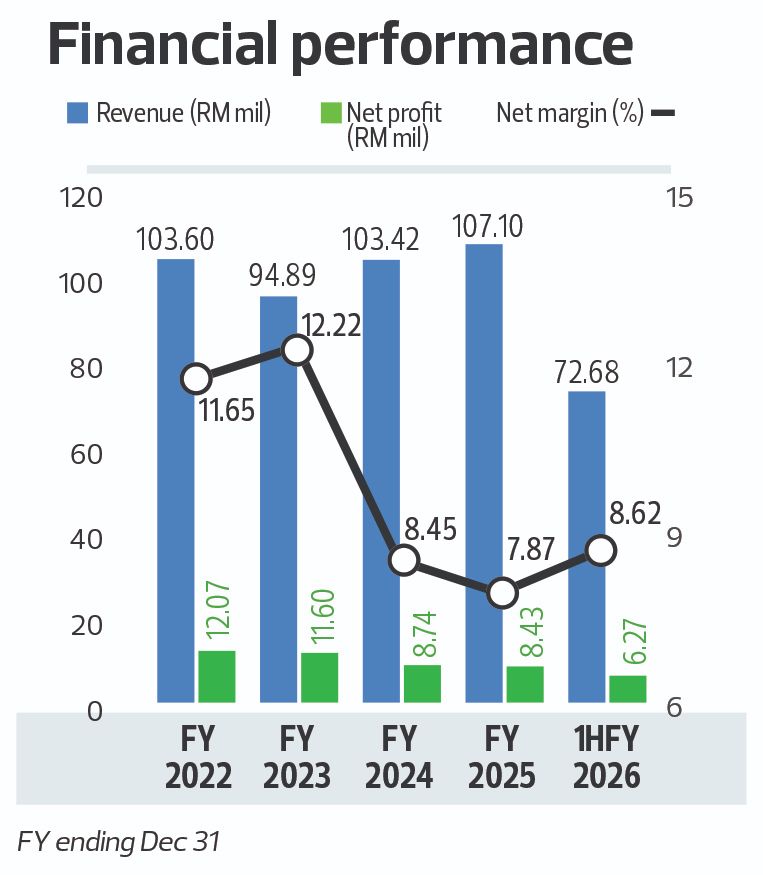
The growing order book and broader customer exposure are beginning to be reflected in 3REN’s financial performance. For the first half of the financial year ending Dec 31, 2026 (1HFY2026), its net profit rose 24.8% to RM6.27 million, while revenue increased 39.3% to RM72.68 million.
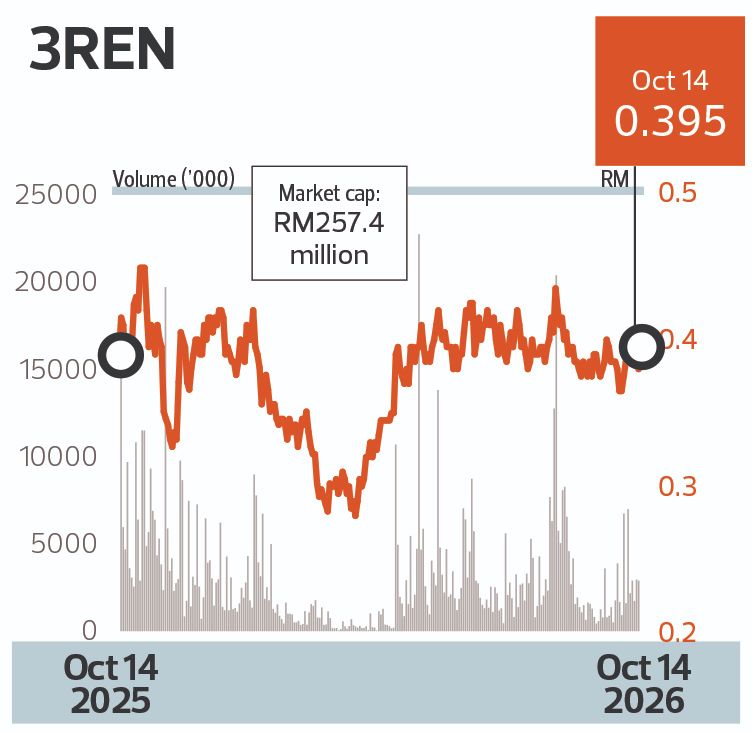
3REN’s share price closed at 39.5 sen last Wednesday, giving the company a market value of RM257.4 million. Compared with its IPO price of 28 sen on Nov 6, 2024, the stock was up nearly 42%.
Based on its annualised net profit of RM12 million, the shares were trading at an indicative price-earnings ratio (PER) of 21.3 times. The stock is not covered by analysts.
As at end-June, the group had total liquidity of RM35.79 million, including cash, short-term funds and fixed deposits, against total borrowings of RM10.2 million. It raised RM30.8 million from its IPO in 2024, of which RM7.39 million remained unutilised.
Executive director and chief revenue officer Lee Chee Hoo was the largest shareholder with a direct stake of 19.85%, while Koh held 4.35%. They had a combined indirect interest of 39.92% through R3 Capital Sdn Bhd. Malaysian Technology Development Corp Sdn Bhd, a wholly-owned subsidiary of Khazanah Nasional Bhd, held 4.79%.
Save by subscribing to us for your print and/or digital copy.
P/S: The Edge is also available on Apple's App Store and Android's Google Play.