

This article first appeared in The Edge Malaysia Weekly on October 19, 2026 - October 25, 2026
What the maths says about Putrajaya’s potential savings from fuel subsidy opt-outs versus unclaimed one-off RM200 Sara payments
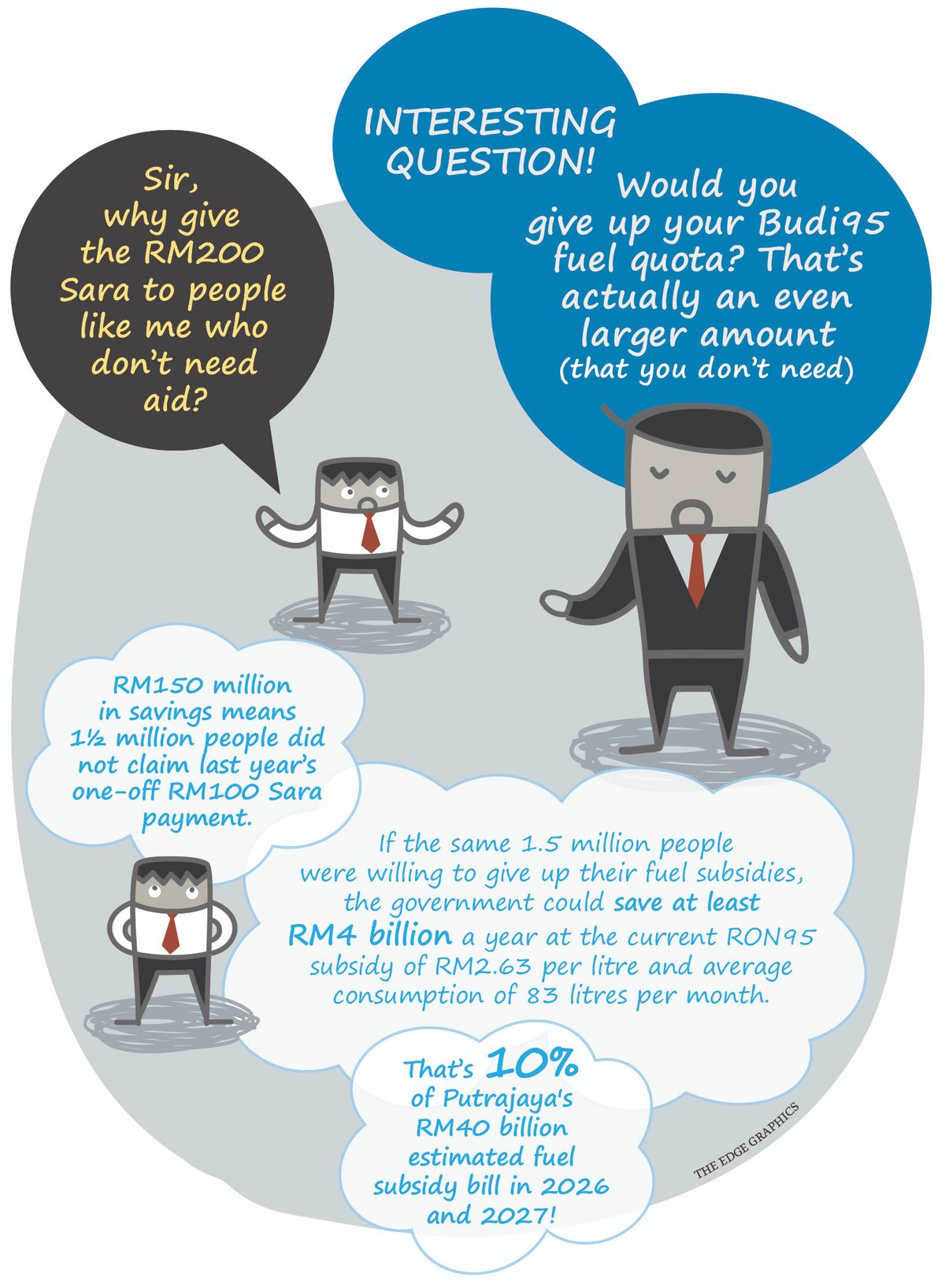
At last week’s Malaysian Economic Association post-Budget 2027 forum, Treasury secretary-general Tan Sri Johan Merican was asked why Putrajaya had again extended the one-off RM200 Sumbangan Asas Rahmah (Sara) payment to people who did not need aid. He responded with a question: “Would you give up your fuel subsidy?”
Fuel subsidies, initially expected to cost the government RM15 billion, are now projected to cost RM40 billion this year after the Middle East conflict pushed Brent crude oil prices above US$100 a barrel. Budget 2027 has also pencilled in RM40 billion for fuel subsidies.
In 2025, about 4% of eligible Malaysians aged 18 and above did not claim the one-off RM100 Sara payment. Of the RM2.1 billion allocated, RM150 million went towards supporting shelter residents, students with special needs and patients. That RM150 million means 1½ million did not claim Sara in 2025.
A similar amount could be available for re-disbursement if those same 1½ million people do not claim their RM100 Sara for 2026 by Dec 31. In 2027, the amount could double to RM300 million as the one-off payment rises to RM200 per person. That would bring the potential re-disbursement to RM600 million over three years, assuming the same 1½ million people continue not to claim their Sara credit through their MyKad.
Under Budget 2027, Malaysian adults who do not receive monthly Sumbangan Tunai Rahmah (STR) assistance will get RM200 in Sara Madani next year — RM100 ahead of Hari Raya Aidilfitri in March and another RM100 in conjunction with the country’s 70th National Day celebrations in August. STR recipients will receive additional Sara assistance of up to RM150 a month, or RM1,800 a year, on top of existing aid.
With about nine million STR recipients, Sara Madani is expected to benefit up to 13 million Malaysians. At RM200 per person, the programme would cost about RM2.6 billion, based on back-of-the-envelope calculations.
What if 1½ million people were willing to give up their fuel subsidies instead?
Citing data up to May, Finance Minister II Datuk Seri Amir Hamzah Azizan told parliament in June that only 1% of the 14 million users in the Budi95 system bought more than 200 litres of RON95 a month, while 5% consumed more than 300 litres of diesel monthly.
Johan had previously put average monthly fuel consumption at 83 litres. At the subsidised RON95 price of RM1.99 per litre, that works out to RM165.17 a month, or RM1,982.04 a year, for the average Malaysian driver.
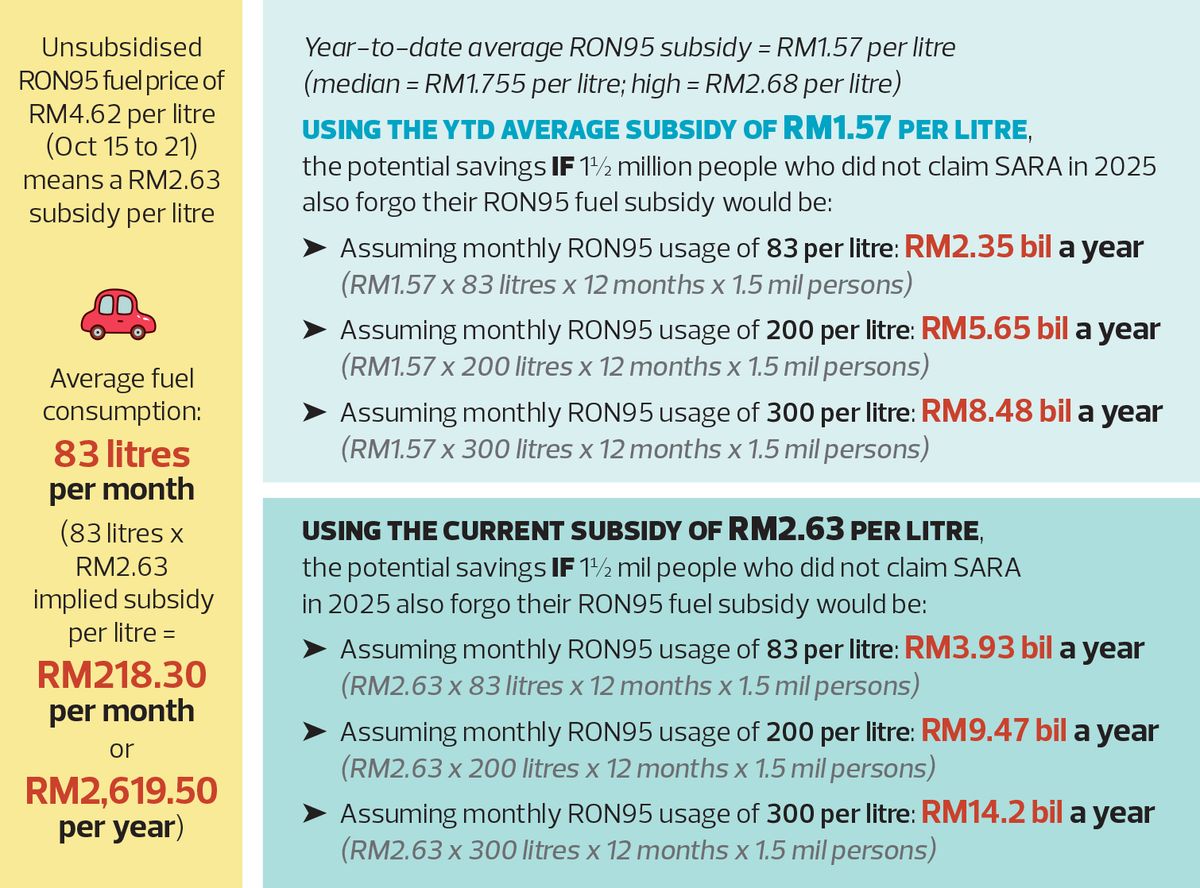
At the current unsubsidised RON95 price of RM4.62 per litre (Oct 15 to 21), 83 litres would cost RM383.46 — about 2.3 times what Malaysians pay at the pump. Putrajaya therefore absorbs RM2.63 per litre, or RM218.29 a month, for the average driver. Annualised, that amounts to RM2,619.48 in fuel subsidies for each driver at current prices.
If the 1½ million people who did not claim their Sara in 2025 also give up their Budi95 subsidy by not using their MyKad at the pump, Putrajaya could save RM3.93 billion a year to redirect to more pressing needs.
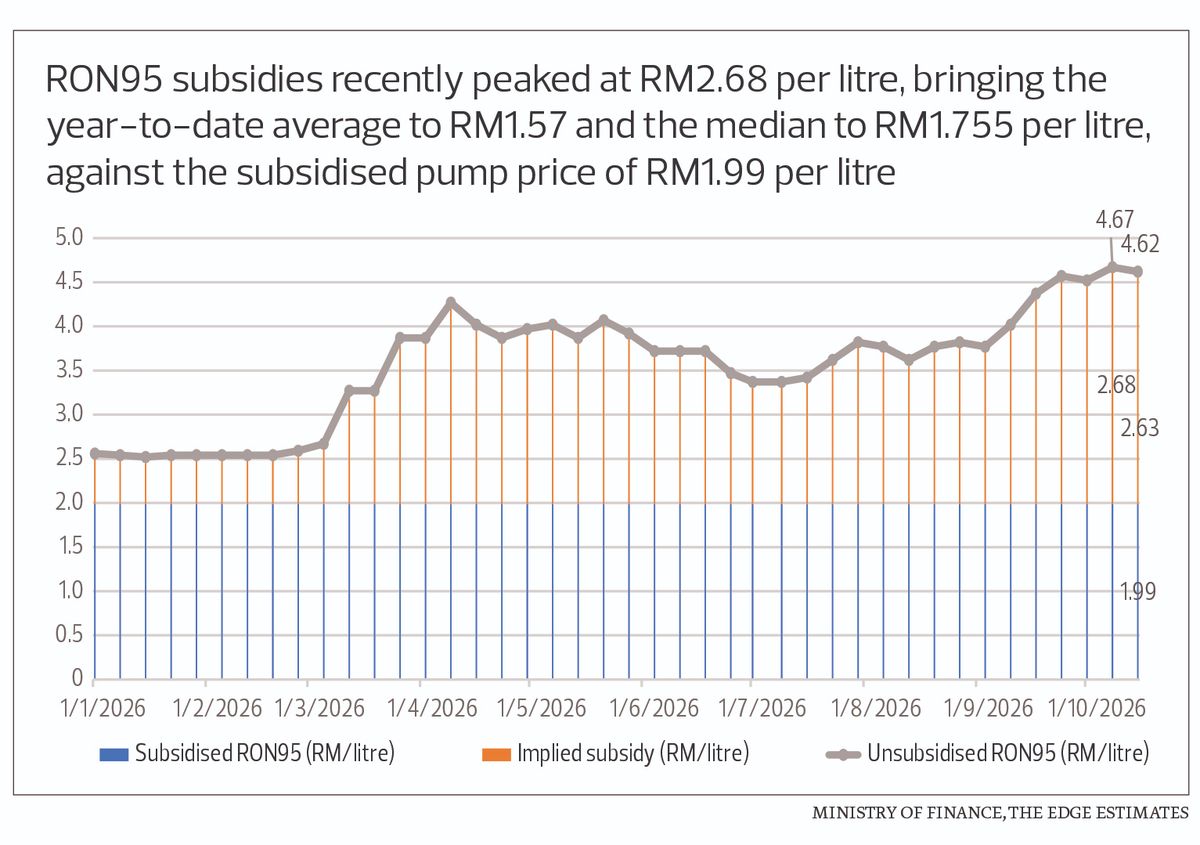
These figures are high because unsubsidised RON95 prices are currently near their year-to-date (YTD) peak. Using the YTD average subsidy of RM1.57 per litre instead, the subsidy for an average driver consuming 83 litres a month works out to RM130.31 monthly, or RM1,563.72 a year.
Multiply that by 1½ million proverbial good Samaritans, and Putrajaya could save RM2.34 billion a year if they were willing to forgo their fuel subsidies.
The savings could be even higher if that many people were willing to give up their fuel subsidies. The YTD median subsidy is RM1.755 per litre, above the RM1.57 YTD average, meaning the subsidy has exceeded the average for more than half the period.
RON95 subsidies peaked at RM2.68 per litre between Oct 8 and 14, when the unsubsidised price reached RM4.67 a litre.
Putrajaya has also said 90% of users consumed less than 200 litres per month, yet raised the maximum RON95 quota back to 300 litres from Sept 1 this year.
For 200 litres, the RON95 subsidy per person is RM526 per month and RM6,312 per year at current fuel prices. Even at the YTD average subsidy per litre of RM1.57, a 200-litre refuel of RON95 would cost Putrajaya RM314 per month and RM3,768 per year.
If the 1½ million people who gave up their Sara allocation in 2025 use 200 litres of RON95 per month, the potential savings from their giving up the fuel subsidies could be a whopping RM5.65 billion.
The maximum monthly fuel quota of 300 litres at the YTD average subsidy of RM1.57 per litre works out to a subsidy of RM471 per month and RM5,652 per year.
That is more than the maximum of RM4,600 per year in STR and Sara allowance given to low-income households with more than five children.
If 1½ million good Samaritans also happen to be pumping 300 litres of subsidised petrol per month, the choice to give up the allocated fuel subsidy could save RM8.48 billion at the average YTD prices. At the current RON95 subsidy levels of RM2.63 per litre, the potential savings could work out to RM9,468 per person using 300 litres per month over one year and a massive RM14.2 billion from 1½ million persons.
That is comparable to the total STR and Sara cash assistance being increased from RM15 billion in 2026 to RM16 billion in 2027. To be sure, there is no way of telling whether the 1½ million persons who gave up their Sara allocation in 2025 use 83 litres or 300 litres of fuel per month or whether they use RON95 at all.
At the forum, Johan reiterated the difficulty of setting an income cut-off for fuel subsidy eligibility. Someone earning RM10,000 or RM15,000 a month while supporting two children, a spouse and perhaps their parents, he noted, could hardly be considered wealthy in the Klang Valley, despite earning well above the average income.
Would you be willing to give up your fuel subsidy? Just don’t use your MyKad at the pump if you think aid should go to those who need it more.
Save by subscribing to us for your print and/or digital copy.
P/S: The Edge is also available on Apple's App Store and Android's Google Play.