

HONG KONG/SINGAPORE (Oct 20): For years, many Chinese entrepreneurs used the same strategy to protect their riches from the taxman. Build a successful business at home, list it on a global exchange, and keep their billions offshore.
That’s no longer a viable path after officials said in July they would begin enforcing a 20% tax on gains from overseas trusts for resident taxpayers. Those who receive such income now have until Oct 22 to tally, report and pay their obligations without penalty.
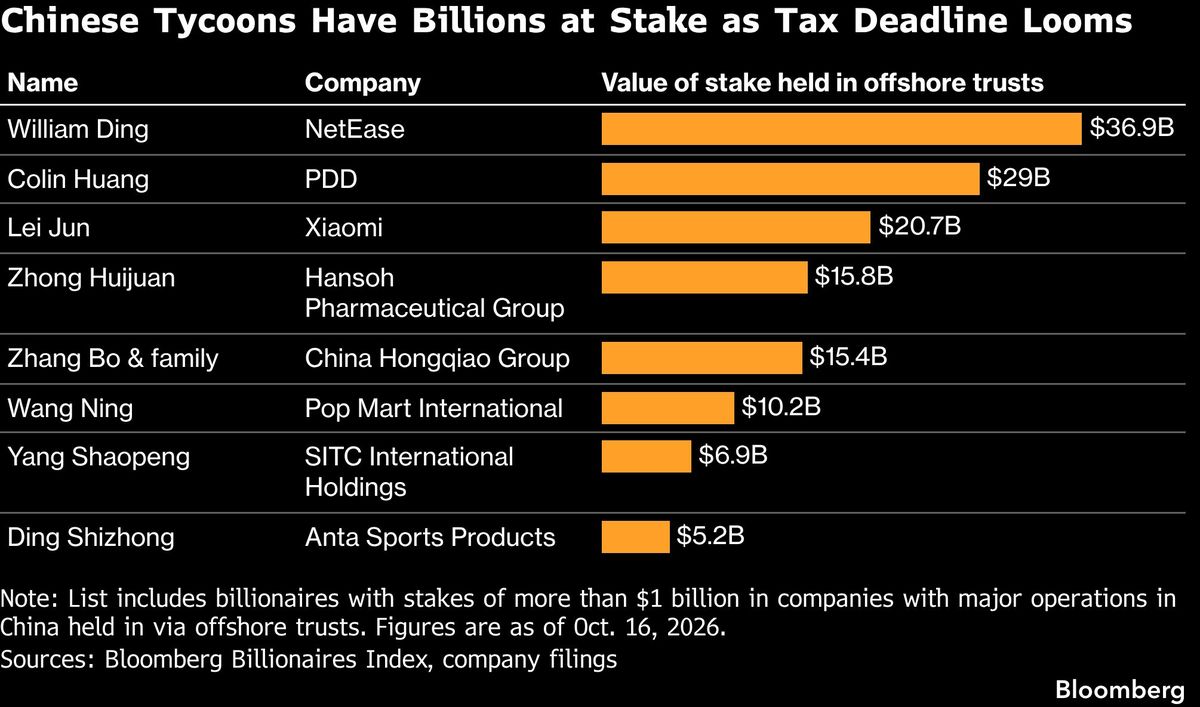
Among those potentially most affected by the move are eight of the world’s 500 richest people and their beneficiaries, according to the Bloomberg Billionaires Index. These are tycoons who hold listed stakes in businesses with major operations in China through offshore trusts, stock exchange filings show.
The Chinese government hasn’t singled out any individuals publicly and it’s unclear if any of these billionaires might be due to pay taxes on gains made by their overseas trusts, or if they’ve been asked to do so. Their holdings, which in each case are the person’s or family’s largest assets, totalled about US$140.2 billion (RM572.5 billion) as of Friday, according to Bloomberg calculations based on regulatory filings.
The eight billionaires, who founded some of China’s most well-known companies, domiciled their trusts in tax havens like the British Virgin Islands and Cayman Islands. They include William Ding, who runs video game developer NetEase Inc and holds about US$37 billion overseas, and Colin Huang, who launched e-commerce giant PDD Holdings Inc and has US$29 billion outside China.
A spokesperson for China Hongqiao Group Ltd, an aluminium producer, said that linking its founder Zhang Bo and the company’s leadership to the tax policy changes “is unfounded and misleading”. Representatives for the other seven companies did not respond to requests for comment.
Much of the overseas wealth was accumulated on investments made before the companies completed initial public offerings in the US or Hong Kong. Some of those businesses, such as PDD and Pop Mart, have soared in value since they began trading, netting their founders billions of dollars on paper.
The tax grab impacts old money trusts more heavily, said Kevin Woo, a partner at law firm Ince & Co Hong Kong.
“Appreciation becomes massive once the company goes public,” he said. Prospective clients who listed their companies long ago “are asking for inventive lawyers who can restructure trusts rather than simply state the rules”, he said, referring to his own conversations rather than the eight billionaires identified by Bloomberg.
The tax collection drive is an extension of Chinese President Xi Jinping’s campaign for “common prosperity”, which included a crackdown on homegrown technology giants and pay cuts for bankers. Even though some of those curbs have eased over the past few years, a prolonged property slump has also dealt a severe blow to the finances of local governments, prompting the search for other sources of revenue.
“They need to optimise revenue streams at local and central government levels and they’re exploring offshore wealth as one of the channels,” said Carlos Casanova, senior economist for Asia at Union Bancaire Privee.
China had begun restricting IPOs of firms incorporated overseas that may offer certain tax benefits, people familiar with the matter said earlier this year. Wealth advisers and lawyers are now helping families trace the history of their offshore structures, going back to when the assets were first transferred into the trusts and tallying how much money they’ve made since then.
“For families with structures that have been around for many years, this can be quite a significant exercise,” said Kylie Luo, head of the asset and wealth management practice at BDO Tax Advisory.
In general, some families are looking to simplify their overseas finances, while others are considering restructuring or unwinding certain arrangements, Luo said. “We’re also seeing more family office structures being set up this year,” she said.
None of the eight billionaires has stated publicly whether they have to respond to the tax rule change, or how they might be doing so.
But some other founders have already turned to investors to raise cash for the taxes. The entrepreneurs behind hotpot chain Haidilao International Holding Ltd and recruitment app Kanzhun Ltd have sold hundreds of millions of dollars of shares combined in response to the new tax enforcement, people familiar with the matter said previously.
How much the new rules will add to China’s government coffers remains uncertain, in part because there’s no public data on who owes what yet. There’s also room for wealthy individuals to negotiate their final bills.
Still, it’s unlikely anyone will get away with paying nothing. China’s taxes apply even to those who have acquired foreign passports — such as Haidilao’s founder — as long as they derive much of their revenue from the country.
“Everyone got a shock,” said Linda Bai, a partner at law firm Dentons Rodyk who has advised China’s ultrarich on setting up trusts for tax purposes. Bai said many of her clients, whom she declined to name, were initially caught off-guard but quickly began to prepare the payments and delve into the technicalities, such as whether certain expenses could be claimed as deductions.
They realised authorities would be able to triangulate how much tax they owed from publicly available IPO documents or acquisition announcements, said Bai. “You cannot run away from it,” she said.
Uploaded by Chng Shear Lane