



In the decade from 2013 to 2022, Mainboard-listed Beng Kuang Marine suffered cumulative losses attributable to shareholders of more than $71 million. During this period, the company’s business was split into four segments, namely infrastructure engineering (IE), corrosion prevention (CP), supply and distribution, as well as shipping and others.
Established in the 1990s as a subcontractor providing corrosion prevention services to shipyards, Beng Kuang has since grown progressively to diversify into various aspects of the offshore and marine (O&M) industries.
The downturn of the offshore and marine industry from mid-2014 onwards impacted its performance for several years, and a key contributor to the losses was the shipping division, which was unable to contribute profit as shipping assets were under-utilised due to third-party operating issues, excessive downtime for repairs and cost challenges, says CEO Yong Jiunn Run. Following three straight years of losses, the Singapore Exchange (SGX) placed Beng Kuang on its watchlist in mid-2023.
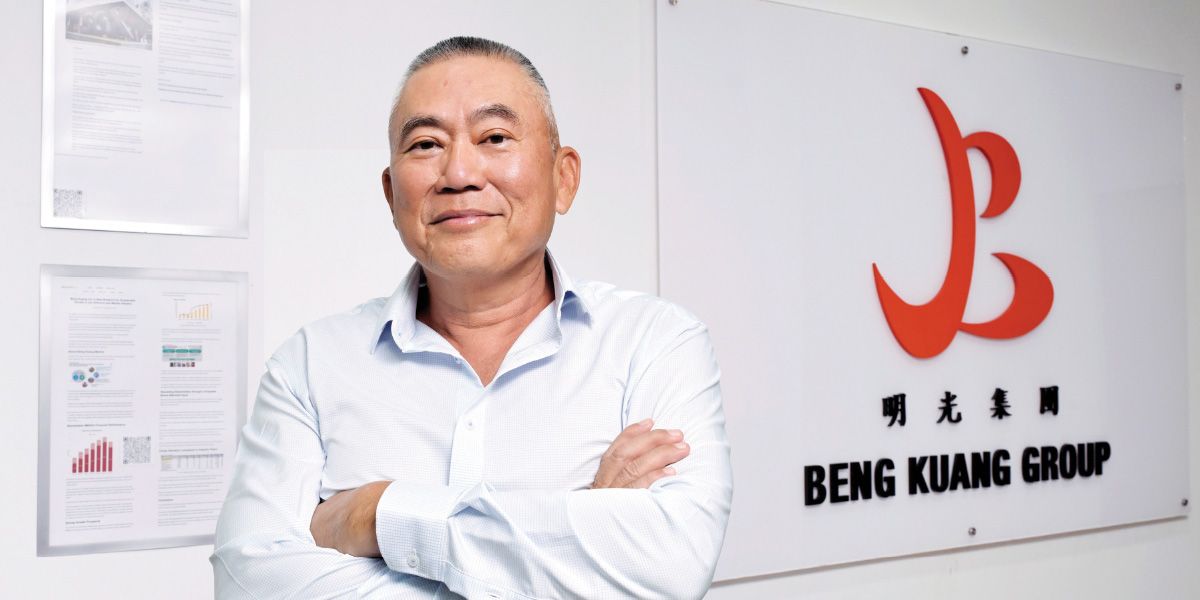
After he joined the company in mid-2021, Yong set out to turn around the business and return it to profitability which was achieved in FY2023. Today, after exiting the SGX watchlist in Oct 2024, Beng Kuang is firmly in the black with a net cash position and positioned for its next phase of growth.
Reporting positive earnings from FY2023 to FY2025 and peaking at $11.5 million for FY2024, Beng Kuang has continued its strong momentum into 2026. For the first half of this year, it reported close to 21% y-o-y growth in patmi to $3.5 million, with revenue of $55.7 million, which is around 10% y-o-y higher. It has also updated that its order book stood at around $71.5 million as at end-September. The current situation stands in contrast to FY2022, when the company reported its highest-ever loss of $21.8 million.
A new direction
With more than three decades of experience in corporate banking, Yong was brought in and charged with charting Beng Kuang’s strategic direction. Under his watch, the company has monetised its non-core fixed assets, hived off underperforming segments and focused on high-potential business segments to create new growth catalysts.
Under the Beng Kuang 2.0 roadmap, Yong narrowed the group’s focus to the “high-growth, cash-generative” IE and CP services segments, transforming into an asset-light and service-centric model which contrasts with its asset-heavy past which incurred high capex and depreciation.
Together, these two divisions provide specialised engineering, maintenance and regulatory compliance solutions that support the reliability, safety and longevity of marine and offshore assets across the energy value chain.
This has enabled Beng Kuang to enhance the quality of its earnings, from lumpy contracts to more stable recurring income streams. “The main motive for the transformation is to create high-quality recurring income streams, in addition to better controlling costs,” says Yong. “Previously, earnings were cyclical and dependent on ‘lumpy’ contracts, but now, we do not have to live from contract to contract.”
On a segmental basis, the IE division contributed $19.7 million in operating profit on $78.5 million in revenue for FY2025 ended Dec 31, while the CP division reported $19.6 million revenue, with operating profit of $2.3 million.
‘Hidden gems’ with moats
The main driver behind Beng Kuang’s brighter prospects is its subsidiary, Asian Sealand Offshore and Marine (ASOM), which became wholly-owned by Beng Kuang in May after Beng Kuang acquired the remaining 49% stake following shareholders’ approval.
In FY2023, FY2024 and FY2025, ASOM reported profits after tax of $10 million, $19.3 million and $14.9 million respectively, on revenue of $50.6 million, $86.3 million and $75.2 million respectively. The bulk of Beng Kuang’s earnings from the IE division is derived from ASOM.
ASOM was incubated by Beng Kuang in 2016, reveals Yong. He adds that by making ASOM a wholly-owned subsidiary, Beng Kuang has strengthened operational alignment across the group’s business, offering greater strategic flexibility in supporting offshore energy clients across multiple markets.
The main business of ASOM is to provide asset integrity solutions for floating, production, storage and offloading (FPSO) and floating, storage and offloading (FSO) vessels, which are typically anchored to their production site for their entire lifecycle, operating 24/7, regardless of oil prices. ASOM has established itself as a proficient “one-stop” in-situ turnkey solutions provider, spanning maintenance, repairs, installation, commissioning, operations and decommissioning for the vessels.
Due to classification requirements, these offshore vessels need continuous maintenance, asset integrity management and regulatory compliance support to operate safely and efficiently. Put simply, lifecycle spending on keeping such assets running is a necessity, providing vendors, such as ASOM, with stable, sustainable and predictable revenue visibility.
Safety and reliability considerations mean that contractors such as ASOM, once appointed to undertake these projects, tend to “stick” around. “Once you get your foot in the door, you will typically get recurring work if you prove you are reliable and proficient with high safety standards,” says Yong. “The costs of switching are high for the asset operators as they need people whom they can trust to maintain safety and mission-worthiness, with downtime leading to revenue loss.”
From its recurrent income base, Beng Kuang, through ASOM, has earned its reputation as a trusted, safe and dependable partner. With a growing global presence, particularly in West Africa, its current clientele includes FPSO contractors/owners (such as SBM Offshore, MODEC, Yinson) as well as oil majors (such as Exxon Mobil).
“Under our Beng Kuang 2.0 roadmap, we have strengthened over the last few years and are focused on building a better-quality business model,” says Yong.
With the consolidation of ASOM into the group, Beng Kuang is positioned for its next phase of growth as it seeks to serve more offshore vessels while expanding the services provided to the 19 FPSOs and FSOs it currently supports.
According to data from the American Bureau of Shipping and Clarksons Research, there are more than 330 FPSO and FSO vessels operating worldwide, with new additions over the next few years bringing the total to above 400, hinting at the size of the market.
With major offshore work progressing and life-extension contracts secured, the business is building a stronger foundation for future earnings. Yong believes the opportunity lies not simply in winning more contracts, but also in developing long-term customer relationships that generate repeat business.
“We want customers to keep coming back to us because they trust our work. That gives us more repeat business, more stable earnings and better cash flow. Ultimately, we want to build a business that can grow steadily and reward our shareholders over the long term.”
In addition, Beng Kuang is not just limited to servicing FPSOs and FSOs, as its asset integrity solutions are applicable across other offshore assets, including floating liquefied natural gas (FLNG) vessels and floating, storage and regasification units (FSRU), which are projected to rise as energy security and demand drives gas extraction and production.
Adjacent boosts
A foundation of Beng Kuang’s business is its corrosion protection solutions, which serve as the company’s “steady” cash base. With a track record of more than 30 years, the division works on a resident contractor model and sees recurring work.
The group’s International Offshore Equipments (IOE) specialises in the design, build and supply of marine and offshore deck equipment, and also provides after-sale services on supply of spare parts, servicing and upgrading recommendations and works.
Beng Kuang is also exploring the potential of shipbuilding and chartering. It has formed a joint venture (JV) with commercial ship owner and maritime management company Epsilon Navigation in April. Under the collaboration, the new JV seeks to execute a ‘build, charter, optimise, monetise and reinvest’ platform strategy for marine asset monetisation.
Unlocking shareholder value
Since its turnaround to profitability in FY2024, Beng Kuang has rewarded shareholders via free warrants and resumption of annual dividends.
In September 2024, the company issued approximately 59.8 million of free warrants with each warrant allowing the holder to subscribe for one new ordinary share at 22 cents. As at Oct 12, Beng Kuang’s share price is 38 cents, representing an upside of around 73% to the exercise price.
“Building on our positive momentum, we’ve been unlocking shareholder value over the last few years,” says Yong, who reiterates that Beng Kuang’s transition to an asset-light, service-centric model has been deliberate.
“We are well-positioned with a proven track record of disciplined execution and reliability,” he adds. “Under our 2.0 roadmap, we have a clear strategic direction focused on building a quality, sustainable business. As we grow, we remain committed to sharing the benefits of that growth with our shareholders and rewarding them for their continued support.”

Management Access
Every month, we dive deep into the companies seeking to unlock value. If you have any questions that has not been touched on, scan the QR code to submit them to Beng Kuang Marine’s management team. Responses to selected questions will be published in four weeks’ time.