

(Oct 20): Shares of data-centre infrastructure company Elice Inc plunged in their trading debut on Tuesday, underscoring lingering concerns about whether the artificial intelligence (AI) boom can justify the billions of dollars being poured into the industry.
The Seoul-based neocloud service provider’s shares fell sharply from the open and plunged as much as 38%, before finishing the day with a 32% loss. That was the worst-ever opening day for a sizeable South Korean initial public offering (IPO), according to data compiled by Bloomberg. It represented an abrupt downturn after the company raised 201 billion won (US$151 million or RM618 million) in an IPO priced at the top of the marketed range, with the retail tranche 400 times subscribed.
The sell-off threatened a tentative recovery in Asian stocks and revived concerns over neoclouds, as rising borrowing costs and doubts over returns from massive AI spending sour investor appetite. CoreWeave Inc’s shares have more than halved since their May peak and its bonds plunged last week, while Australia’s Firmus Grid Ltd scrapped a planned IPO over valuation concerns. Data-centre operator AirTrunk is delaying a planned listing, while Nscale Ltd is facing pushback over its target IPO valuation, Bloomberg News has reported.
“Elice’s debut comes at a time when sentiment towards AI infrastructure companies has weakened, particularly in the US,” said Albert Yong, a managing partner and the chief investment officer of Petra Capital Management. “Sentiment towards AI infrastructure has been highly volatile and often disconnected from underlying fundamentals.”
Founded in 2015 by three students in the doctorate programme of KAIST, one of the country’s top technology universities, Elice began as a coding education platform before pivoting to AI cloud infrastructure, supplying products including servers, liquid-cooled chips, cloud and networking equipment and software. The company has since developed a modular data centre platform with high-density power systems and advanced liquid cooling designed for high-performance AI chip clusters.
Elice sold its shares in the IPO at 90,500 won apiece, for a post-listing market capitalisation exceeding one trillion won. The shares sank to as low as 58,000 won on Tuesday on the tech-heavy Kosdaq market, before rebounding slightly to close at 61,500 won. Mirae Asset Securities Co and Samsung Securities Co served as lead underwriters.
The pressure on investor sentiment is against the backdrop of South Korea also weighing tighter scrutiny of new listings. Authorities are examining whether a proposed US IPO of SK Hynix Inc’s unit Solidigm would constitute a “duplicate listing”, a structure in which a company already own by a plublicly traded parent lists its shares separately. Critics argue that such deals can disavantage existing shareholders by allowing a subsidiary’s value to be unlocked separately. The debate adds another layer of uncertainty for companies seeking to tap public markets.
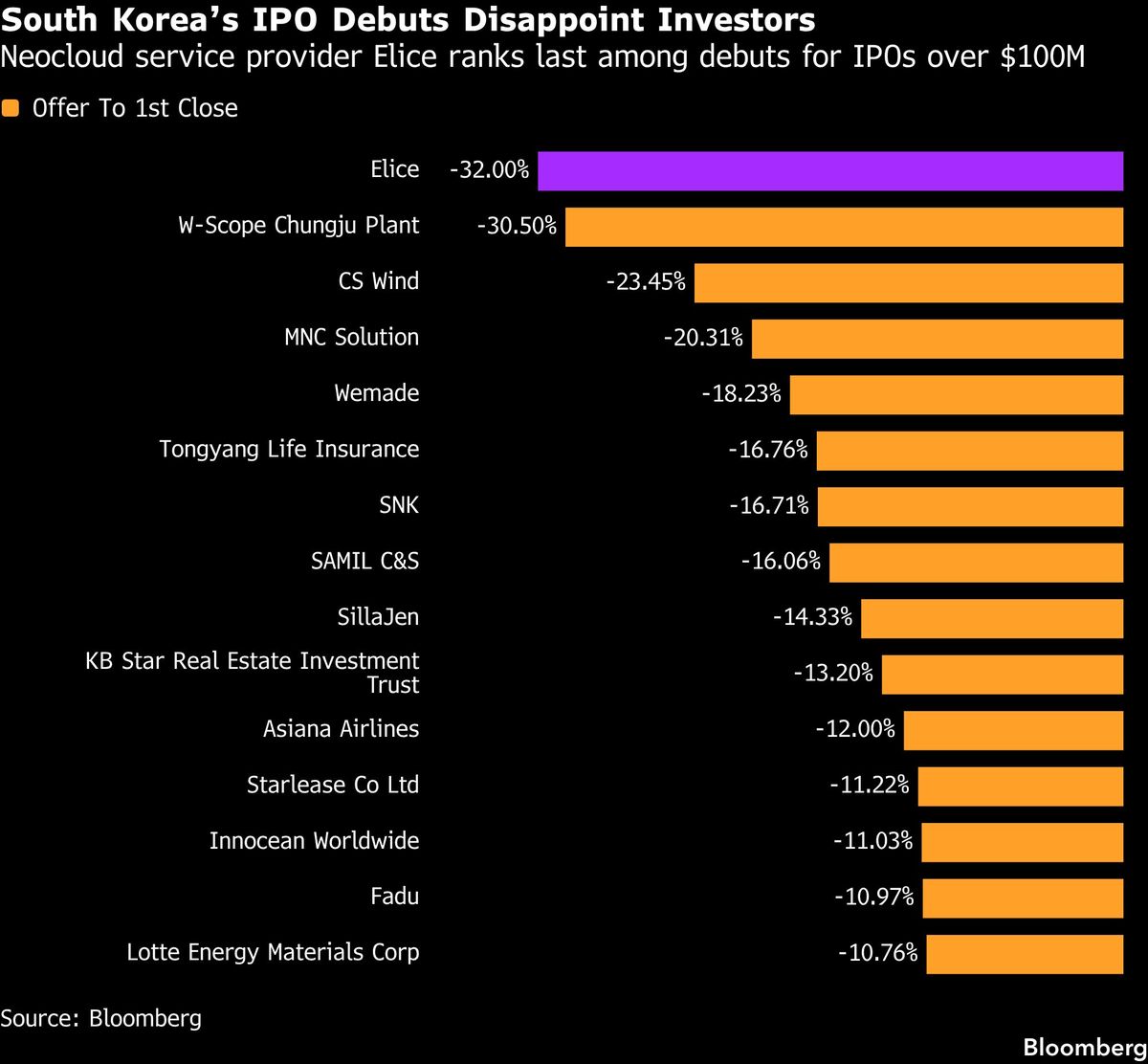
Elice was able to generate demand among South Korean retail investors, who poured roughly 10.3 trillion won into subscription deposits in hopes of buying shares.
The stock’s plunge sent shockwaves across South Korea’s retail investment community, known as ants. On Toss Securities’ popular mobile app, one poster shared an illustration of Alice — spelled similar to Elice in Korean — in Wonderland, smashing ants with a large hammer. “All ants are dying,” the post said above the illustration.
A user on X posted a screenshot of a 68,255 won position, down 24.75%, on the day, saying: “This is the first time I have lost money on an IPO.” Another investor wrote that the stock “ruined South Korean stocks and crypto”, to which a comment said “I just want Elice to go away to Wonderland”.
“Retail investors may have blindly believed that IPO stocks would always go up,” said Jo Hyunik, an investment division manager at Seoul-based Iroom Investment Advisors.
To win over investors, Elice touted a 200% surge in first-half revenue to 34.4 billion won, according to its prospectus. The company swung to an operating profit of 10.3 billion won, while earnings before interest, taxes, depreciation and amortisation jumped more than 11-fold to 23.2 billion won. The company is expected to record an 83% sales jump in 2026 and an operating margin of about 33%, analyst Douglas Kim wrote in a note on Smartkarma.
Elice’s financial structure is different from CoreWeave’s, and investors don’t need to view the company as “particularly risky”, said Kim Dojoon, the chief executive officer of Zian Investment Management. But, he added, “It remains to be seen whether the company can maintain its current profitability.”
A successful offering could have helped break an IPO drought in South Korea, where the primary market has been in the doldrums as fundraising surged across Asia. First-time listings in Seoul have raised US$1.4 billion in 2026, compared with more than US$3 billion in each of the previous three years, according to Bloomberg-compiled data. Meanwhile, SK Hynix Inc completed the biggest-ever US share sale by a foreign company.
Elice’s IPO was the biggest on the Kosdaq this year and surpassed in South Korea only by the US$337 million offering of K Bank Co in March.
Backed by venture capital firms including Vertex Ventures and Altos Ventures, Elice plans to use its IPO proceeds to build more AI data centres around South Korea and abroad, according to CEO Jae Won Kim.
“We are going all-in on becoming a full-stack AI infrastructure leader globally,” Kim said in an interview. “This IPO is about giving ourselves the financial firepower to execute.”
Uploaded by Tham Yek Lee