


(Oct 19): The European Union is considering strengthening the rules around a riskier form of insurance provided to the banking sector, as part of an upcoming package to broadly ease access to securitised finance.
Insurers participating in so-called unfunded significant risk transfers should meet a set of extra solvency criteria in order to ensure financial stability if policymakers back the most lenient bank-capital treatment for those products, according to an expert opinion for the European Commission seen by Bloomberg.
In preparation for a key meeting later this week, the executive cited the bailout of American International Group Inc during the 2008 financial crisis as a warning against loosening rules on credit protection too far. That episode showed how the unsecured insuring of credit risk can expose the financial sector to multiple risks when defaults spike, it said.
The EU, under the Irish government’s rotating presidency, is seeking to finalise a legal package seeking to boost the region’s ability to package and re-sell financial assets — a key element in its push to unleash fresh financing for goals including defence and climate resilience.
“We should not forget the case of AIG, which ran into serious difficulties during the 2008 financial crisis also linked to the use of unfunded credit protection,” the European Commission officials wrote in the note.
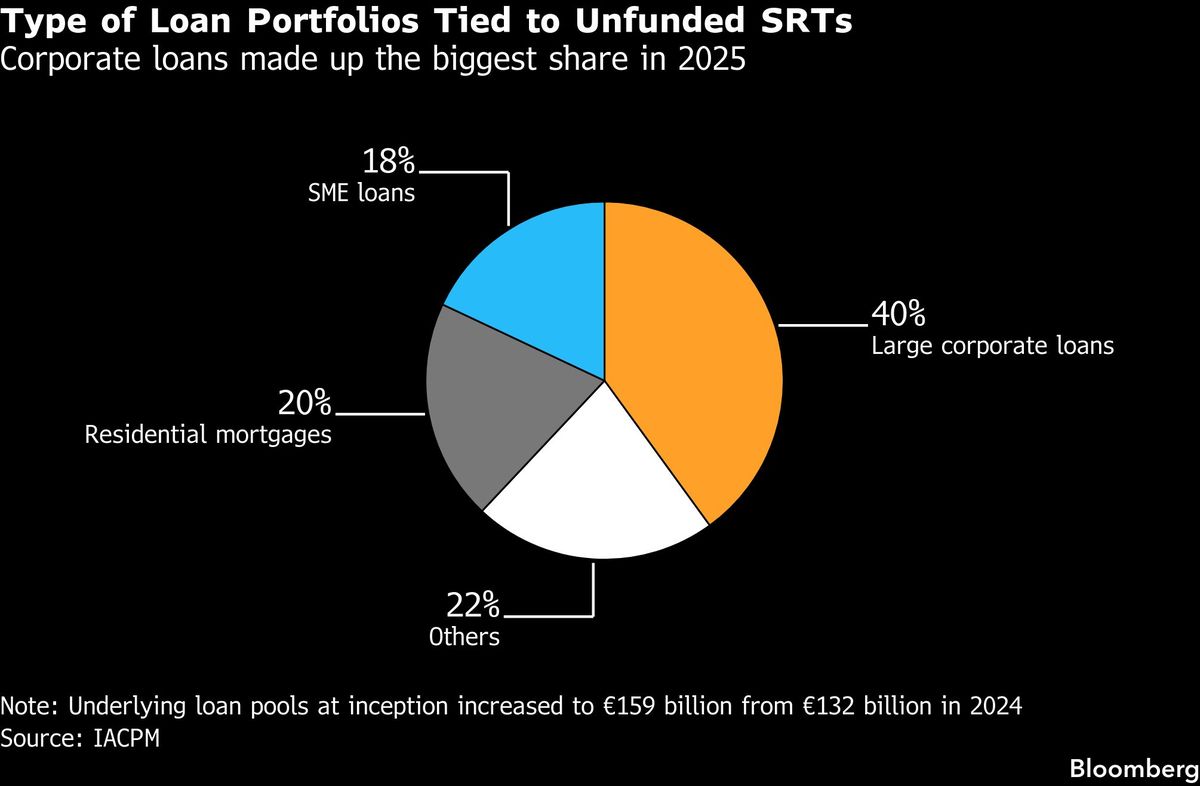
Insurance firms increasingly take part in the booming SRT market via unfunded credit protections, which essentially are commitments to cover losses on an earmarked bank’s loan portfolio. Munich Re AG, AXA SA, AXIS Capital and Liberty Mutual are among insurance firms investing in unfunded SRTs.
In contrast to funded SRTs — under which investors put up liquid assets for the bank to offset potential losses — unfunded credit protections leave the bank exposed to the insurer’s ability and willingness to pay for the loan losses.
Policymakers are balancing efforts to streamline rules with safeguards aimed at avoiding a European reprise of AIG’s liquidity crunch. The insurer had provided credit protection on hundreds of billions of dollars of fixed-income securities, including instruments linked to subprime mortgages.
“Outside the counterparty credit risk, unfunded protection can expose the bank to several other important risks, such as legal risk — where the protection provider may dispute whether the credit event covered by the protection has occurred — and settlement or liquidity risk, related to delayed compensations or payments by the protection provider,” the note said.
On top of complying with a set of credit quality and disclosure criteria generally required for certain SRTs to be deemed as “resilient,” — and therefore eligible for more lenient capital treatment — insurers providing such credit protections should have maintained their solvency ratios above certain levels during the previous three years, according to the note.
At least two protection providers have to take part in such transactions, which must include provisions to replace an insurer if a credit rating is downgraded below a minimum threshold, the note said.
Banking supervisors should also run assessments of the lenders’ concentration risk via their SRTs, the commission said.
The European Insurance and Occupational Pensions Authority and European Systemic Risk Board should also be mandated to assess the concentration risks at insurers and the potential impact for the EU financial system, the note said.
SRTs typically insure a first or junior portion of a portfolio in exchange for coupons that regularly exceed 10%. The senior portion of the securitisation is typically retained by the lender originating the loan portfolio.
The main difference between allowing certain unfunded credit protection to be deemed ‘resilient’ or not lies on the capital levels that banks need to set aside to cover unexpected losses on the senior tranche of the transaction, according to the note. That would determine whether a 5% risk floor — an indicator of the capital that banks need to set aside to cover unexpected losses — or 7% could be applied.
Insurers are aiming for a bigger slice of the market for SRTs this year as banks step up their use of the hedging instruments. Firms expect to participate in about 50% more SRTs than in 2025, according to a survey of 14 global insurers and reinsurers by the International Association of Credit Portfolio Managers released in August.
A representative for the European Commission declined to comment.
Uploaded by Evelyn Chan