

KUALA LUMPUR (Oct 19): The softer-than-expected inflation increase in September reinforced economists' expectations that Bank Negara Malaysia (BNM) will keep interest rates unchanged next month.
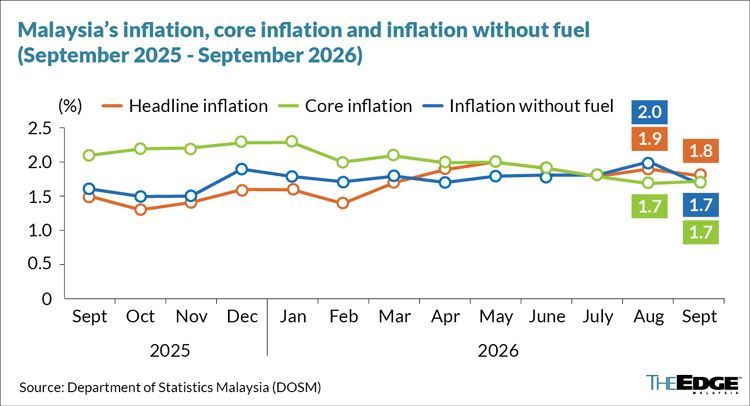
September’s consumer price index (CPI), the final inflation reading before BNM’s Nov 5 policy decision, rose 1.8% year-on-year (y-o-y), below August’s 1.9% increase and the median forecast of 1.9% in a Bloomberg survey.
Pantheon Macroeconomics expects a prolonged hold in the overnight policy rate (OPR) at 2.75%, while RHB Research anticipates a 25-basis-point increase only in the first half of 2027. UOB Global Economics & Markets Research, however, forecasts the rate reaching 3% in the fourth quarter of this year.
“On the surface, September’s (inflation) data does not seem worrying,” Pantheon Asia economist Meekita Gupta said in a note on Monday. “For now, core inflation is at bay, holding steady at 1.7%. We are sticking to our call for a prolonged rate hold.”
The September inflation slowdown came on the backs of softer food inflation and easing housing and utility price pressures, which offset stronger transport inflation. Housing, water, electricity, gas and other fuels inflation eased to 1.4% from 2.1%, while transport inflation accelerated to 2.5% from 2%.
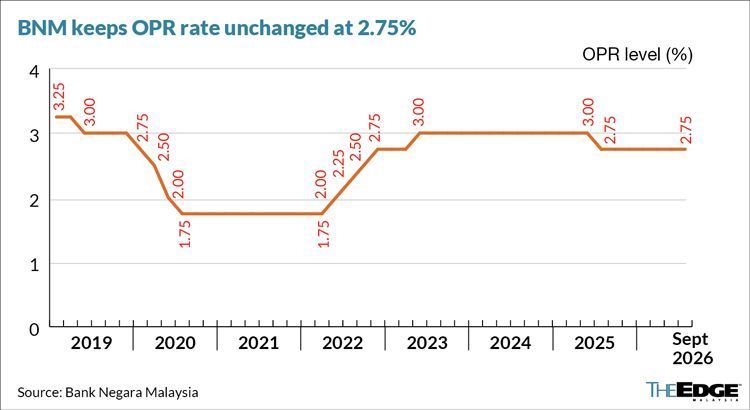
BNM last cut the OPR by 25 basis points to 2.75% in July 2025. The rate remained at that level at its latest review in September.
“Robust economic prospects and manageable inflation should support a broad policy stance in the near term, with no immediate need for further rate adjustments,” RHB senior economist Chin Yee Sian said.
Chin expects a 25-basis-point hike by the first half of next year as a move towards a more neutral policy setting, “rather than a response to significant inflationary pressures”. Such a move would be supported by resilient growth and give BNM greater room to respond to future shocks, he added.
UOB economists Julia Goh and Loke Siew Ting, took a different view on timing, arguing that stronger-than-expected third-quarter growth and an expansionary Budget 2027 reinforced the case for a rate increase. Higher minimum wages, larger cash transfers, tax reductions and tax relief measures pointed to resilient domestic demand heading into 2027, they said.
“This reinforces the case for a gradual policy normalisation by BNM, which we expect could be initiated as early as the upcoming Monetary Policy Committee (MPC) meeting on Nov 5.”
They also cited the BNM governor’s Oct 15 remarks as indicating greater flexibility to adjust rates following September’s change in forward guidance, alongside a readiness to respond if inflationary pressures intensified.
The Finance Ministry projects inflation of 1.5%-2.5% this year and 1.8%-2.8% next year. The remaining performance for the last three months of the year, however, is still subject to global commodity price movements, domestic policy adjustments and potential upside risks from food prices due to El Niño-related weather disruptions.
Chin said price controls, subsidies and a relatively stable ringgit should cushion the transmission of higher commodity and production costs to consumers. Nevertheless, disruptions to shipping through the Strait of Hormuz and elevated energy prices are ongoing risks.
RHB also warned that El Niño-related disruptions and prolonged dry conditions could reduce agricultural yields, particularly for rice and oil palm, adding to food price pressures into 2027.