

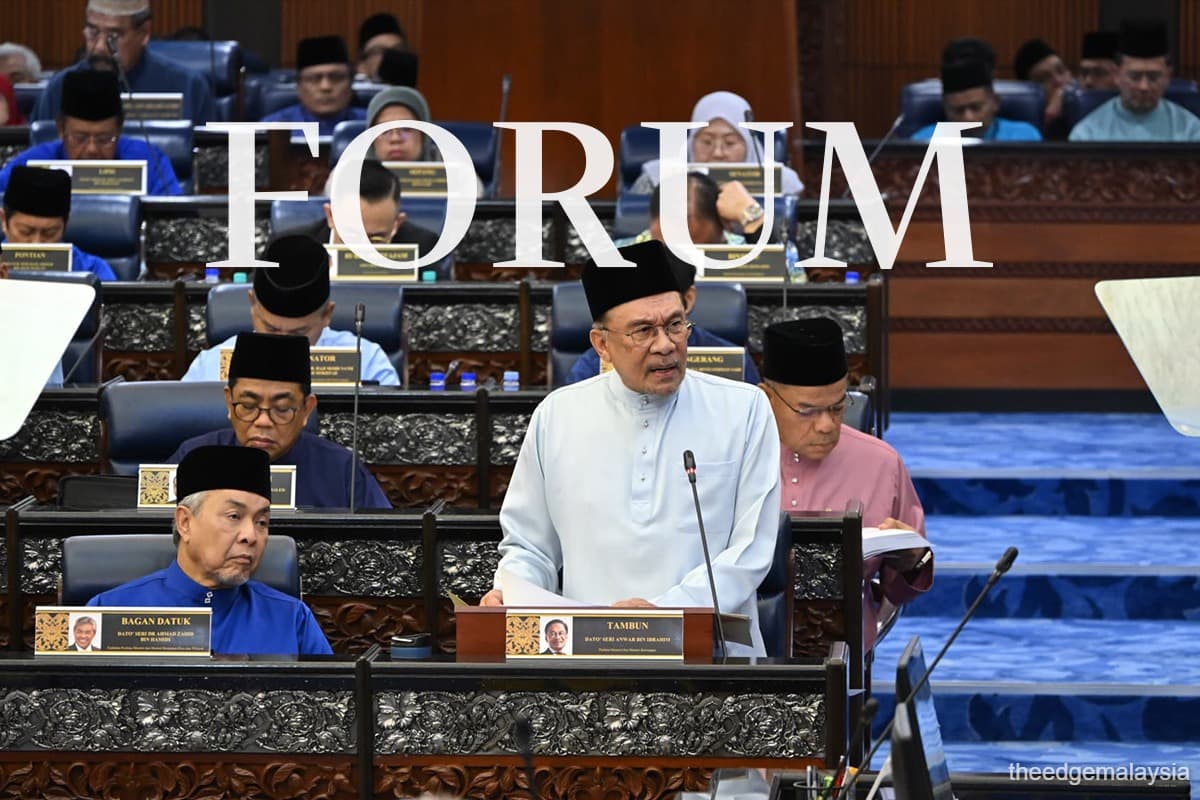
This article first appeared in Forum, The Edge Malaysia Weekly on October 19, 2026 - October 25, 2026

The intention of the budget is to set the framework in terms of moving the economy in the direction set out in the five-year economic plans. The government does not owe us a living. It is required to facilitate the environment for us to operate in it and do so with prudent management, solid infrastructure and reliable laws.
Tax changes
We have seen personal reliefs being expanded and widened in Budget 2027, in particular to cover more healthcare costs in terms of caregiving to parents and the elderly. All these are illusionary changes, as the amount of the relief did not increase.
So, the real benefit is the relief for self/dependants being increased from RM9,000 to RM12,000 and the personal income tax rate being lowered by 1% for the income range of RM70,000 to RM150,000. For higher income earners, the moment you cross the RM1 million mark, you now pay 30% instead of 28%, as the 30% had applied only to income exceeding RM2 million.
For small and medium enterprises (SMEs), we see the tax rate down by 1% for income up to RM600,000. We see some improvements in terms of the sales and service tax (SST) reduction for elderly care services as a way of managing the cost-of-living conundrum. The greater work of trying to incorporate goods and services tax elements within the SST will take a much longer timeframe but, essentially, what can be done is to grant exemptions or credits for some goods/services, and that needs a clear focus on who really needs it.
Allocations
The various allocations to businesses for digitisation and improving the skills of workers and guarantee schemes continue to be provided. Who measures the success of these allocations? Why do all these allocations get paid out so fast? Do they really reach those who need it? Is the paperwork involved too onerous?
Tax administration
We should see a greater focus in terms of the tax administration being given the capacity to generate more revenue, as the Inland Revenue Board and the Royal Customs Department can do more in terms of using data analytics and artificial intelligence (AI) as well as enhancing e-invoicing. The customs authorities need to continue reducing leakages in excise duties and import duties. The area of stamp duty administration will continue to be enhanced. There is considerable upside in strengthening tax administration through data, technology and compliance measures. So, the immediate priority is to strengthen tax administration through e-invoice data, analytics and risk-based enforcement while continuing efforts to improve voluntary compliance.
As many have stated, the principle is to collect what is legally due, spending it responsibly and removing avoidable distortions before asking taxpayers to contribute more.
Overall summation
As expected, the budget is mildly expansionary and meant to be friendly to the people. The tax of 2% on dividends exceeding RM100,000 is likely to be increased in the future by way of widening its scope in terms of a lowered threshold and an increase in the rate. The capital gains tax (CGT) may also have the capacity to be widened in scope in the near future.
Personal reliefs should be managed better because we have too many. A suggestion is to consolidate such personal reliefs into three or four categories instead of the large number that currently exist. We need to make it simpler, easier to claim and not being required to support a claim. We can just refer to one’s personal economic circumstances, and a specific total amount of relief can be given to that taxpayer.
Recommendations
Incentives given to companies should be tracked to ensure that benefits such as creating high-paying jobs are realised. Will this be done robustly?
A long-term plan for raising the minimum wage is needed. Why do we wait to announce this in the budget? Announce a plan, which of course can be subject to change due to various factors. Businesses need predictability and consistent application of policies.
Unchecked continuation of broad-based assistance will limit spending on other priority areas. Sustaining a large subsidy bill over the long term is unsustainable and will put pressure on the fiscal space. Only provide subsidies to those really in need. All aid must be targeted and focused.
A lot of tax reforms have been initiated over the years, such as widening the SST, introducing CGT, the tax identification number, e-invoicing, the global minimum tax and the stamp duty self-assessment system. The challenge is how can reforms be implemented in a way that achieves policy objectives while remaining practical to taxpayers. Implementation readiness must be viewed as a strategic priority rather than a post-policy consideration.
Early engagement, clear communication, practical guidance, sufficient lead time and adaptability is critical as we have seen in the launch of e-invoicing and the expansion of the SST.
Tax reform is a change management exercise involving businesses, taxpayers and government agencies. Implementation readiness must be taken into consideration from the outset when designing any new tax measure. This involves anticipating and addressing resource needs, costs, reasonableness of implementation timelines and practical challenges that segments of taxpayers may face. Stakeholder engagement is essential and co-creating a journey is the desired path. Testing via a pilot programme should be done — it is all about certainty and confidence building and making things seamless.
Conclusion
We do not pay taxes for government agencies to squander for the benefit of a few. The public is getting tired of the wastage via corruption and misuse. When will we see the accountability and trust being repaid by politicians and agencies to the rakyat?
Dr Veerinderjeet Singh has been in the tax field for 46 years and has advised clients, organisations and the government as well as been involved in international agencies
Save by subscribing to us for your print and/or digital copy.
P/S: The Edge is also available on Apple's App Store and Android's Google Play.