

(Oct 19): China’s central bank signalled its overnight reverse repurchase rate will replace the current seven-day rate as the new policy benchmark, in another step that aligns it closer with global peers and has the potential to push down borrowing costs.
The People’s Bank of China (PBOC) will study the possibility of switching the main tenor of its open market operations to the overnight one at an appropriate time, Governor Pan Gongsheng said at the Financial Street Forum in Beijing Monday, according to a newspaper affiliated with the PBOC. Once that happens, the overnight reverse repo rate will become its primary policy lever, the Financial News cited him as saying.
With the rate on new overnight reverse repo transactions set at 1.25% in June, some economists will see the switchover as effectively a rate cut given it’s lower than the current seven-day benchmark. Prior to the announcement, Huatai Securities analysts led by Zhang Jiqiang wrote that such a shift would “function as a de facto rate cut”.
Overnight repos are the most heavily traded product in the interbank money market and their rate, known as DR001, has already become the target of the PBOC’s operations, the Financial News cited Pan as saying. The agreements reflect the cost for banks to borrow from one another overnight by using bonds as collateral.
Xing Zhaopeng, senior China strategist at Australia & New Zealand Banking Group Ltd, said the latest decision “will substantially change the policy framework and the market”, though the level of the rate remains unclear.
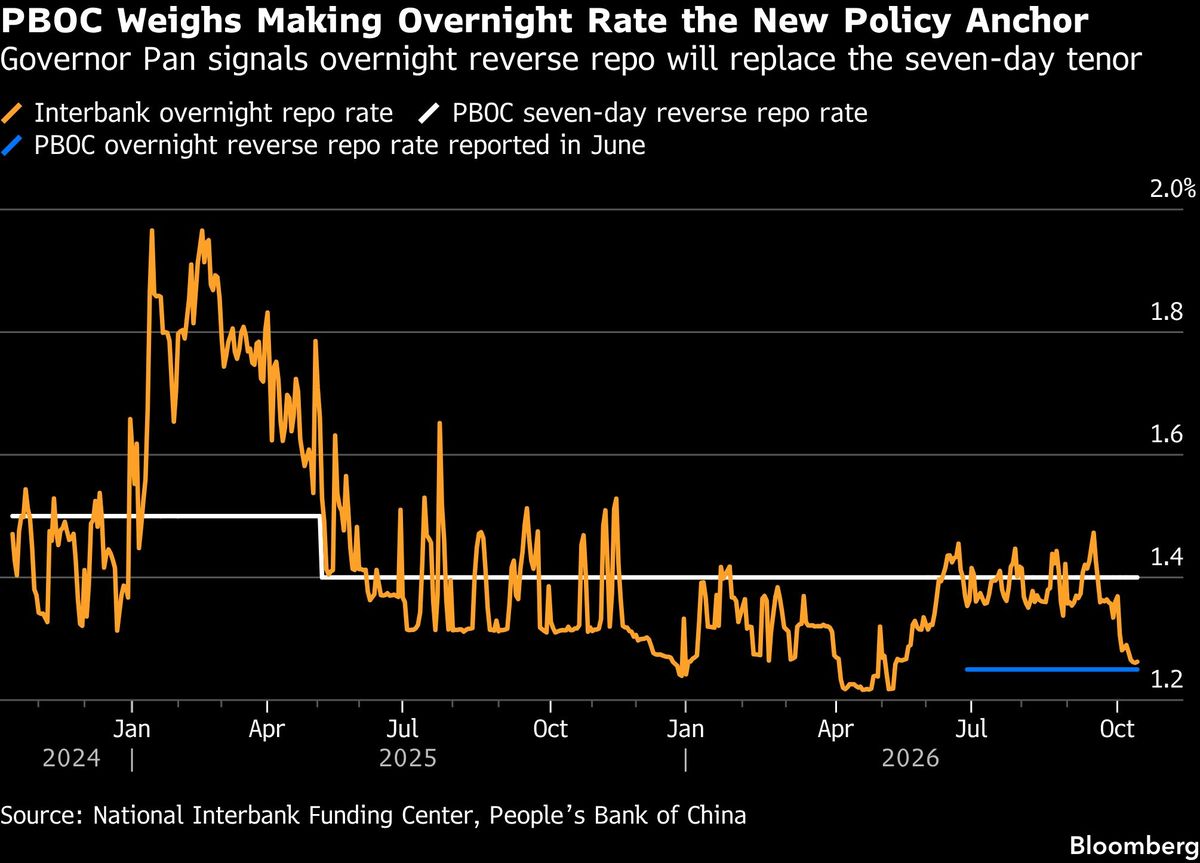
“The current rate corridors will be re-calibrated” if the overnight reverse repo rate is lower than 1.4%, he said. Since the interbank overnight repo rate is now below 1.3%, it’s possible the overnight reverse repo rate could be at 1.25%, according to Xing.
The overnight repo rate was steady at 1.26% following the news. The yuan rose 0.1% to 6.6813 per dollar in the offshore market, holding on to an earlier gain. Yields on the government’s 10-year and 30-year bonds were little changed at 1.64% and 2.06%, respectively.
The PBOC first introduced an overnight tenor to its open market operations in June in a key move to expand its short-term liquidity toolkit. The decision has fuelled speculation that the overnight rate will play a greater role and eventually become the main policy benchmark to anchor market borrowing costs.
Such an approach would make the PBOC operate more like other major central banks, which tend to treat overnight market rates as the main target of policy operations.
The costs of overnight borrowing among banks have dropped below 1.3% in October to their lowest level since May, widening their gap against the seven-day reverse repo rate. The recent declines in market rates reflect expectations of a transition in China’s monetary policy anchor, according to analysts.
The central bank has conducted overnight reverse repo operations every month from June to September, and their frequency as well as volume offered have been on the rise. The transactions have helped address market demand for funds during month-end payments or tax payment times.
Along with the policy rate, Pan also called for a transition in the system for pricing bank loans and other financial products.
Companies with strong financials can negotiate with banks and choose the interbank overnight repo rate as the benchmark for pricing their loans, he said. The loan prime rate, or LPR — which banks previously relied on for determining the cost of borrowing — can still be used when it comes to loans to small businesses and individuals, according to Pan.
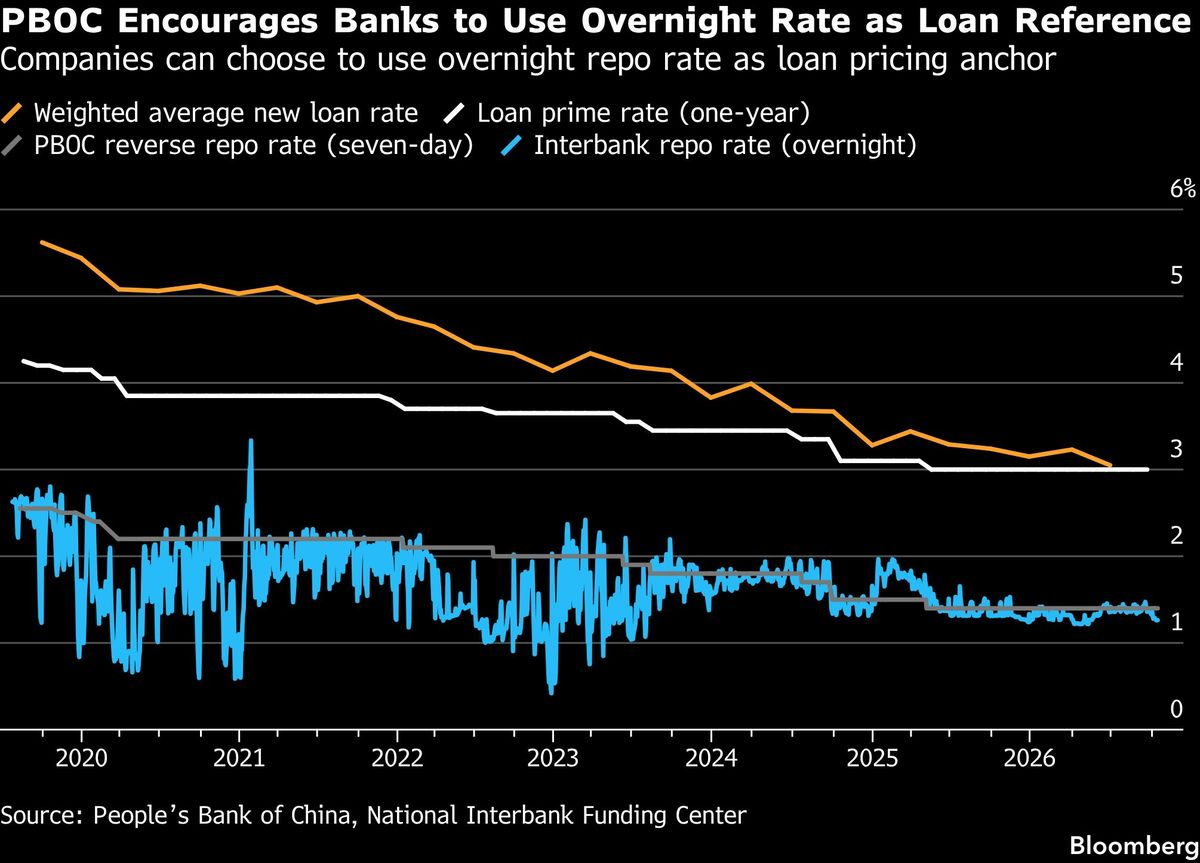
Bonds and other derivatives could also reference the repo rate, and the PBOC will publish a guidance document in the future to help financial institutions complete the transition, Pan said.
The LPR has become increasingly rigid and detached from market reality. Starting in July, several banks have experimented with anchoring their new loans to interbank rates.
The PBOC will also set up a new liquidity tool to help non-bank financial institutions deal with large amounts of redemption requests from clients, Pan said. The joint effort with the financial and stock regulators is meant to establish a mechanism to stabilise the bond market and prevent a negative loop of sell-offs and the risk of liquidity squeeze, he said, according to the Financial News.
Uploaded by Chng Shear Lane