


This article first appeared in Forum, The Edge Malaysia Weekly on October 19, 2026 - October 25, 2026

Budget 2027 sends two important signals. To households and micro, small and medium enterprises (MSMEs), it demonstrates that the government is responsive to rising living and business costs. To investors, it reaffirms Malaysia’s commitment to fiscal consolidation, reinforcing confidence in the country’s economic position.
The government is targeting a fiscal deficit of 3.3% of gross domestic product (GDP) in 2027, down from a revised 3.6% in 2026. More than RM80 billion has been allocated for subsidies, assistance and incentives, including RM40 billion to maintain fuel subsidies. The allocation for Sumbangan Tunai Rahmah (STR) and Sumbangan Asas Rahmah (Sara) will rise from RM15 billion to RM16 billion.
The government has also included tax measures for households and MSMEs. Individual tax relief will increase from RM9,000 to RM12,000, while tax rates for selected middle-income bands will be reduced by one percentage point. Other reliefs covering health and well-being, parental care, education, skills training and lifestyle expenses will also be enhanced. For qualifying MSMEs, the tax rates on the first RM150,000 and the next RM450,000 of chargeable income will be reduced to 14% and 16%, respectively. These Budget 2027 tax measures will provide welcome support to households and MSMEs and are expected to cost circa RM3 billion.
Where will the revenue come from?
The revenue projections provide useful insight into how the government intends to fund its commitments without introducing new taxes or increasing existing headline tax rates.
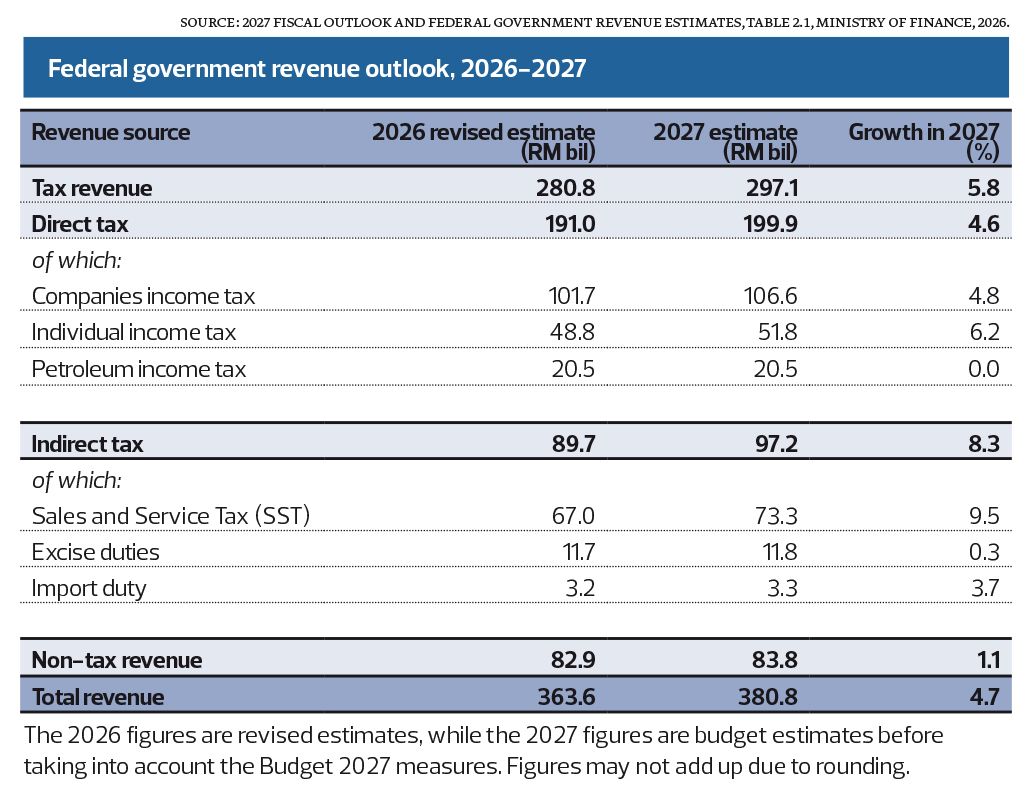
Tax revenue is expected to grow by 5.8%, faster than projected real GDP growth of 4.2% to 5.2%, while total federal government revenue is forecast to grow by 4.7%. This suggests that the revenue strategy for 2027 rests on three main pillars: continued economic growth, the effect of earlier tax reforms and stronger tax compliance and enforcement.
In the absence of significant additional non-tax revenue, stronger tax compliance and enforcement may therefore assume greater importance in bridging the RM3 billion funding gap arising from the Budget 2027 measures.
The strongest growth is expected in indirect taxes. Indirect tax revenue is forecast to increase by 8.3% to RM97.2 billion, led by a 9.5% rise in sales and service tax (SST) revenue to RM73.3 billion. This is likely based on expected steady consumption, potentially supported by the additional cash flow available to individuals and MSMEs arising from the abovementioned reductions in tax rates and expansions of personal reliefs, and the continuing effect of the SST expansion implemented in July 2025. The projected SST growth demonstrates the fiscal significance of broadening the scope of an existing tax, even without raising its headline rates in Budget 2027.
Individual income tax revenue is projected to increase by 6.2% to RM51.8 billion. The forecast appears to be underpinned by expectations of continued growth in employment income, favourable labour market conditions and ongoing improvements in tax compliance and collection efficiency. As the estimates in the table above were prepared before taking into account the Budget 2027 measures, the projected increase does not reflect the impact of the newly announced 30% tax rate on chargeable income exceeding RM1 million, nor the reductions in tax rates and enhancements to personal tax reliefs.
From e-Invoicing to data-driven enforcement
The less visible part of the budget but increasingly important part of the revenue strategy is tax administration.
By the end of August 2026, more than 265,000 taxpayers had submitted over 1.8 billion e-Invoices, creating a large and structured pool of transaction-level data for the Inland Revenue Board of Malaysia (LHDN). It enables the LHDN to compare information across businesses, identify inconsistencies and develop more accurate risk profiles.
This should allow the LHDN and Royal Malaysian Customs Department to conduct more targeted audits, particularly on taxpayers, sectors and transactions displaying higher-risk characteristics. At the same time, the visibility created by e-Invoicing should encourage voluntary compliance because transactions that previously sat outside the tax authorities’ field of view become easier to identify.
Businesses should therefore view e-Invoicing not merely as a reporting requirement, but as a significant change in the tax risk environment. Strong tax governance, reliable data and documented tax positions will become increasingly important.
The LHDN’s Tax Corporate Governance Framework reflects the broader direction of Malaysia’s tax system towards greater transparency, accountability and proactive compliance. While participation remains voluntary, businesses with strong tax governance practices will benefit from a more constructive relationship with the tax authorities and greater certainty in managing tax matters. As tax administration becomes increasingly data-driven and risk-focused, sound tax governance will become an expected feature of responsible corporate behaviour, particularly for larger taxpayers.
Investment income and petroleum income tax remain important contributors to government’s revenue
Non-tax revenue will also remain important. According to the 2027 Fiscal Outlook and Federal Government Revenue Estimates, investment income in 2027 is projected to include contributions from Petroliam Nasional Bhd of RM32 billion and Bank Negara Malaysia of RM7 billion.
Petroleum income tax collections are projected to remain broadly flat in 2027, amid expectations of more moderate oil prices. The government also expects fuel subsidy expenditure to remain at around RM40 billion despite the increase in subsidised fuel quotas from 200 litres to 300 litres per person.
The longer-term question
The International Monetary Fund’s recent assessment of Malaysia welcomed the progress in fiscal consolidation but also highlighted the importance of building fiscal buffers through sustainable revenue and expenditure measures.
Budget 2027 does not reintroduce the goods and services tax or introduce a hybrid GST–SST system with an input tax credit mechanism, which was widely speculated. Instead, it proposes targeted improvements to the existing SST regime, including a sales tax refund facility for certain transactions. This reflects the government’s preference, at least for now, to refine the current indirect tax system.
Over the longer term, Malaysia may still need to evaluate how subsidies can become more targeted, how the tax base can be broadened fairly and how future revenue reforms can be implemented without undermining economic competitiveness. The objective should not simply be to collect or spend more, but to build a fiscal system capable of supporting Malaysians today while preserving sufficient room to respond to tomorrow’s challenges.
Yeo Eng Ping is the EY Asia East tax leader and partner at Ernst & Young Tax Consultants Sdn Bhd
Save by subscribing to us for your print and/or digital copy.
P/S: The Edge is also available on Apple's App Store and Android's Google Play.