

(Oct 17): Wall Street has spent the year betting on staggering artificial intelligence (AI) growth while worrying about stubborn inflation. This week, investors got a fresh taste of both risks: a deepening rout in the AI complex that reached into its debt financing, and oil at US$110 a barrel threatening to make inflation harder to contain.
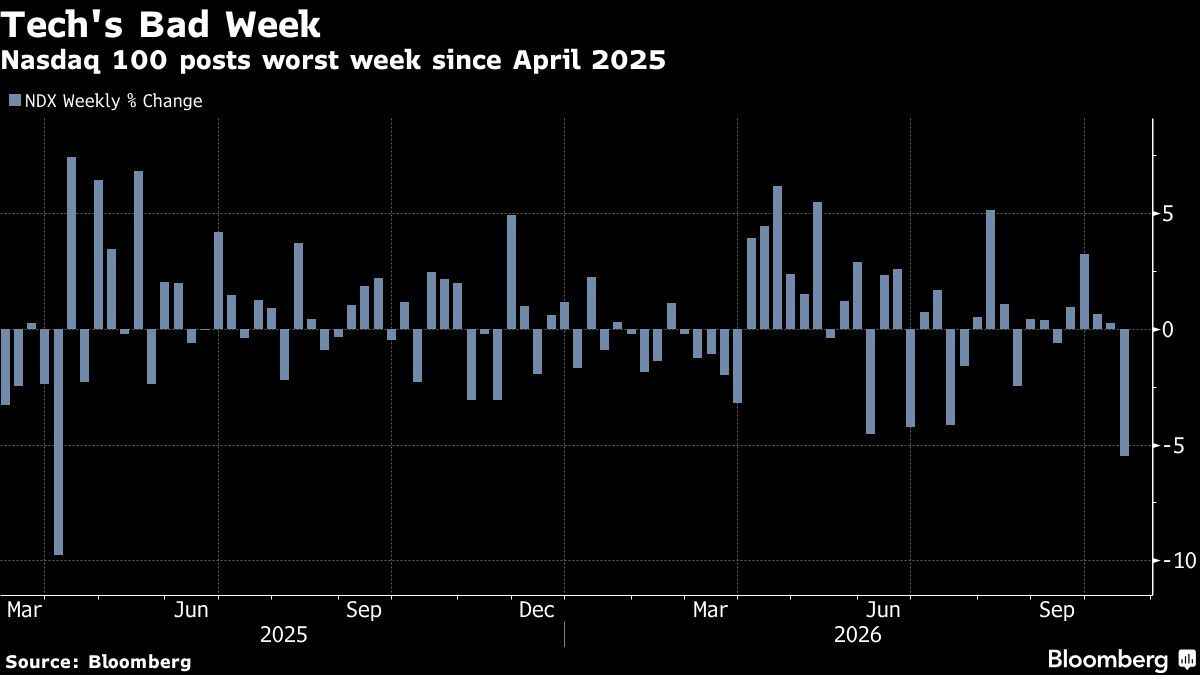
The pressure gathered force across the sprawling AI complex, from chipmakers and data-centre suppliers to the heavily indebted companies building the infrastructure. Bonds of neocloud provider CoreWeave Inc sank to levels signalling distress as investors questioned whether AI demand and revenues could justify the trillions of dollars being poured into computing capacity. An eight-session rout in semiconductor shares — the longest since 2008 — wiped roughly 16% off the sector’s benchmark. The VIX spiked and the Nasdaq 100 lost 5.5% for its worst week since the April 2025 tariff turmoil.
Until Friday, the unlikely winner was Treasuries. Two hotter-than-expected inflation reports couldn’t stop investors rushing into government debt when stocks tumbled. Oil’s surge to its highest level since May briefly sent yields climbing again on Friday, exposing the tension between demand for safety and renewed inflation fears. Still, long-dated government debt, as measured by the TLT ETF, saw one of its strongest weeks of the year.
The angst over one of the biggest investment booms in history is hardly new. What shifted this week is the mainstream scrutiny over the trillion-dollar borrowings behind it. The gap between spending today and returns tomorrow is getting harder to overlook. Fears of slowing AI growth are colliding just as elevated energy prices are fuelling borrowing costs higher.
“A lot of the concern is about how much money the hyperscalers are borrowing — they’ve gone through huge amounts of cash flow before needing to borrow,” said Dennis Follmer, chief investment officer at Montis Financial, which oversees roughly US$1.4 billion (RM5.72 billion). “I do think that’s going to cause some trouble down the road.”
Follmer has been cutting his exposure to US large-cap stocks and spreading risk more widely. His team has shifted toward the equal-weighted S&P 500 through the RSP ETF and increased allocations to international and private markets. He has been reducing duration risk, replacing some conventional fixed-income holdings with catastrophe bonds.
This week’s volatility tested two convictions: that AI would keep delivering extraordinary growth, and stubborn inflation would keep Treasury yields moving only in one direction. In Bank of America’s October fund-manager survey, 45% of respondents identified long global semiconductors as the most crowded trade, down from 82% in July. Short Treasuries ranked second, at 27%, up from 18% the previous month. Both positions came under pressure when AI-driven markets swung.
Still, there’s been no indiscriminate flight from risk. Broad investment-grade credit spreads held near the tight end of their five-year range, while ETF investors found reasons to buy the dip.
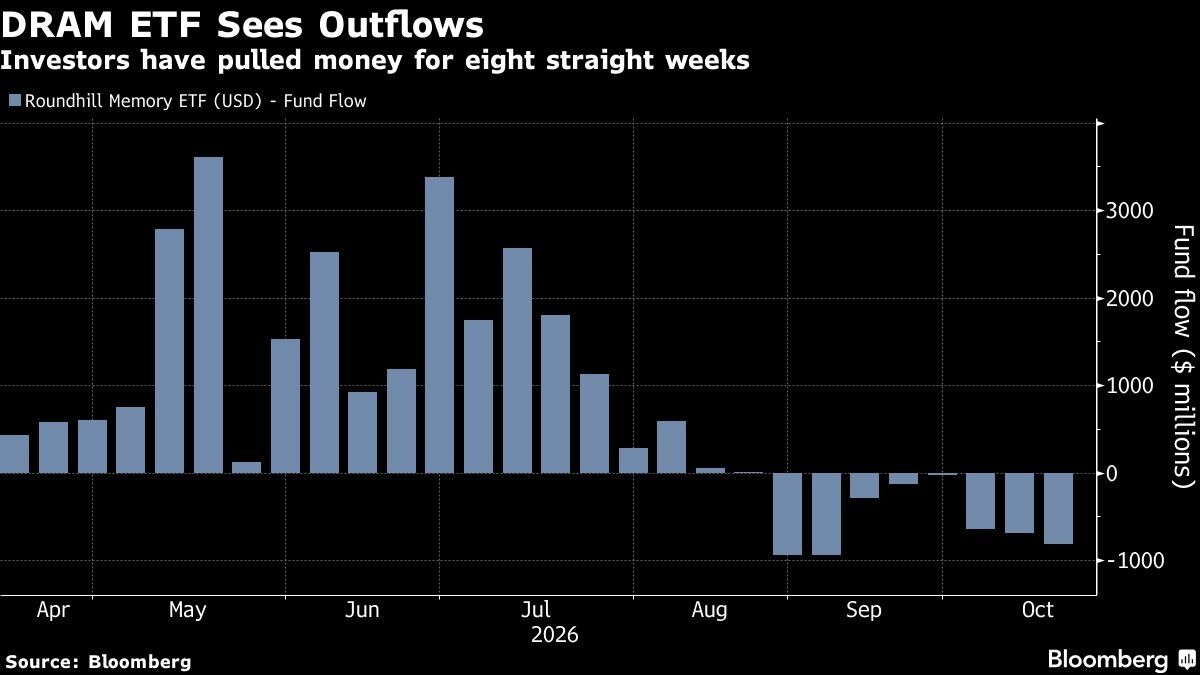
But the punishment was especially severe in investment strategies offering concentrated bets on the AI boom. The popular DRAM memory fund, whose biggest holdings include Samsung Electronics Co and SK Hynix Inc, fell 19%, its steepest weekly loss since launching in April, extending a run of eight consecutive weeks of outflows. Korea-centred chip funds, photonics plays and computing-focused vehicles also recorded double-digit declines.
“Markets priced in bubble valuations for AI companies — that bubble is starting to deflate,” said JonesTrading Chief Market Strategist Michael O’Rourke.
The next test comes with earnings, when investors will get a clearer look at whether AI revenues are keeping pace with spending. Oil’s surge, meanwhile, threatens to sustain inflation pressures and complicate the Federal Reserve’s next move. The approaching US midterm elections add another element of uncertainty for investors positioning across stocks, bonds and credit.
JPMorgan strategists say the setup for AI looks less favourable than it did during July’s sell-off, citing weaker retail buying, a smaller base of short positions that could fuel a rebound and less support from corporate buybacks.
Others are finding opportunities in the damage. Cathie Wood’s ARK Investment Management added shares of CoreWeave and Cerebras Systems Inc Wood has compared the anxiety over CoreWeave’s borrowing costs with an earlier period of distress in Coinbase Global Inc’s bonds, before the cryptocurrency exchange benefited from the industry’s growth.
Keith Lerner, chief investment officer at Truist Advisory Services, is also sticking with technology. His team remains overweight the sector, arguing that much of the bad news has already been reflected in share prices and that some valuations are near the low end of their historical range.
Mark Malek, chief investment officer of Siebert Financial, sees the pressure on neocloud financing as a potentially “very uncomfortable bump in the road” for the broader technology sector. “Now we see financing itself is going to become one of those scarcities that is going to impact the supply chain,” Malek said.
Yet Malek’s team remains invested in the industry’s longer-term growth. “This is part of a coming-of-age for any industry,” he said.
Uploaded by Chng Shear Lane