


This article first appeared in City & Country, The Edge Malaysia Weekly on October 19, 2026 - October 25, 2026
Penang’s residential market is seeing resilient demand, supported by an active industrial sector that is driving housing demand, although buyers remain cautious in their spending, according to Nawawi Tie Leung Property Consultants Sdn Bhd executive director and regional head of research and consulting Saleha Yusoff.
Presenting The Edge Malaysia | Nawawi Tie Leung Property Consultants Penang Housing Property Monitor 2Q2026, she says: “Penang’s property market remained relatively stable in 2Q2026, underpinned by the state’s resilient manufacturing and semiconductor ecosystem, continued investment in high-value industries, and progress on major infrastructure projects.
“However, market performance remained uneven across sectors, with industrial properties continuing to show stronger fundamentals while residential buyers remained more cautious and price-sensitive.”
She notes that expansion of the industrial sector has driven increased demand for residential property, particularly around Bayan Lepas, Batu Kawan, Valdor and parts of Seberang Perai. She says, however, that buyers are becoming increasingly selective, with affordability being a key consideration.
“Buyers are generally taking more time to compare projects, locations and pricing before committing to purchases. As a result, demand remains more resilient for properties that are competitively priced, located close to employment centres and established amenities, or offer a clear value proposition,” says Saleha.

On the island, the secondary market in mature locations has benefited from limited supply, while high-rise options face greater competition from existing and future supply. As a result, developers have become more selective when it comes to new launches, product positioning and pricing. Moreover, rising development and construction costs put upward pressure on pricing for new launches.
Meanwhile, ongoing infrastructure projects, such as the Mutiara LRT Line and the expansion of Penang International Airport, will remain important long-term catalysts, strengthening the state’s connectivity and supporting further growth in tourism, business travel and investment, says Saleha.
“Overall, we expect Penang’s property market to remain relatively stable, supported by strong economic fundamentals and continued investment in the manufacturing and technology sectors.
“Demand should remain resilient in areas supported by clear economic or lifestyle drivers, particularly those close to employment centres, established amenities and improving infrastructure.”
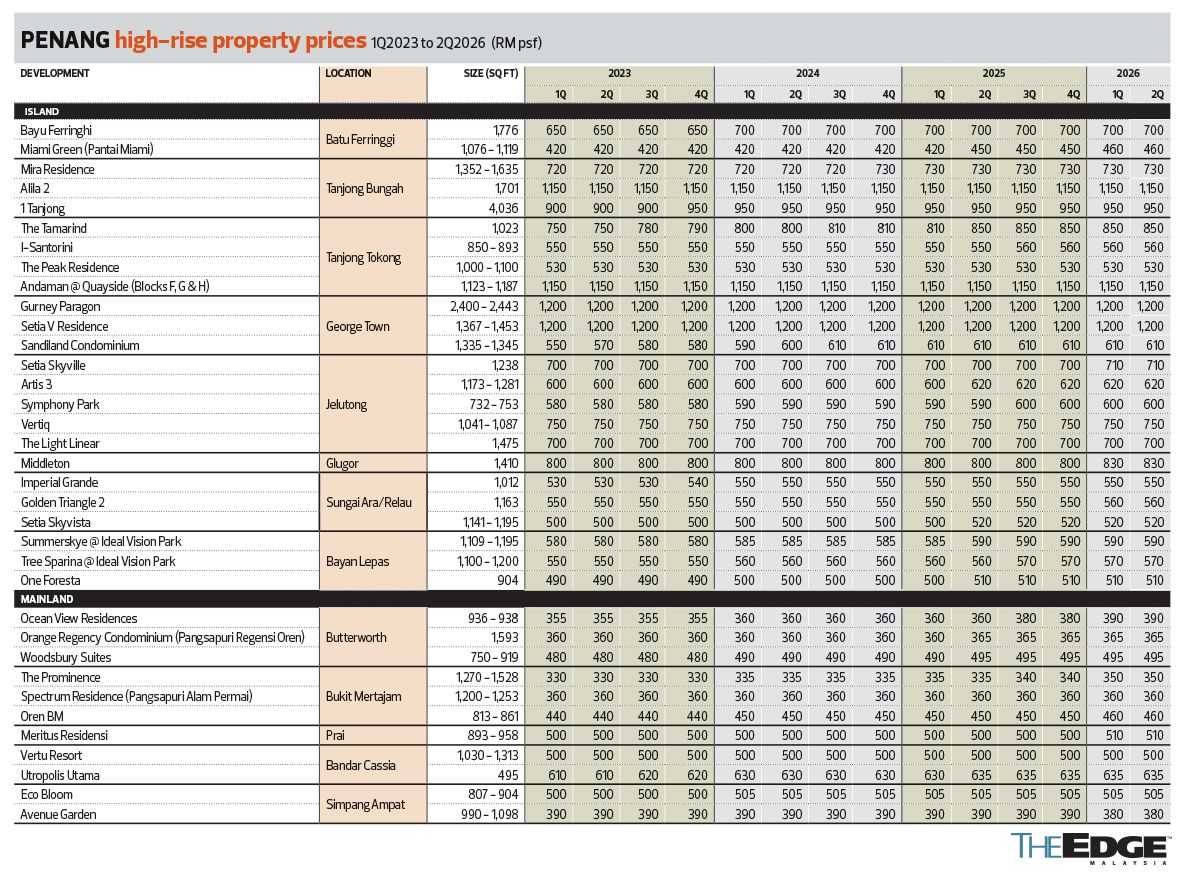
Landed homes
Landed home prices on the island were largely unchanged quarter on quarter (q-o-q), with only marginal movements year on year (y-o-y).
The best performers were terraced houses in Island Glades, in the Jelutong/Greenland area, where prices held steady q-o-q but rose 7% y-o-y to RM800 psf.
“The increase in the average transacted price y-o-y reflects the continued resilience of landed residential properties, especially terraced houses in mature neighbourhoods with limited properties available for sale,” says Saleha.
She notes that the neighbourhood’s maturity and central location are key strengths, alongside the scarcity of landed homes.
“There is very limited new supply of landed housing within the Jelutong-Green Lane corridor, particularly in established neighbourhoods with existing amenities and good connectivity. This scarcity continues to underpin property values,” says Saleha.
“The area also has a strong owner-occupier base. Its accessibility to George Town, Bayan Lepas, the Penang Bridge and established schools, healthcare and retail amenities makes it attractive to families looking for a long-term home rather than investors seeking a purely an investment property.”
Island Park semi-detached homes, meanwhile, saw prices dip 2% q-o-q to RM530 psf from RM540 psf, and 5% y-o-y from RM560 psf.
Saleha says: “These are only marginal changes and may reflect negotiations between buyers and sellers rather than a weakening in residential values in Island Park. The transaction may have involved an older unit requiring refurbishment, giving the buyer greater room to negotiate.”
Aside from this outlier, the next y-o-y mover in the monitor were terraced homes at Tree Residency in Bayan Lepas, which rose 5% to RM1,000 psf.
“There have been limited transactions at Tree Residency. The marginal price increase is likely to have been driven by the passage of time and limited supply,” says Saleha.
The other performers in the monitor were terraced houses in Setia Pearl Island at RM755 psf and Southbay Residence at RM750 psf, both of which rose 3% y-o-y.
On the mainland, landed home prices were unchanged q-o-q, with modest y-o-y gains in selected areas. Semi-detached homes in Bandar Putra Bernam and Taman Villa Mutiara Indah rose 4% y-o-y, to RM240 psf from RM230 psf and RM260 psf from RM250 psf, respectively.
Saleha says Bandar Putra Bernam benefits from the continued development in Bertam and the wider northern Seberang Perai corridor.
“Growing economic and employment activity in the area, including industrial development around Bertam, provides an underlying demand base for housing. The creation of jobs and supporting industries has strengthened housing demand from both owner-occupiers and those seeking homes closer to their workplaces, which in turn has helped support property values within the township.”
She adds that affordability also plays a role in demand because of the lower entry price on the mainland compared with the island.
Saleha notes that the price movement in Taman Villa Mutiara Indah is typical of the secondary residential market. “Such movements can reflect differences in the mix of units transacted from one quarter to another, including unit size, condition, location within the development and individual transaction circumstances. At this stage, the increase should therefore be interpreted as a modest price movement rather than evidence of a broader upward repricing of homes within the development.”
Meanwhile, prices of homes in Jesselton Hills (Taman Jasa Intan) (RM410 psf), Bandar Machang Bubok (RM410 psf) and Hijauan Hill (RM310 psf) increased by 3%.
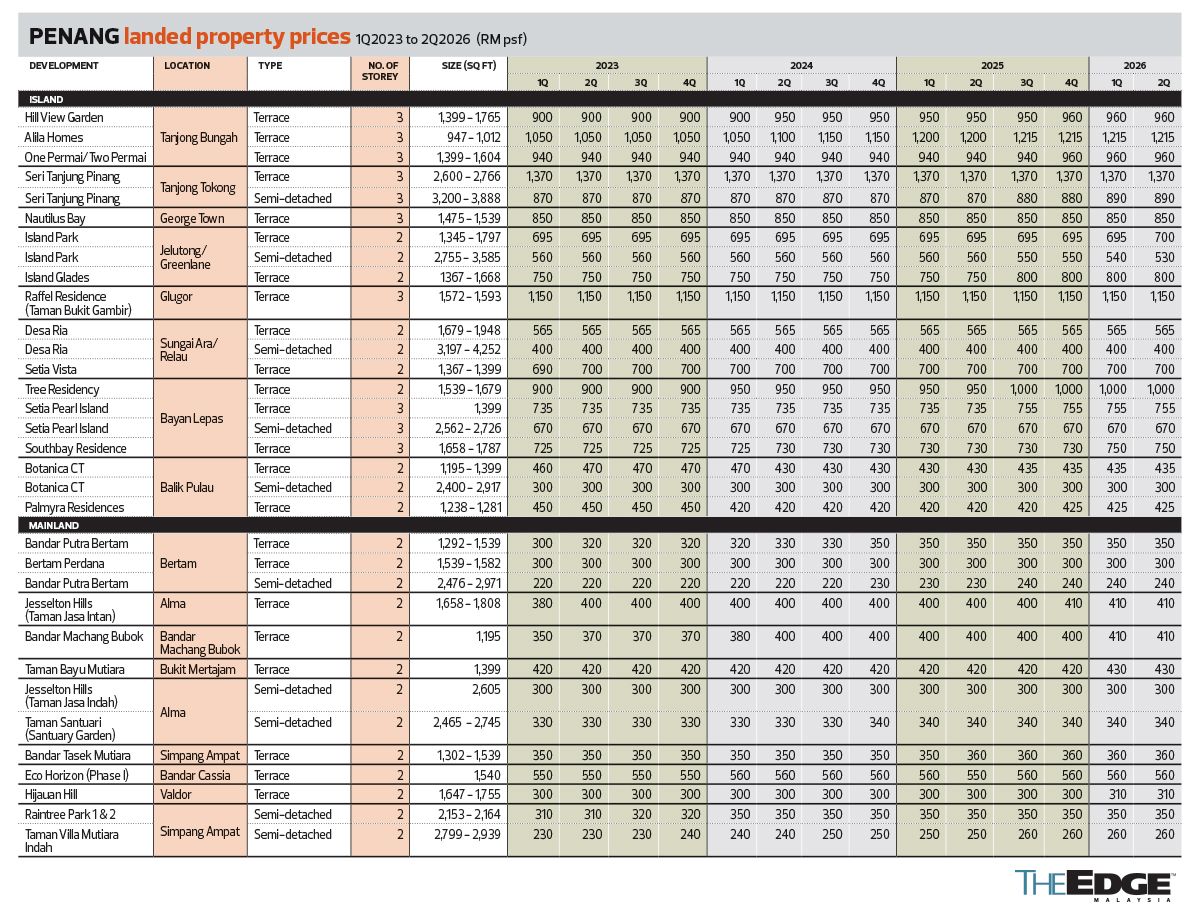
High-rise developments
High-rise projects on both the island and mainland recorded no q-o-q price movement, although selected schemes on the island saw marginal y-o-y changes.
The top performer was Middleton with a 4% increase to RM830 psf from RM800 psf. Saleha says the modest increases do not indicate any significant strengthening in prices.
Values rose 2% at schemes such as Miami Green (Pantai Miami) (RM460 psf), I-Santorini (RM560 psf), Symphony Park (up to RM600 psf), Golden Triangle 2 (up to RM560 psf) and Tree Sparina @ Ideal Vision Park (up to RM570 psf).
Saleha highlights Miami Green (Pantai Miami) as a steady performer because of its price point.
“Miami Green’s main strength is its relatively affordable positioning for a seaview high-rise development on Penang island. Properties offering sea views and access to the northern coastal corridor generally command a premium, but Miami Green provides buyers with a more accessible entry point compared with many newer waterfront developments,” says Saleha.
“Its established location and proximity to Batu Ferringhi, Tanjung Bungah and the wider northern coastal amenities also continue to underpin its appeal.”
The ease of accessibility to the beach, schools and recreational facilities along Penang’s northern coast makes this high-rise development highly sought after.
“This creates demand from different buyer groups, including local owner-occupiers, expatriates and buyers looking for a second home or investment property,” says Saleha.
On the mainland, Ocean View Residences rose 8% y-o-y to RM390 psf.
“The price increase [for Ocean View Residences] is likely driven by its proximity to Penang Sentral and infrastructure development such as the Juru-Sungai Dua elevated highway,” says Saleha.
The Prominence ranked second, with prices rising 4% y-o-y to RM350 psf, followed by Oren BM, up 2% to RM460 psf, and Meritus Residensi, up 2% to RM510 psf.
Saleha notes that while Utropolis Utama recorded no price increase in the quarter under review, this does not necessarily mean demand for its units has weakened.
“Utropolis Utama benefits from its location in the growing Batu Kawan development corridor and its proximity to educational institutions, industrial areas and commercial activities. The continued expansion of Batu Kawan as an employment and investment hub provides an important underlying demand driver,” she says.
An overview of the monitor’s second-quarter data points to a stable market with limited price volatility, a trend Saleha expects to continue.
“Overall, we expect Penang’s residential market to remain resilient rather than experience strong broad-based growth,” she says.
“Performance will increasingly depend on the fundamentals of individual locations and developments, with properties offering the right combination of affordability, accessibility, employment proximity, established amenities and limited competing supply likely to outperform the wider market.”
Save by subscribing to us for your print and/or digital copy.
P/S: The Edge is also available on Apple's App Store and Android's Google Play.