

This article first appeared in The Edge Malaysia Weekly on October 19, 2026 - October 25, 2026

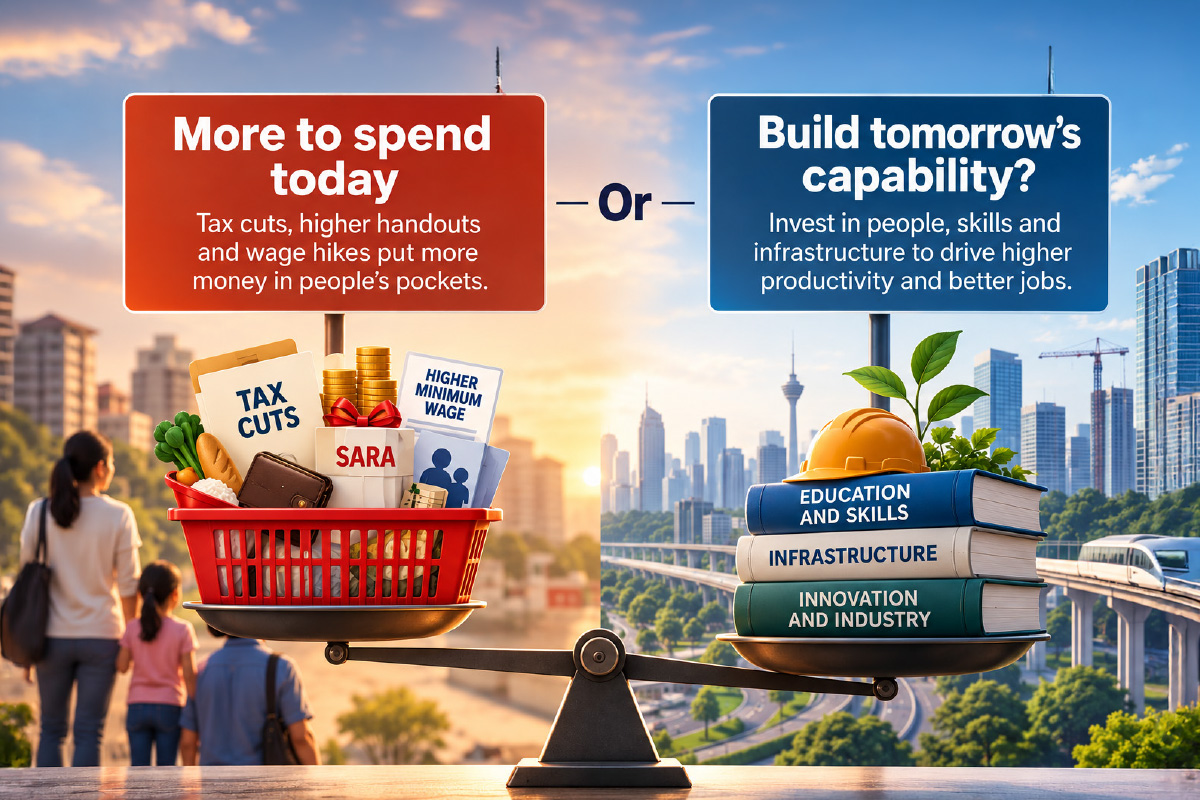
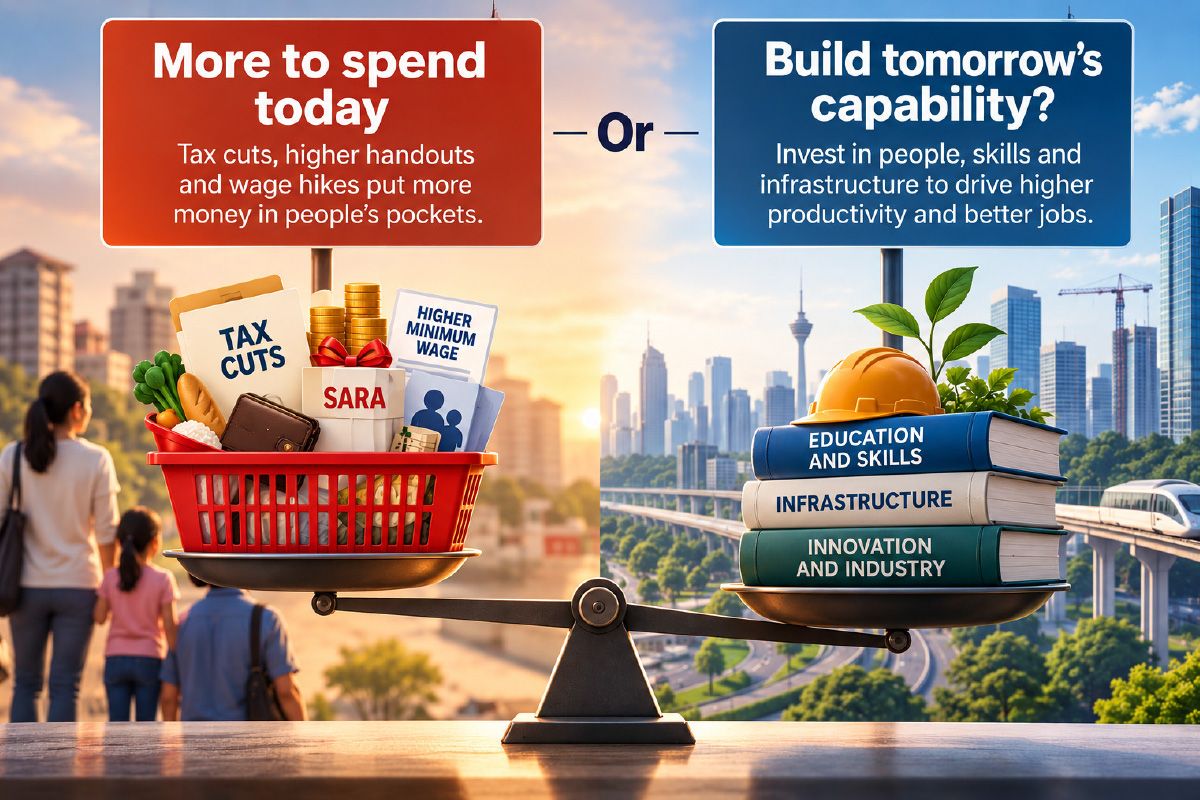
A budget should be judged by both the relief it provides today and the productive capability it builds for tomorrow.
With the rising cost of living as a primary concern, Malaysia’s just-released Budget 2027 has something for almost everyone. Tax cuts for the middle class, higher Sumbangan Asas Rahmah (SARA) payments and another minimum wage hike for lower-income workers, increased financial assistance for civil servants and pensioners — and a smaller fiscal deficit for investors worried about the nation’s fiscal sustainability.
No doubt, this is a politically attractive budget, particularly with the next general election looming. Giving households more disposable incomes, whether through tax cuts, financial assistance or higher wages, could improve public sentiment and, potentially, the government’s re-election prospects.
But there is no free lunch in economics. When the government spends more on handouts, someone else must ultimately bear the cost, whether through higher taxes, lower benefits, higher national debts or reduced development expenditure that could eventually affect future productive capability.
The important question, therefore, is not simply who will be paying for the government’s generosity, but also what Malaysia may be sacrificing in return. Are we allocating too much of our limited fiscal resources to easing today’s burden at the expense of investments that could raise incomes and living standards tomorrow?
The handouts
For long-suffering middle-income households, there is finally some relief in Budget 2027. The government has announced a one-percentage-point reduction in personal income tax rates for chargeable incomes of between RM70,001 and RM150,000, alongside an increase in the basic individual tax relief from RM9,000 to RM12,000. Other tax reliefs will also be expanded to cover expenses such as postpartum care, parental care, sports shoes and children’s tuition fees.
Meanwhile, SARA assistance of up to RM150 per month (RM1,800 annually) will be extended for Sumbangan Tunai Rahmah (STR) recipients, while Malaysians aged 18 and above who are not STR recipients will receive RM200 annually, double the RM100 given in 2026.
At the same time, the government has kept to its promise of continued fiscal consolidation. The budget deficit is forecast to fall from 3.6% of gross domestic product in 2026 to 3.3% in 2027.
How is the government paying for these additional transfers while also lowering the deficit?
Who is paying?
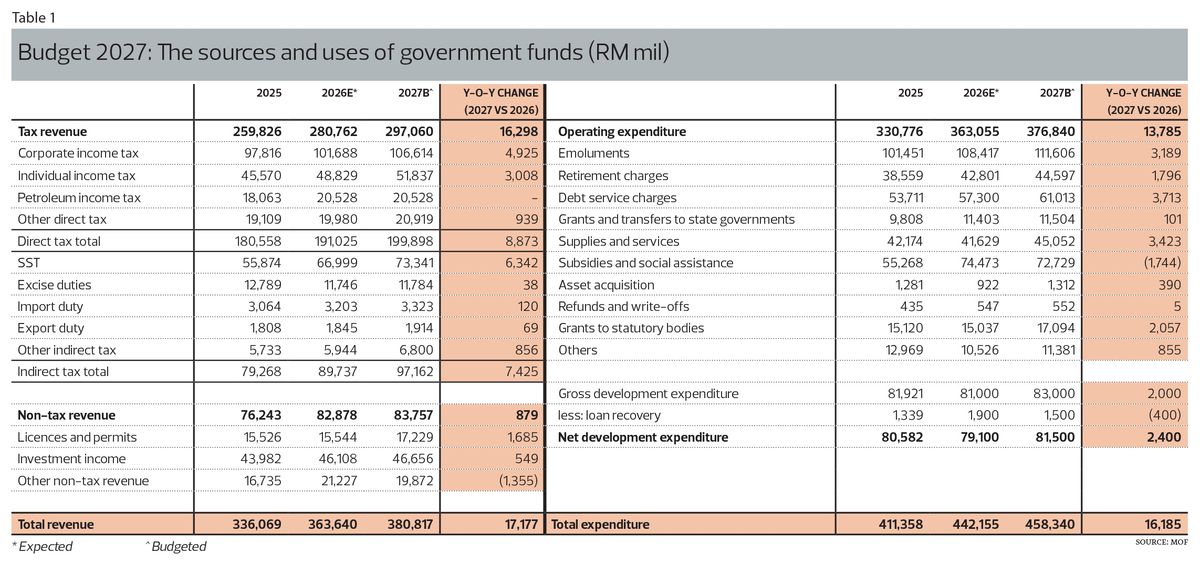
According to the government’s estimates, the federal budget deficit is expected to narrow marginally from RM78.5 billion in 2026 to RM77.5 billion in 2027. This is achieved through a 4.7% increase in revenue — by RM17.2 billion to RM380.8 billion — outpacing the RM16.2 billion, or 3.7%, increase in total expenditure to RM458.3 billion (see Table 1).
One of the most interesting policy shifts is in Malaysia’s tax structure and the resulting change in the composition of revenue growth. Instead of relying primarily on raising corporate or individual income taxes, the government is increasingly turning to consumption taxes to finance its expenditure.
In particular, the Sales and Service Tax (SST) is emerging as the largest contributor to government revenue growth. SST collection is projected to rise by RM6.3 billion, or 9.5%, in 2027. This is considerably faster than the government’s projected nominal GDP growth of 6.1%. The increase in SST alone accounts for nearly 37% of the projected RM17.2 billion increase in total federal revenue.
By comparison, corporate income tax revenue is projected to increase by a more modest 4.8%, while individual income tax revenue is expected to rise by 6.2%. As a share of GDP, corporate income tax collection is expected to decline from 4.7% to 4.6%, while individual income tax collection will remain at 2.2%.
We see this shift towards consumption tax as a positive development. As we have argued previously, our corporate tax is already among the highest in the region. Raising it further will surely disincentivise investments. Similarly, higher personal taxes will reduce the incentives to work, reduce disposable incomes and further dampen consumption.
Neither are sustainable long-term solutions to the government’s growing fiscal needs. Malaysia needs a broader tax base.
More Malaysians should have skin in the game
One of the structural weaknesses of Malaysia’s tax system is its narrow personal income tax base. Only about one-third of workers pay personal income tax, leaving the burden of funding rising government expenditure disproportionately concentrated among a relatively small segment of the working population.
Malaysia needs to broaden its tax base, and consumption taxes are an effective way to do so. Rather than taxing only a minority of income earners, everyone contributes when they spend.
Consumption tax can be regressive. But the burden on lower-income households can be mitigated by zero-rating essential goods. More importantly, a broader tax base encourages greater public accountability, as more Malaysians have a stake in how their taxes are spent.
The problem is that SST is not the most efficient consumption tax.
If we are already paying as much SST as the old GST, why not bring back the more efficient system?
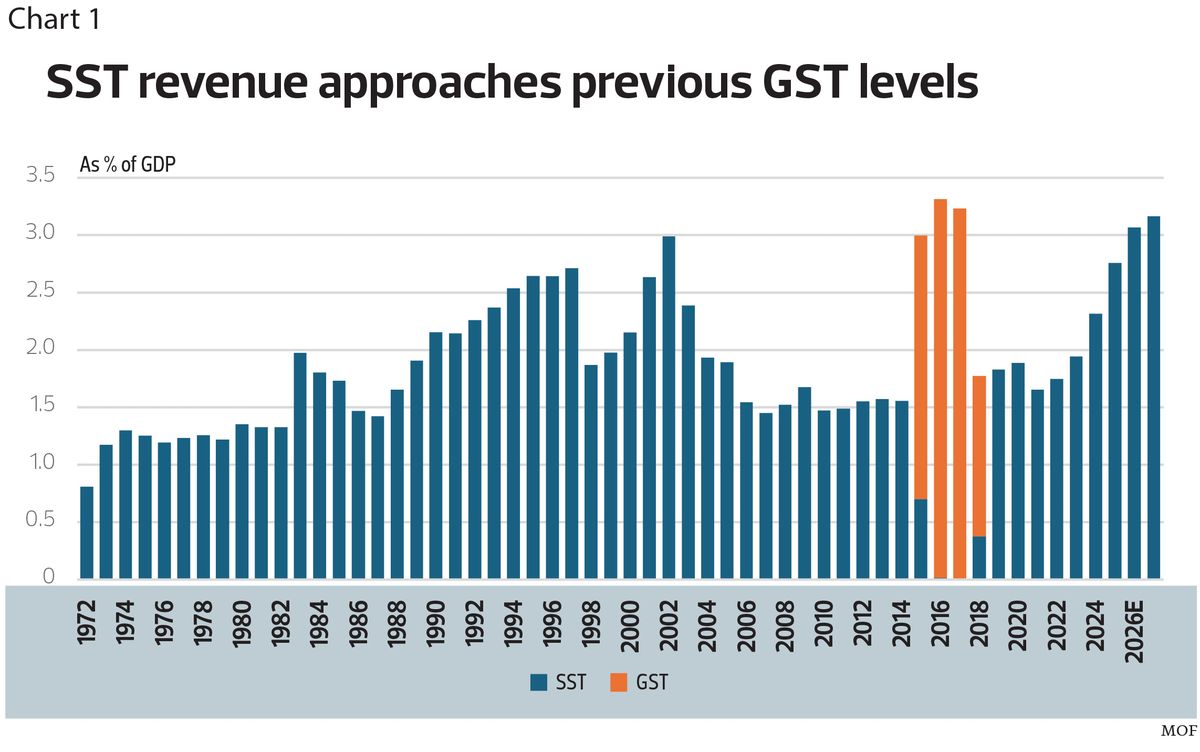
Based on the government’s projections, SST revenue will rise from 2.8% of GDP in 2025 to 3.1% in 2026 and 3.2% in 2027. This is close to the revenue collected under the previous Goods and Services Tax (GST) regime, which amounted to approximately 3.3% of GDP in 2016 (see Chart 1). In other words, relative to the size of the economy, Malaysia is now collecting almost as much revenue through SST as it did when GST was implemented.
Yet, the two systems are fundamentally different.
GST is a multi-stage consumption tax, collected throughout the production and distribution chain. Businesses charge GST on their sales but can generally claim credits for GST paid on their business inputs. This creates an audit trail across the supply chain. Each registered business has an incentive to obtain proper invoices from suppliers to substantiate its input tax claims, making transactions easier for the tax authorities to verify.
GST also provides greater transparency to consumers, as the tax charged on a purchase can be clearly identified.
SST, on the other hand, combines a single-stage sales tax with a service tax imposed on prescribed services. Unlike GST, it does not provide a comprehensive input tax credit mechanism across the economy. It therefore lacks one of GST’s important safeguards against under-reporting and tax evasion.
Without input credits, taxes paid at earlier stages become embedded in business costs, creating a cascading effect as goods and services move through the supply chain. Basically, consumers end up paying more assuming the same tax rate as GST.
This also means the total tax paid is less transparent to consumers. A shopper may see the final selling price without knowing how much tax has already been incorporated into the cost of the product.
This raises an obvious question. If Malaysians are already paying almost as much consumption tax relative to GDP as they did under GST, why not bring back the more efficient system? As we said, GST offers greater transparency, better tax compliance and limited cascading impact than the SST.
Ironically, GST’s political unpopularity stems partly from consumers seeing exactly how much tax they pay. But obscuring total tax paid does not make it disappear. This, we think can be remedied through better consumer education.
If public perception is the main obstacle, why not turn the argument around? With GST’s broader coverage and more efficient collection, the government could potentially apply a lower headline tax rate while collecting the same revenue as SST. Gain the people’s buy-in by replacing SST with a lower-rate GST.
And if the name GST itself is deemed too politically toxic, then rebrand it. Call it LST — Lower Sales Tax — perhaps?
Spending priorities increasingly favour today over tomorrow
Of the projected RM17.2 billion increase in revenue for 2027, roughly RM8.7 billion, or half, will go towards paying higher emoluments, retirement charges and debt service payments. Collectively, these fixed expenditure commitments will reach RM217.2 billion, equivalent to 57% of total federal revenue.
With fiscal resources already stretched, the government is nevertheless still raising financial assistance for civil servants and retirees.
Under Budget 2027, special financial assistance for eligible civil servants will triple from RM500 to RM1,500, benefiting 1.3 million civil servants at Premier Grade B and below, including contract appointees. Meanwhile, government retirees, including eligible veterans, will receive RM750, up from RM250 in 2026.
A back-of-the-envelope calculation suggests these increases alone could cost the government an additional RM1.8 billion, on top of the RM1 billion increase in SARA assistance.
To be fair, subsidy rationalisation and efforts to reduce leakages have helped contain expenditure. Overall allocation for subsidies and social assistance is projected to decline by RM1.7 billion in 2027.
But the question is whether these savings are being put to their best use.
Cash handouts provide relief today. Development investments, by contrast, can expand the nation’s productive capacity and create the conditions for higher incomes tomorrow.
The reality is that development spending has become increasingly constrained.
Gross development expenditure is budgeted at RM83 billion in 2027, below the RM96 billion spent in 2023 and RM84 billion in 2024.
Relative to the size of the economy, the decline is even more alarming. Gross development expenditure is projected to fall to just 3.6% of GDP in 2027, compared with an average of approximately 4.2% during the 2010s and 7.3% during the 2000s.
The composition of development expenditure has also changed considerably over the years. Notably, development expenditure in the economic sector, which includes transport infrastructure, agriculture, trade and industry, and public utilities, is projected to fall to approximately 1.6% of GDP in 2027, the lowest level on record (see Chart 2).
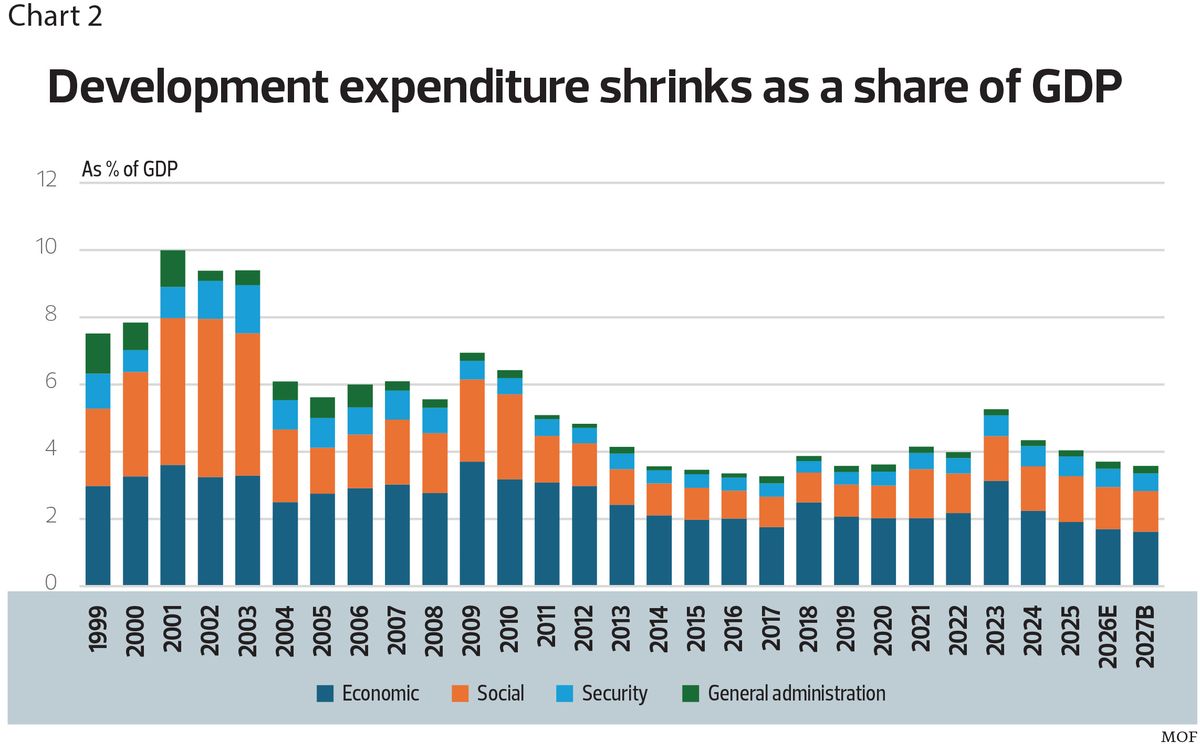
This is because a greater share of development resources is being devoted to the social sectors, particularly education and healthcare.
Malaysia needs to expand its healthcare capacity as the population ages. And the education system is in critical need of reform, although simply throwing more money at the deteriorating quality of education is not the answer.
Both economic and social development are essential and remain substantial. Shrinking development expenditure relative to GDP is forcing the government to make increasingly difficult spending choices.
This is the real opportunity cost of increasing transfers and operating expenditure. Something has to give. Reducing development expenditure will affect the nation’s future growth potential. And this has consequences for another policy priority — raising the people’s wages and living standards.
Sustained higher incomes need higher productivity, not just wage policy
Another major announcement in Budget 2027 is the increase in the monthly minimum wage from RM1,700 to RM2,000, effective June 2027. Micro, small and medium enterprises (MSMEs) with annual revenue of below RM50 million will be exempted from the new requirement, at least for the time being.
The government also plans to introduce a minimum starting wage of RM2,500 for semi-skilled workers and graduates, although the detailed implementation mechanism has yet to be announced.
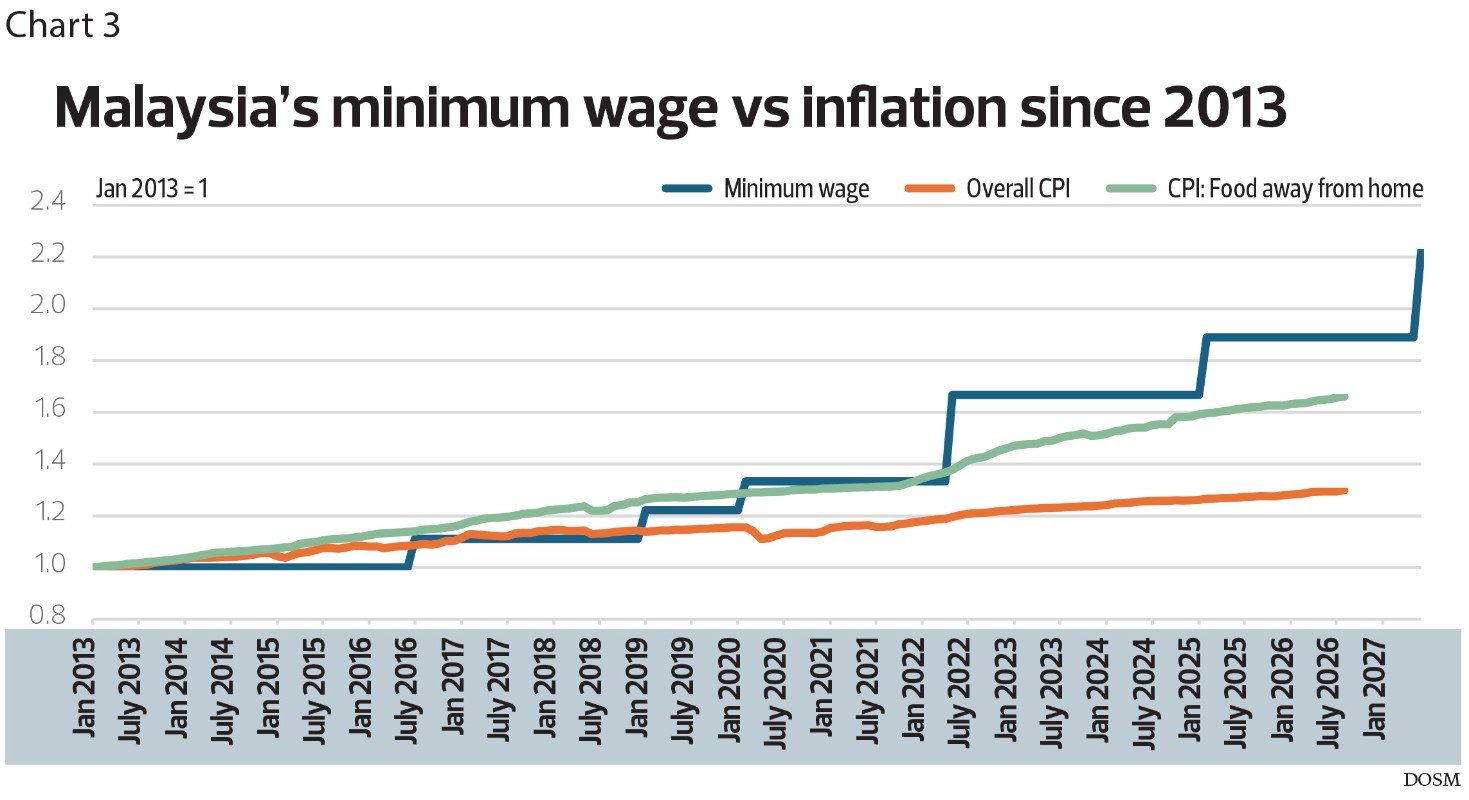
Since Malaysia introduced its minimum wage policy in January 2013, the wage floor has been raised five times, with the increase in 2027 marking the sixth adjustment.
Until 2022, minimum wage increases broadly tracked inflation, measured using the Consumer Price Index (CPI) for food away from home. We believe this index better reflects the price increases consumers experience in everyday transactions, as the broader CPI includes government-controlled and subsidised items that keep reported inflation low.
Since 2022, however, minimum wage hikes have outpaced even this higher measure of inflation (see Chart 3).
This raises an important question: has Malaysia’s labour productivity improved sufficiently to support these rather aggressive wage increases?
Earlier this year, the World Bank’s Malaysia Economic Monitor highlighted that real wages have grown faster than labour productivity (measured as output per worker). Between 2010 and 2024, real median and mean wages rose by approximately 43%, compared with an increase of around 30% in labour productivity per worker.
This doesn’t necessarily mean workers are overpaid. But sustainable improvements in wages and living standards ultimately depend on workers being able to produce more or produce higher-value goods and services. Without corresponding improvements in productivity, repeated increases in minimum wages would put businesses under growing pressure, particularly those operating on thin margins.
In fact, it is wrong to assume that companies with annual revenue above RM50 million are necessarily more profitable than MSMEs and can easily absorb higher labour costs.
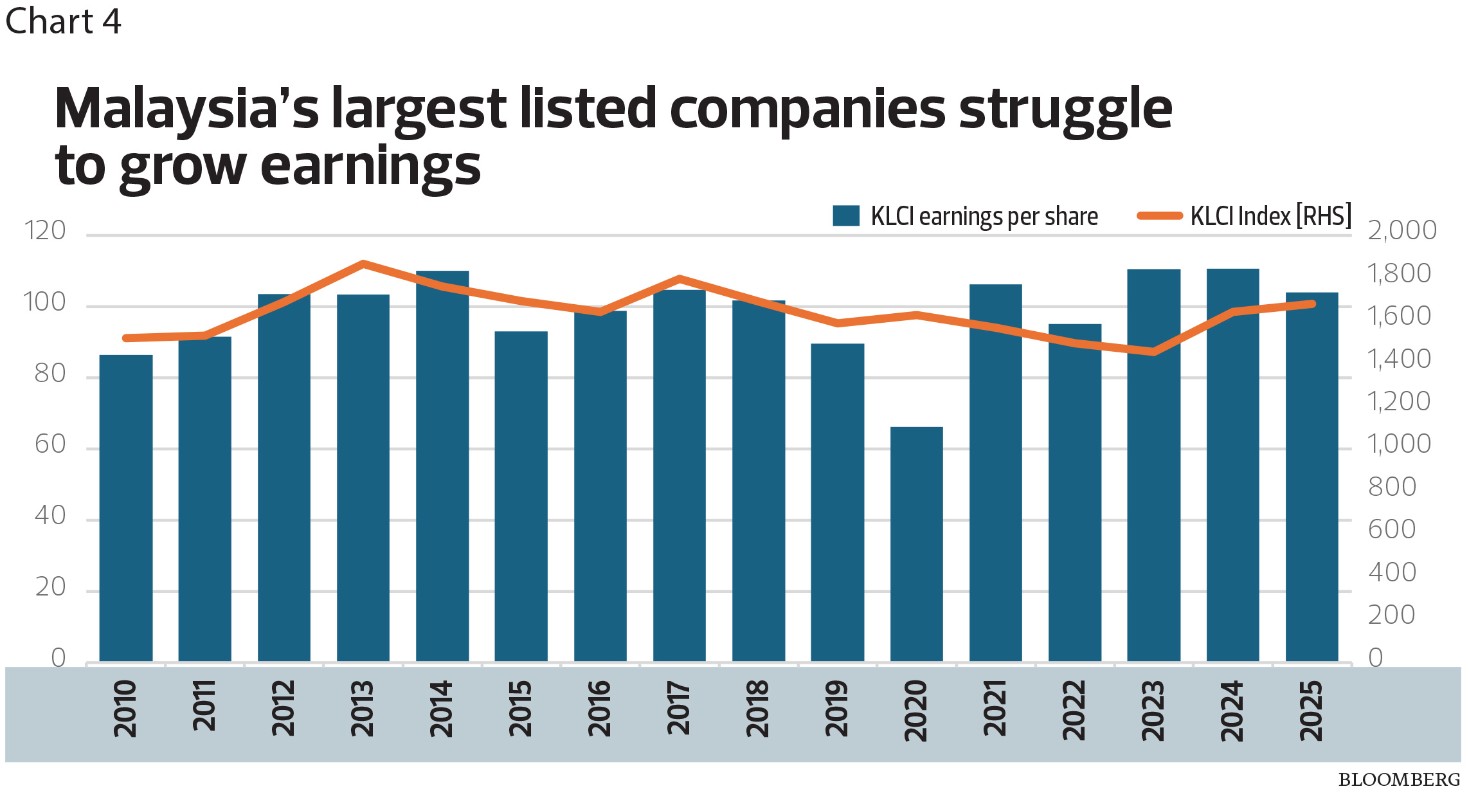
Just look at the FBM KLCI, which comprises Malaysia’s largest listed companies. The index has remained largely stagnant for over a decade, reflecting lacklustre earnings growth among its constituents, many of which are already struggling with shrinking profit margins.
Mandating a minimum salary of RM2,500 for graduates also risks encouraging credential inflation.
Students may opt for easier, less demanding courses simply to obtain a degree and qualify for the higher wage floor, without necessarily acquiring the skills employers need.
This raises a fundamental question: are graduates currently earning less than RM2,500 because they lack the skills employers demand, or because companies are unwilling to pay them wages commensurate with their qualifications and economic contributions? Or is the economy itself failing to create the higher-paying jobs?
The distinction matters. Because making the wrong diagnosis and prescribing the wrong treatment can kill rather than cure.
For instance, if the problem lies in inadequate skills, imposing a higher salary floor without addressing the underlying skills mismatch could further weaken incentives for students to acquire the relevant qualifications and skills. At the same time, it could make employers more reluctant to hire inexperienced graduates.
What we are saying is that Malaysia cannot sustainably improve living standards simply by legislating higher wages.
It must create the environment in which businesses can afford to pay higher wages because their workers generate greater economic value.
That means improving education quality and graduate capabilities so that they can effectively translate technological advancements into economic outcomes. It means reducing regulatory inefficiencies, removing protectionist policies and rent-seeking, and enabling market-driven competition. It means investing in automation, moving into higher-value industries and so on.
Pushing wages up without addressing the underlying structural economic weaknesses risks discouraging investments and job creation, undermining the very objective the policy is intended to achieve.
There is no quick fix. The solution must begin with education reform. This is an issue we will explore in greater depth in our three-part series on Malaysia’s education system, beginning next week.
Conclusion
Budget 2027 is a generous, perhaps pre-general election, budget. There are tax reliefs for middle-income households as well as increased cash handouts and higher minimum wages for low-income earners, semi-skilled workers and underemployed tertiary graduates.
These measures will provide welcome relief for many struggling with cost-of-living pressures. But there is a necessary trade-off.
Every additional ringgit committed to transfers is a ringgit that cannot simultaneously be spent on development investments. That means less money to build new hospitals, expand public transportation or improve the infrastructure needed to support private investments.
Cash handouts offer immediate, tangible benefits — and they are popular with voters. A new hospital may take years to complete. An improved education system may take a generation to produce results. Investments in transport infrastructure and public utilities may not translate into stronger productivity and higher wages until years later.
Yet, these investments determine Malaysia’s future growth potential.
Ultimately, the test of Budget 2027 is whether today’s relief helps build tomorrow’s earnings power.
Transfers can ease hardship and wage floors can raise pay. Sustained prosperity requires the capability to produce more.
Portfolio commentary
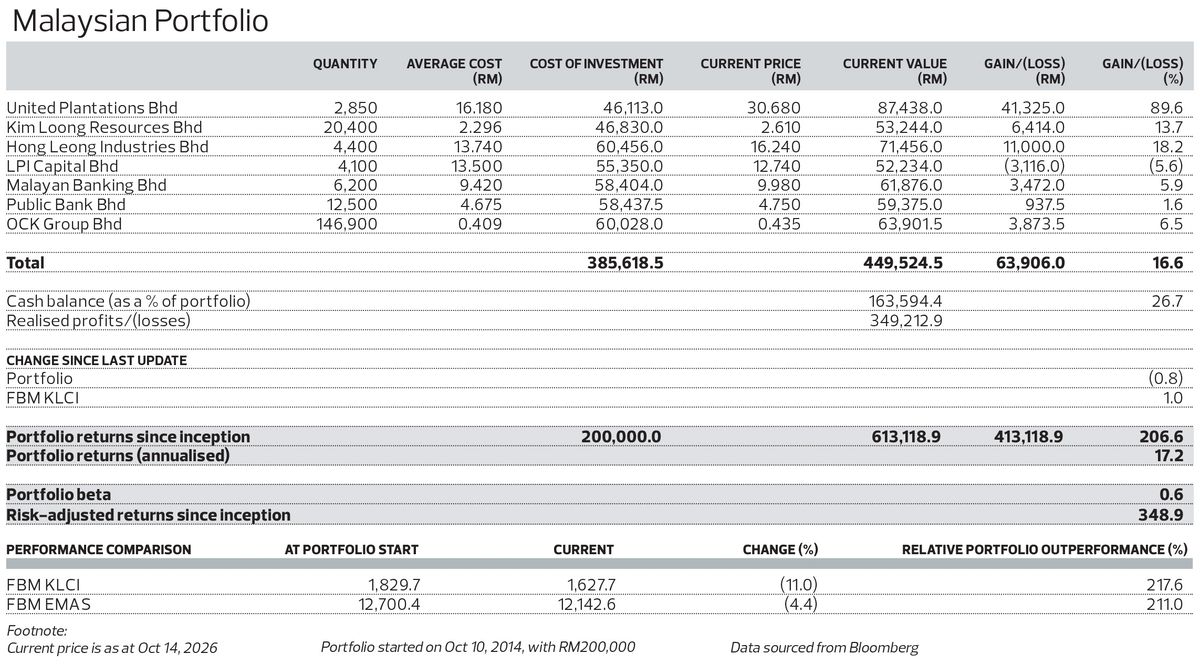
The Malaysian portfolio fell 0.8% for the week ended Oct 14. The winners were Public Bank (+3.5%), Maybank (+1.1%) and Hong Leong Industries (+0.1%) while the biggest losers were OCK Group (-5.4%), Kim Loong Resources (-3.3%) and United Plantations (-1.6%). Total portfolio returns now stand at 206.6% since inception. This portfolio is outperforming the benchmark FBM KLCI, which is down 11.0% over the same period, by a long, long way.
The Absolute Returns Portfolio also ended lower, down 0.9%. Total portfolio returns now stand at 33.7% since inception. The top gainers were Alibaba Group Holding (+4.8%), Schneider Electric (+3.2%) and Thermo Fisher Scientific (+1.7%) while the top losers were Nvidia Corp (-6.8%), Singapore Tech Engineering Ltd (-5.7%) and Talen Energy Corp (-5.3%).
Meanwhile, the AI portfolio fell sharply, losing 8.0% for the week. The selloff in high-growth tech stocks was precipitated by jittery AI trade and hot US inflation numbers that raised the odds of another interest rate hike. There are signs that higher energy prices may be starting to filter through the economy. The Federal Reserve will meet later this month. Last week’s loss pared total portfolio returns to 23.7% since inception. The sole gainer was Alibaba (+4.8%), while the biggest losing stocks include Unusual Machines (-16.4%), Roundhill Memory ETF (-19.0%) and Marvell Technology Inc (-13.8%).
Disclaimer: This is a personal portfolio for information purposes only and does not constitute a recommendation or solicitation or expression of views to influence readers to buy/sell stocks. Our shareholders, directors and employees may have positions in or may be materially interested in any of the stocks. We may also have or have had dealings with or may provide or have provided content services to the companies mentioned in the reports.
This is why takeover offers must include an all-cash option
When Sunway Bhd made its conditional voluntary takeover offer for IJM Corp Bhd back in January, we concluded that the offer price was neither fair nor reasonable (see flashback).
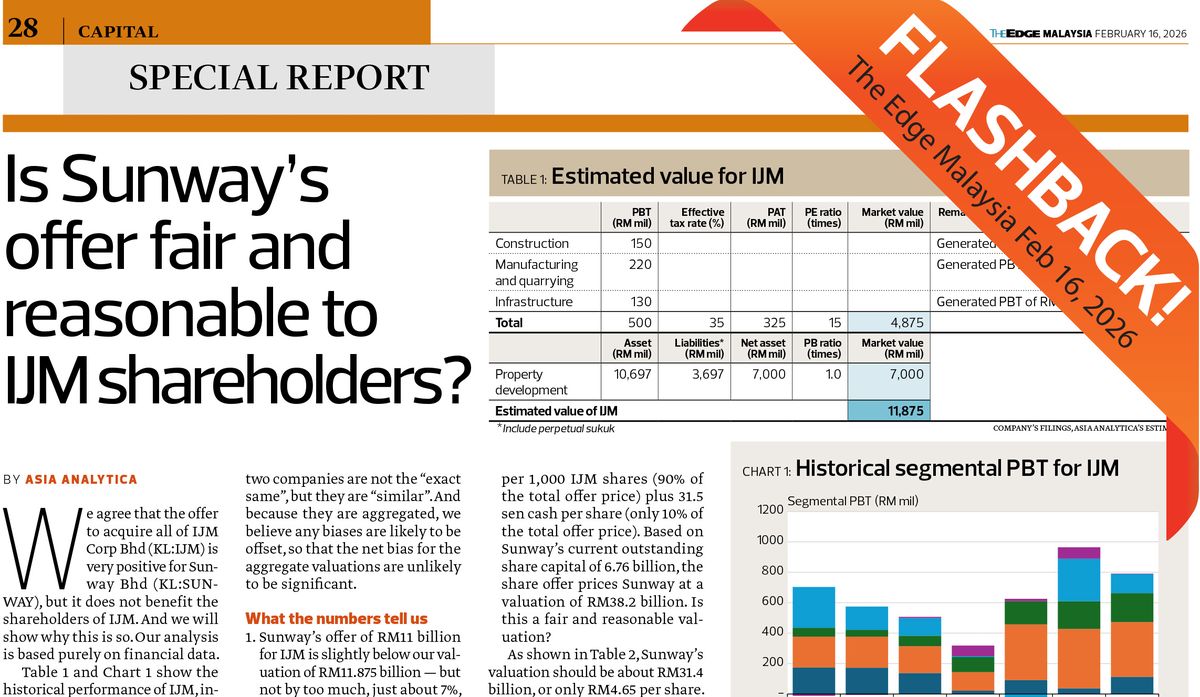
Our main contention was that the offer of RM3.15 per IJM share did not include an all-cash option for IJM shareholders. Instead, they would have been paid primarily with Sunway shares — 90% of the takeover price — with only the remaining 10% in cash.
A takeover offer without an all-cash option raises concerns. Cash is certainty — IJM shareholders could have gotten RM3,150 per 1,000 shares had they been given the option. Those who chose to swap their shares for Sunway’s could still opt for the share swap. The point is that it would be IJM shareholders’ decision.
The absence of an all-cash option meant that IJM shareholders would be exposed to subsequent business risks in Sunway. Basically, they would have swapped market risks in IJM for Sunway. It also raises the issue of valuation. Back then, we valued Sunway at RM4.65 per share using the same valuation parameters on both companies. Sunway priced its shares at RM5.63 (net dividends) in the takeover offer. In short, we concluded that Sunway shares were overvalued by 21%.
And we have been proven right. The takeover offer failed to reach the minimum acceptance threshold and lapsed. And IJM shareholders — including the 33% that had accepted the offer — may have dodged a bullet.
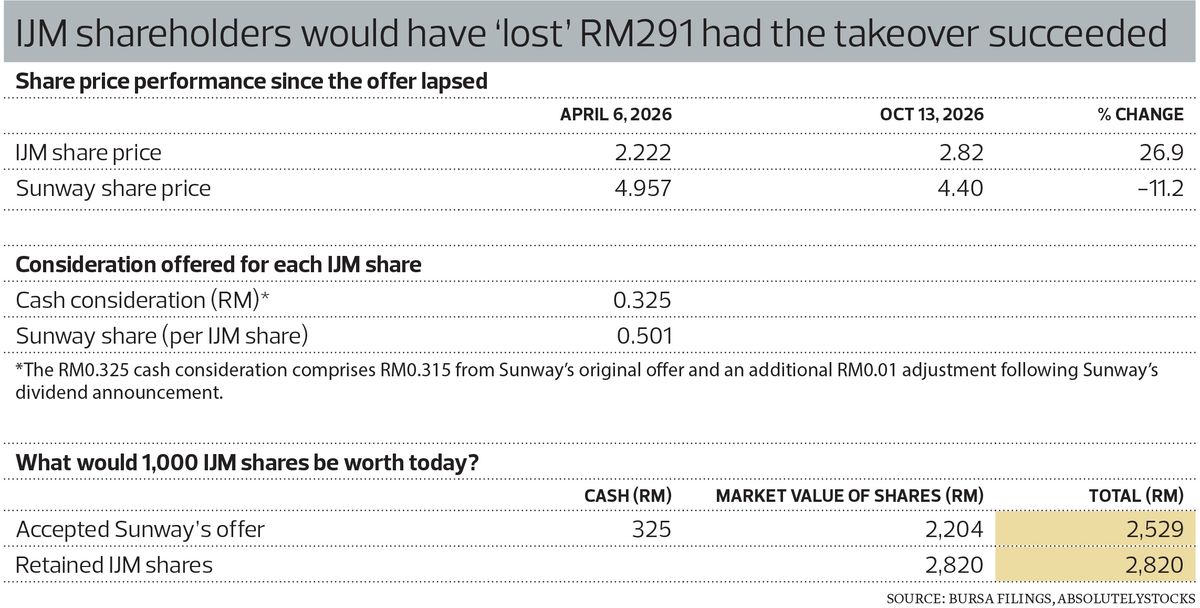
Sunway shares have since fallen to RM4.40, which incidentally is just below our fair value for the stock. Meanwhile, IJM shares have risen nearly 27% to RM2.82, from RM2.22 when the takeover offer closed.
Had the takeover offer succeeded, their Sunway shares plus the RM325 cash received for every 1,000 IJM shares would be worth only RM2,529 today. In contrast, 1,000 IJM shares are worth RM2,820 today. In short, IJM shareholders would have “lost” RM291 had the takeover succeeded (see table).
Of course, no one can predict the future. We could have been wrong in our valuations. But it does not change our basic principle — a takeover offer can be made with shares, but it must also include an all-cash option. Leave the choice to the shareholders. — By Tong Kooi Ong and Asia Analytica
Save by subscribing to us for your print and/or digital copy.
P/S: The Edge is also available on Apple's App Store and Android's Google Play.