

(Oct 16): UK Chancellor of the Exchequer John Healey is set to raise taxes on banks to fund cost-of-living support for voters and stabilise the public finances, as he looks for sources of revenue that won’t violate Labour Party campaign pledges.
An increase in bank taxes is one of the major measures that Healey submitted to the Office for Budget Responsibility ahead of his first fiscal event on Oct 28, according to people familiar with the matter. The move will likely involve increasing the bank surcharge that’s levied on top of the standard corporation tax rate, said the people, who spoke on condition of anonymity to discuss plans that had not been announced.
The proposal to increase the 3% bank surcharge was reported by the Guardian newspaper earlier on Thursday. The rate was set at 8% until 2023, when Healey’s Conservative predecessor, Jeremy Hunt, reduced it. Fully reversing it would raise £2 billion (US$2.7 billion or RM10.9 billion).
A Treasury spokesperson declined to comment on the plans. “As has always been the case, decisions on tax are a matter for the chancellor to set out at fiscal events, rather than routinely commenting on rumours, speculation or proposals,” the Treasury said.
Shares in NatWest Group plc and Lloyds Banking Group plc fell more than 2% in early trading on Friday, making them the worst performers in the FTSE 100 index. Barclays plc and HSBC Holdings plc, which have more international business, were less affected by the news.
Speculation about bank taxes has swirled since Prime Minister Andy Burnham took power in July, and Healey declined to rule out the move while attending International Monetary Fund (IMF) meetings in Bangkok this week. That’s despite describing the City of London’s finance industry as “part of the jewel” in the British economic crown during an interview with Bloomberg in the Thai capital.
“My observations on the banks are just that people too often see them as big distant financial institutions, when they are hardwired into the economic fabric,” Healey subsequently told reporters when pressed on whether he favoured an increase in bank taxes. “That said, I have got decisions to take in the budget, and I will set those out in two weeks’ time.”
Burnham has promised to deliver “breathing space” for Britons facing sharp increases in energy bills and mortgage costs in the wake of the US-led war against Iran. Healey confirmed at the IMF meetings that any such support would be temporary and targeted to the neediest.
Options the Treasury has been drawing up for the budget include spending more on the warm homes discount — currently a £150 discount on energy bills for people on low income or receiving certain welfare payments — and freezing fuel duty.
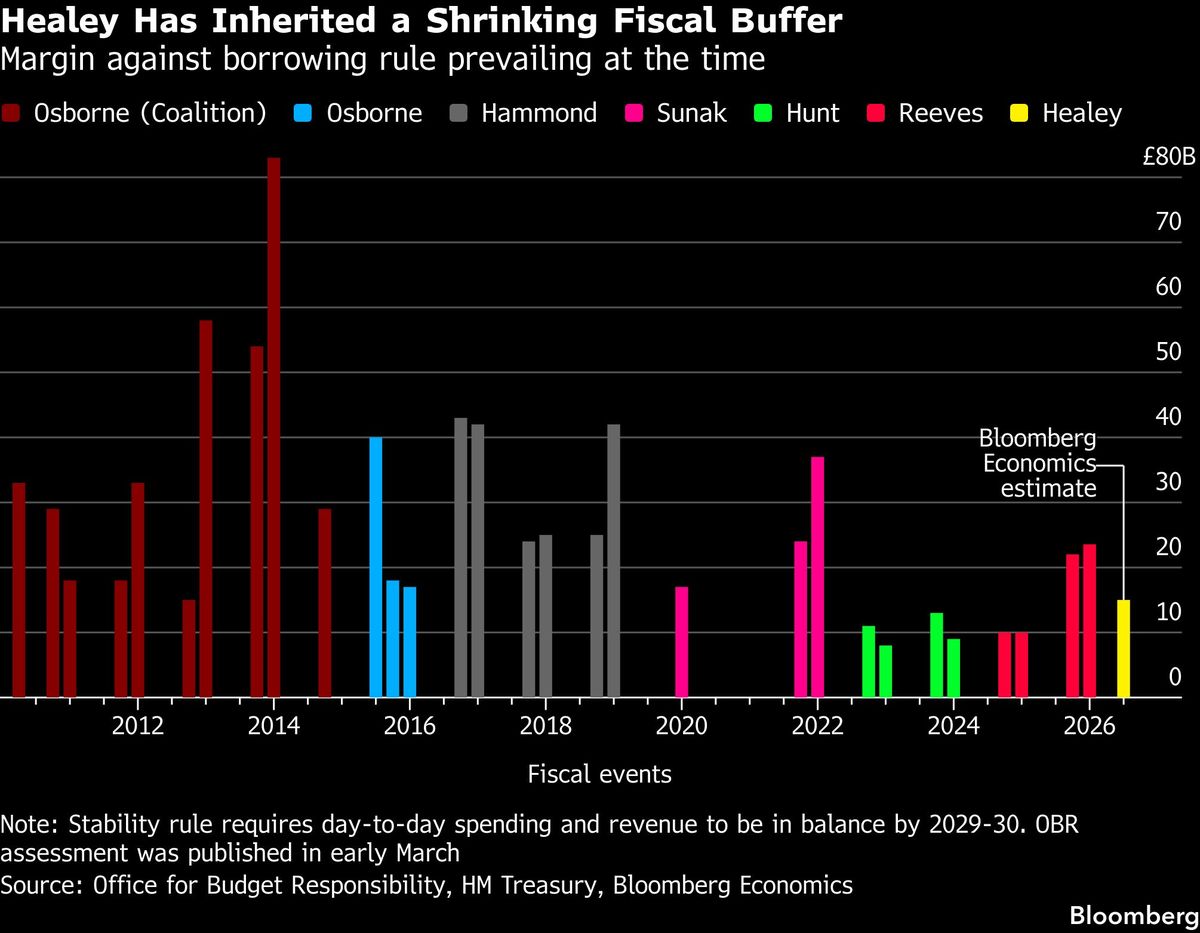
Healey is also seeking to repair the public finances, after a rise in borrowing costs linked to the war is estimated to have halved the £23.6 billion fiscal buffer he inherited from former chancellor Rachel Reeves. He also needs to close a gap in defence spending.
Healey’s move towards taxing banks follows an intense lobbying campaign from left-wing think tanks and trade unions. They have been urging the Treasury to target the industry after it enjoyed recent windfall profits, spurred by higher interest rates.
In August, HSBC Holdings plc reported a second-quarter profit increase of 60% to US$10.1 billion. The rest of the big four, including Barclays plc, Natwest Group plc and Lloyds Banking Group plc, posted cumulative profits in the first-half of almost £30 billion.
The bank surcharge was reduced to 3% from 8% in 2023 to offset some of the increase in corporation tax that year to 25% from 19%. That left UK banks paying 28% rather than 33%, which would have made them more highly taxed them elsewhere.
But those sceptical about proposals to raise bank taxes include Bank of England governor Andrew Bailey, who has previously warned that raising costs on the firms would result in higher mortgage rates and risk undermining financial stability.
Asked about the proposal at an Institute of International Finance meeting in Bangkok, Bailey declined to comment. “It’s not for me. I am not involved. It’s for the Treasury,” he said.
UK Finance, which represents British banks, said the sector already makes a major contribution to the public finances and faces materially higher tax rates in London than other financial centers. “Further tax increases would weaken the UK’s competitiveness, discourage investment and job creation, and work against the government’s ambition to deliver growth in every postcode,” the group said.
Healey has insisted that he will maintain fiscal discipline at his budget, stressing that he will continue to meet the UK’s main budgetary rules, which require day-to-day spending to be covered by tax receipts by 2029/30, and for debt to be falling as a share of the economy.
Healey met with the heads of Britain’s big banks earlier this month and told them the UK faces a tough fiscal position, but said he hadn’t decided on whether to hike taxes on the sector. Attendees at the meeting included HSBC’s Georges Elhedery, CS Venkatakrishnan at Barclays, Charlie Nunn from Lloyds and Paul Thwaite at NatWest.
City of London executives have been fearing that Healey will impose a windfall tax on the profits of domestic banks and exempt the UK operations of international lenders in order to limit the hit to Britain’s global competitiveness, Bloomberg has previously reported.
There have been concerns among bankers that the government believes UK lenders haven’t done enough to support small businesses, and some of the revenues raised from banks could be used to lessen costs for those firms, according to people familiar with the matter.
A windfall tax on UK profits of its big four lenders could raise as much as £18.9 billion, according to a calculation from Positive Money, a group that campaigns against inequality. The Green Party has called for a 38% windfall tax on banks in order to fund a tax cut for small- and medium-sized enterprises.
The Institute for Public Policy Research, a left-leaning think tank that’s close to the Labour government, last year suggested a tax on banks to recover what it called a “staggering” state subsidy they had received as a result of the Bank of England’s quantitative easing programme.
Uploaded by Tham Yek Lee