

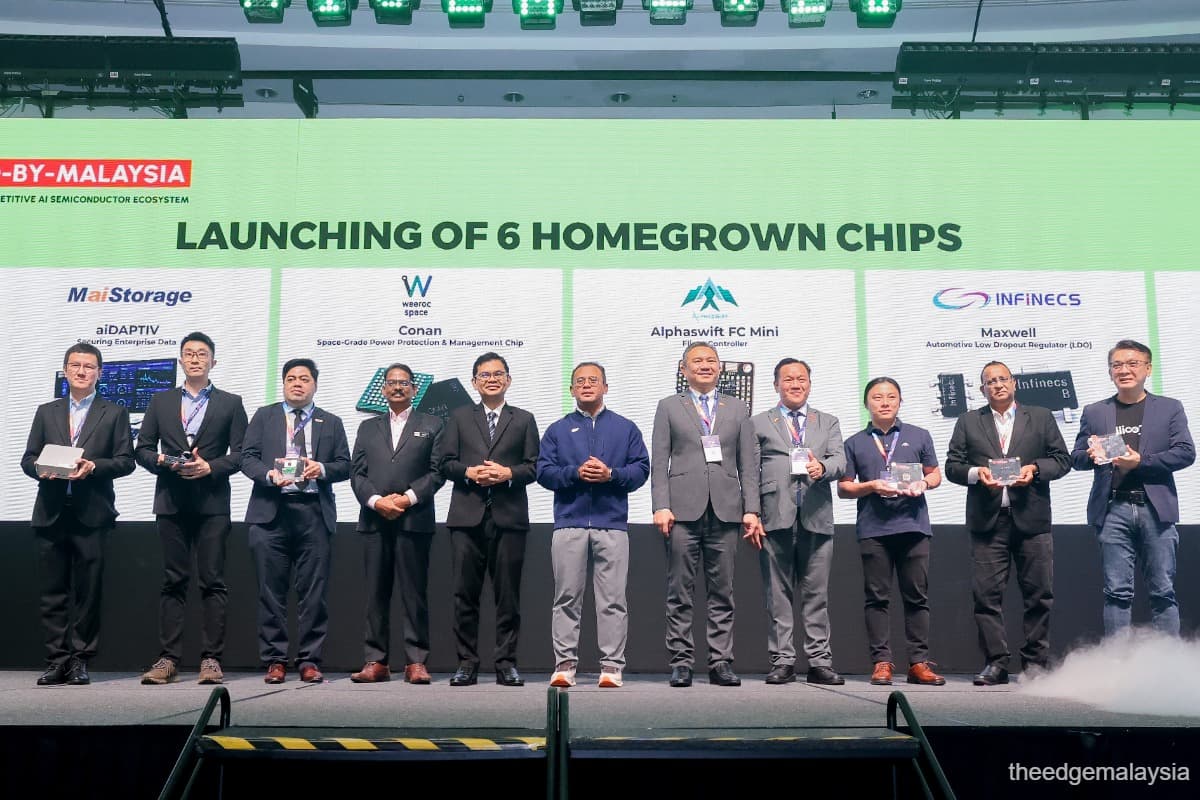
KUALA LUMPUR (Oct 16): Malaysia’s six homegrown semiconductor innovations developed under the Semiconductor IC Design Park have an estimated combined sales potential of RM300 million, said Economy Minister Akmal Nasrullah Mohd Nasir. However, he did not specify when the sales target could be achieved.
Speaking at the launch of the six chips on Friday, Akmal said the next step was to secure customers, meet industry requirements and turn the innovations into commercially successful products.
The six innovations are SkyeChip Bhd’s (KL:SKYECHIP) MARS1000, an AI processor for cameras, robots and factory systems; MaiStorage’s aiDAPTIV+ storage solutions for AI computers and servers; and SiliconX’s field-programmable gate array, a reprogrammable chip for industrial and automotive use.
The other three are Infinecs’ automotive power regulator, Weeroc Space’s power controller chip for satellites and space systems, and Alphaswift’s FC Mini flight controller for autonomous drones.
Malaysia launched its first integrated circuit (IC) design park in Puchong in August 2024, followed by a second facility in Cyberjaya in November 2025.
Akmal said the innovations showed that Malaysian companies were developing advanced technologies for global markets, rather than simply manufacturing products designed elsewhere.
He added that Malaysia had spent more than 50 years building its semiconductor industry, progressing from assembly operations in Penang to testing, packaging, equipment, manufacturing services and chip design.
The global semiconductor industry is entering a new phase, driven by demand for AI computing power, memory, advanced packaging and specialised chips. Data centres, electric vehicles, smart factories and intelligent devices are also creating new opportunities.
Under the 13th Malaysia Plan, Malaysia is prioritising AI and high-value industries. Its National Semiconductor Strategy aims to strengthen capabilities in IC design, advanced packaging and manufacturing equipment.
The strategy also targets the development of 110 high-value Malaysian semiconductor companies, including 10 existing local semiconductor-related companies and 100 new ones, while strengthening the country’s engineering talent.
Akmal said Malaysia must move beyond manufacturing products locally to designing, developing and owning its own technologies.
“Made in Malaysia” refers to where a product is manufactured, while “Made by Malaysia” reflects the country’s ability to create and own the technology behind it. He said Malaysia needed both, but future growth should focus on creating and retaining more value through homegrown innovation.