

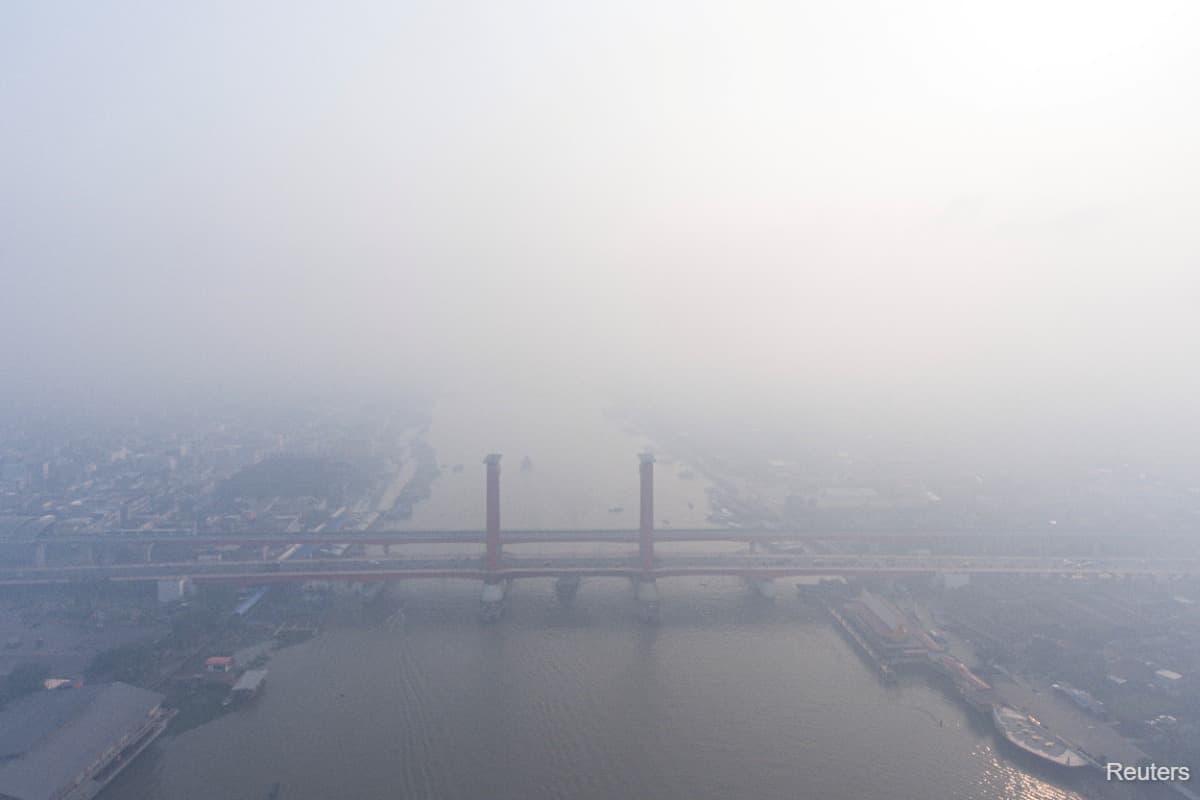
JAKARTA (Oct 16): Indonesia’s prolonged forest and land fire crisis underscores the need for stronger Asean action to tackle transboundary haze, with analysts calling for closer cooperation in firefighting and joint fire prevention.
Malaysian political analyst Prof Datuk Dr Sivamurugan Pandian said Indonesia could demonstrate regional leadership by working with its neighbours to address the environmental challenges behind recurring haze.
“Indonesia can turn the haze crisis into an opportunity to strengthen Asean ties. Regional cooperation, shared responsibility and concrete action are essential because haze knows no borders,” he told Bernama.
Months of fires across Sumatra and Kalimantan have blanketed communities in smoke, forced school closures in neighbouring countries and disrupted outdoor activities.
Indonesia’s health ministry recorded 277,075 cases of acute respiratory infections across seven fire-affected provinces as of Oct 12, while public frustration over the handling of the fires has triggered demonstrations and legal action.
Sivamurugan said cooperation should go beyond firefighting to include information-sharing, joint prevention and sustainable land management, including tackling irresponsible land-clearing practices and balancing economic interests with environmental protection.
“If Indonesia and its neighbours can work together effectively, the crisis could become a catalyst for rebuilding regional trust, strengthening environmental governance and demonstrating that collective action remains central to Asean solidarity,” he said.
Malaysia is also seeking stronger regional cooperation, with Foreign Minister Datuk Seri Mohamad Hasan saying on Thursday that Kuala Lumpur would prioritise diplomatic engagement and Asean mechanisms over measures that could strain bilateral relations.
Mohamad said Malaysia would submit proposals at upcoming Asean meetings, including exploring the inclusion of transboundary haze within Asean’s disaster management framework.
Dr Muhammad Ramaditya, a lecturer in administrative science at the University of Indonesia and an economic and business analyst, said accepting assistance from neighbouring countries could strengthen Indonesia’s firefighting capacity and diplomatic ties.
He said additional resources and technology could help tackle persistent peatland fires more effectively.
“Accepting such offers of assistance does not signify weakness; rather, it reflects a form of inclusive diplomacy. It aligns with the spirit of gotong royong or mutual cooperation among these related nations,” he told Bernama.
President Prabowo Subianto has approved foreign assistance to combat the fires, with technical discussions underway through Indonesia’s National Disaster Management Agency (BNPB), Foreign Minister Arrmanatha Nasir said on Thursday.
Malaysia had earlier offered a Bombardier CL-415MP aircraft, three helicopters and 52 personnel to support firefighting operations.
Singapore has also offered support, with Minister for Sustainability and the Environment Grace Fu saying on Oct 10 that she had contacted her Indonesian counterpart, Jumhur Hidayat.
A 14-day Japanese military firefighting mission in Kalimantan ended on Sept 29, with CH-47 Chinook helicopters deployed for water-bombing operations.
Indonesia has also tested a Brazilian-made fire-suppressant liquid in Sumatra and Kalimantan, while South Sumatra has trialled a technique developed through cooperation with Thailand that uses dry ice to disperse thick haze.
Indonesia itself has mobilised about 60,000 personnel and firefighting aircraft across six priority provinces, although persistent peat fires, difficult terrain and poor visibility have hampered containment efforts.
With the Asean agreement on transboundary haze pollution providing a framework for cooperation that respects national sovereignty, the challenge now is for Indonesia and its neighbours to turn regional solidarity into coordinated action.
Uploaded by Evelyn Chan