

This article first appeared in City & Country, The Edge Malaysia Weekly on October 12, 2026 - October 18, 2026
Malaysia’s construction industry may be growing at a healthy clip, but many contractors, particularly the smaller ones, may not be receiving their payments quickly enough.
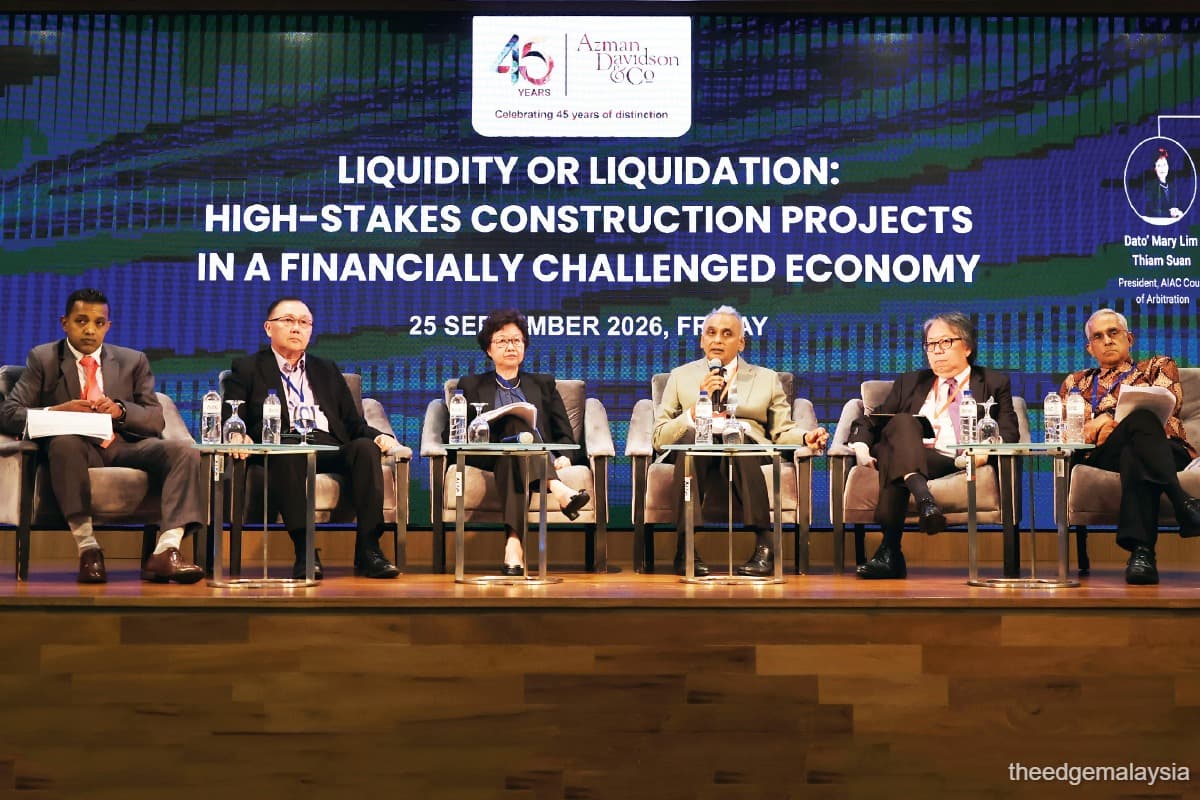
This was the message of a panel discussion titled “Liquidity or liquidation: High-stakes construction projects in a financially challenged economy” held on Sept 25, in conjunction with law firm Azman Davidson & Co’s 45th anniversary. The discussion examined how payment delays, rising costs and contractual disputes can threaten the financial viability of a project.
Azman Davidson partner Raja Kumar Raja Kandan moderated the panel, which comprised Asian International Arbitration Centre (AIAC) Court of Arbitration president Datuk Mary Lim Thiam Suan, Master Builders Association Malaysia (MBAM) immediate past president Oliver H C Wee, Azman Davidson senior partner Rajendra Navaratnam, Azman Davidson managing partner H Y Chong and ADAMPRIMUS senior partner Datuk Adam Primus.
The value of construction work done in Malaysia rose 8.8% year on year to RM47.8 billion in the second quarter of 2026, according to the Department of Statistics Malaysia. Contract awards also remained strong, with about RM234 billion recorded in 2024 and RM243 billion in 2025.
Yet construction industry growth does not necessarily translate into healthy cash flows for the companies doing the work.
“A lot of the time, it’s not really performance issues; it’s actually cash flow issues. And we are effectively [banks] without security,” Wee said.
The contractor as banker
Projects are capital-intensive, margins are tight and material costs remain unpredictable. To make matters worse, contractors often have to pay workers, suppliers and subcontractors well before receiving full payment from the employer.
Wee described the contractor’s role as increasingly resembling that of a financier, as the contractor is only paid by the developer after the contractor’s work is completed.
“Throughout the payment cycle, we realise that we have unintentionally become a funder. It is just like being a banker,” he said.
Contractors use working capital to keep projects moving while waiting for progress payments. If payments are delayed or reduced, the pressure can move down the supply chain.
Chong said contractors often have legal avenues to recover unpaid sums through adjudication or arbitration but little contractual protection against an employer that cannot pay.
“Most of the forms, of course, give you the right to seek recovery by filing an action, whether through adjudication or arbitration. But in that sense, if we are talking from the contractor’s point of view, in terms of the structure of the contract, there is very little protection if the employer is suffering,” he explained.
Growth can hide weakness
As at August, the value of contract awards had reached about RM155 billion, roughly 60% of last year’s total, according to Wee.
“There are still a lot of jobs in the market,” Wee said. He noted, however, that the risks attached to those jobs have changed.
While many contractors are locked into fixed-price contracts, material prices can rise after a contract has been signed, supply chains can be disrupted and delivery timelines can shift.
“As we continue to practise under the same format of fixed-price contracts, contractors are fighting in a more competitive situation with thinner margins,” Wee added.
“The chances of facing financial difficulties and disputes, I would say, are much higher than before.”
The panel questioned whether contractors should effectively be financing construction projects through the payment cycle.
Chong argued against this, pointing to practices in other jurisdictions where developers have to demonstrate financial strength before starting a project and where contractors have stronger forms of payment security.
“If you are a RM2 company, whatever value of security you have is the value of the assets,” he said.
Lim said standard forms generally place substantial risk on contractors. Under a fixed-price arrangement, a contractor can be caught between an agreed contract sum and costs that have risen sharply.
“I think the way forward is to have a bit more of a collaborative element in the contracting,” she suggested.
“If you had some manner of adjusting the risk allocation to take that into account for the benefit of the project, rather than for the benefit of the party that happened to have pushed all the risk to the other party, I think we would be able to get somewhere.”
Winning a dispute does not guarantee payment
Malaysia’s Construction Industry Payment and Adjudication Act 2012 (CIPAA) provided contractors with a faster avenue for resolving payment disputes. Lim said the number of CIPAA cases has risen significantly since the legislation took effect in 2014.
She added that a contractor can win the dispute and still not be able to get his money back from a financially distressed employer.
That is where liquidity starts to intersect with insolvency. For a small and medium enterprise (SME) contractor, time is particularly important. Wee noted that more than 90% of Malaysia’s approximately 130,000 registered contractors are SMEs.
“How many can survive three or four months without payment?” he asked, adding that contractors need to conduct a financial stress test before taking on a project.
“Can your bank account survive if the client really can’t pay you for three certificates, or four certificates, while material prices are escalating?”
The panellists also stressed that legal action is not always the best first response. Rajendra said the appropriate approach depends on why an employer is not paying. If an employer refuses to pay despite having the money to do so, legal action may be appropriate. But if it is unable to pay, forcing the issue may simply accelerate the collapse.
“If they genuinely cannot pay, then I suppose the only way you can resolve it, step one, is always to begin the conversation,” he said.
That could involve deferred payments, payment in kind or other arrangements.
For the industry, faster dispute resolution alone will not solve the problem. Payment security, financing structures, risk allocation and earlier negotiation all have a role to play.
Adam noted that insolvency and restructuring ultimately come down to commercial reality: whether there is a viable business, whether a project can be completed and whether there is enough value left to distribute.
“If there are surpluses, you share. If there are no surpluses, there is no deal,” he said.
Save by subscribing to us for your print and/or digital copy.
P/S: The Edge is also available on Apple's App Store and Android's Google Play.