

This article first appeared in City & Country, The Edge Malaysia Weekly on October 12, 2026 - October 18, 2026
The industrial property markets in the Klang Valley and Penang continued to be resilient in the first half of 2026, although buyers and occupiers were more selective amid economic uncertainties, higher development costs and changing business requirements.
The two property markets share a similar characteristic — underlying occupier demand remains intact — but location, infrastructure, specifications and pricing are becoming increasingly important in determining where activity is concentrated.
In the Klang Valley, demand was still supported by logistics operators, advanced manufacturers, digital infrastructure providers and small and medium enterprise (SME) owner-occupiers.
In Penang, the established manufacturing base, particularly its electrical and electronics (E&E) ecosystem, continued to underpin industrial activity. It remains fundamentally supported by occupier demand, while growth is increasingly concentrated in strategically located industrial corridors and newer developments that offer better connectivity, infrastructure and specifications.

Klang Valley: Resilient demand, selective investment
The Klang Valley industrial property market was resilient in 1H2026 despite a more selective investment environment, with geopolitical uncertainties and global trade policy risks weighing on investment activity.
According to CBRE | WTW group managing director Tan Ka Leong, occupier demand remained healthy across logistics, manufacturing and modern industrial developments, while investment activity was concentrated in well-connected industrial corridors such as Shah Alam, Klang and Bandar Bukit Raja.
This resilience was reflected in industrial property prices.
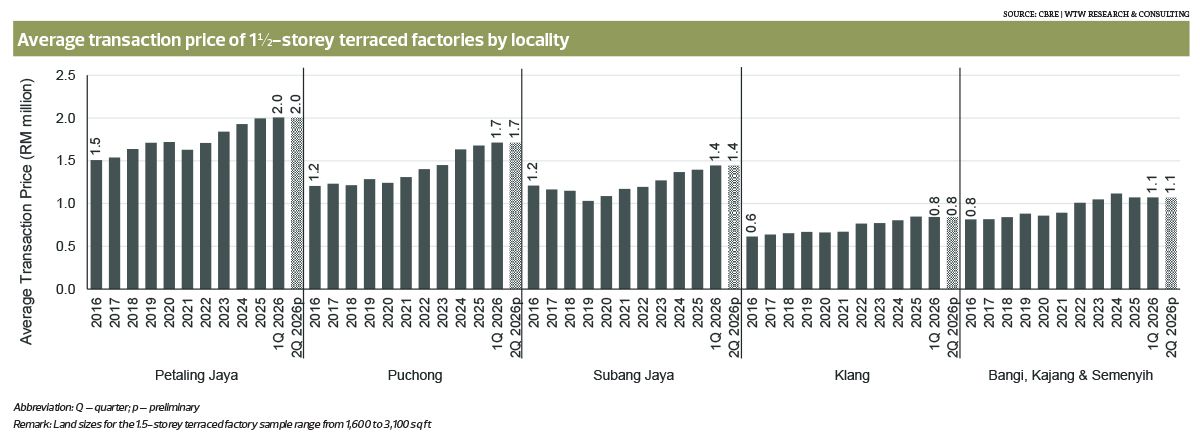
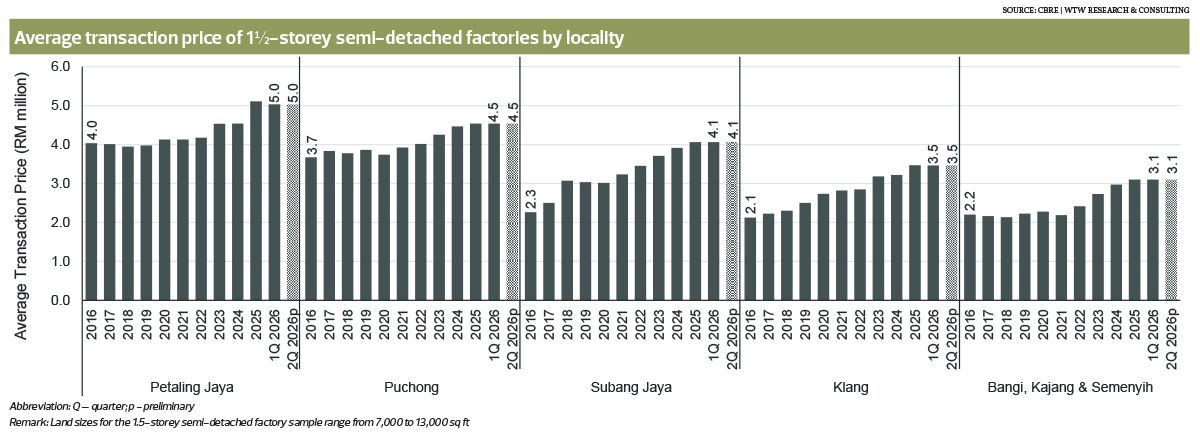
The average transaction prices of 1½-storey terraced factories remained resilient in the Klang Valley in 1H2026. Mature industrial locations such as Petaling Jaya, Puchong and Subang Jaya recorded modest price appreciation despite softer market activity, while Klang and the Bangi-Kajang-Semenyih corridor were broadly stable after several years of growth.
“The semi-detached factory segment also recorded limited price movement in most key industrial submarkets compared with end-2025 levels, reflecting a more stable capital value environment,” he says when presenting The Edge Malaysia | CBRE | WTW Industrial Property Monitor 2Q2026.

Tan attributes the resilience partly to owner-occupier demand, particularly among SMEs looking for affordable industrial premises in established locations. However, he observes that the pace of price growth has moderated amid a more selective investment environment, economic uncertainties and elevated operating costs.
Meanwhile, industrial land prices in Klang and the Bangi-Kajang-Semenyih corridor were broadly unchanged during 1H2026 after sustained appreciation over the past decade. While short-term movement was limited, the longer-term upward trend reflected the strategic importance of these corridors, supported by improving transport connectivity, logistics demand and the continued expansion of industrial activity to peripheral locations where larger development sites are available.
Market activity during the period in review also showed continued interest in established industrial locations.
Axis Real Estate Investment Trust (KL:AXREIT) acquired an industrial complex in Shah Alam’s Seksyen 16 for RM38 million and a distribution centre in Bandar Saujana Putra for RM128 million. “The transactions highlight continued investor interest in stable logistics and warehouse assets capable of generating recurring income,” says Tan.
Meanwhile, Melewar Steel Tube Sdn Bhd acquired an industrial property in Shah Alam’s Seksyen 15 for RM30 million from Melewar Industrial Group Bhd through a related-party transaction. JT Development Sdn Bhd also acquired three parcels of freehold industrial land in Kapar for RM85.8 million.
Bandar Bukit Raja Business Park Phase 1 comprises 110 acres of industrial land, with estimated completion in 2026 and asking price from RM168 psf. ELEV8 Entrepreneurs’ Park in Bandar Baru Salak Tinggi covers 95.6 acres and is expected to be completed by 2028, offering semi-detached factories from RM4.5 million and cluster factories from RM3.9 million.
In Telok Panglima Garang, EuroHub Industrial Park spans 10 acres and is scheduled for completion in 2028, with semi-detached factories priced from RM5.7 million. Meanwhile, MH Industrial Park covers 4.5 acres and is expected to be completed in 2027, with semi-detached factories from RM7.5 million.
Tan expects the Klang Valley industrial property market to remain fundamentally resilient over the medium term, supported by demand from logistics operators, manufacturers, digital infrastructure providers and SME owner-occupiers.
“The implementation of the New Incentive Framework from March 2026 is expected to further support Malaysia’s transition to higher-value investment activities by encouraging industrial upgrading, technology adoption and productivity enhancement. This may encourage greater investment in advanced manufacturing and modern industrial facilities with enhanced specifications and infrastructure capabilities,” he says.
At the same time, global trade uncertainties, evolving tariff policies and elevated construction costs could moderate investment activity in the near term. Demand is expected to remain concentrated in strategically connected corridors such as Klang, Shah Alam and Bandar Bukit Raja, while expanding industrial locations such as Telok Panglima Garang and Bandar Baru Salak Tinggi could gain further traction because of greater land availability and more competitive pricing.
“Consequently, developers continue to adopt phased development strategies while expanding the supply of industrial plots and modern factory products in strategically connected industrial locations,” he adds.
Penang: Manufacturing continues to anchor demand
In Penang, the industrial property sector was stable, supported by its established manufacturing base and continued demand from E&E, logistics and related industrial sectors.
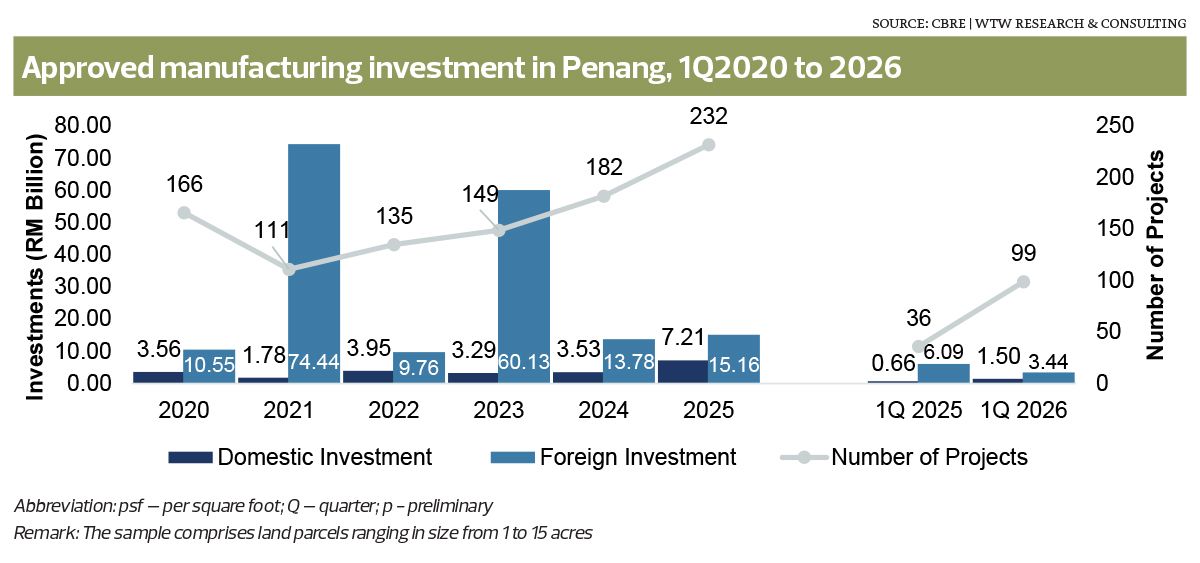
According to CBRE | WTW senior director Peh Seng Yee, approved private investments in the state stood at about RM32.9 billion in 2025 (745 projects), compared with RM31.9 billion in 2024 (520 projects).
“In 1Q2026, there were about RM6.23 billion worth of approved private investments from 147 projects, with foreign direct investments (FDIs) accounting for about 58% and domestic direct investments (DDIs) 42%. Manufacturing remained the principal investment driver in 2025, with Penang recording RM22.4 billion from 232 approved manufacturing projects, compared with RM17.3 billion from 182 projects in 2024,” he says.
In 1Q2026, approved manufacturing investments totalled RM4.94 billion, down from RM6.75 billion in the previous corresponding period. FDIs accounted for 70% of the approved investments in manufacturing, while DDIs made up the remaining 30%.
Penang’s existing industrial property stock stood at 10,055 units in 1Q2026, up from 9,974 units in 2025. Future supply stood at about 158 units, with the pipeline concentrated in Seberang Perai, where greater land availability and infrastructure provision offer more scope for industrial expansion than on Penang Island.
“Industrial property overhang remained low at seven units valued at about RM22.4 million in 2025, down from 26 units worth RM44.7 million in 2024. No industrial overhang units were recorded in 1Q2026, indicating that completed unsold stock had been absorbed without a material accumulation of inventory,” says Peh.
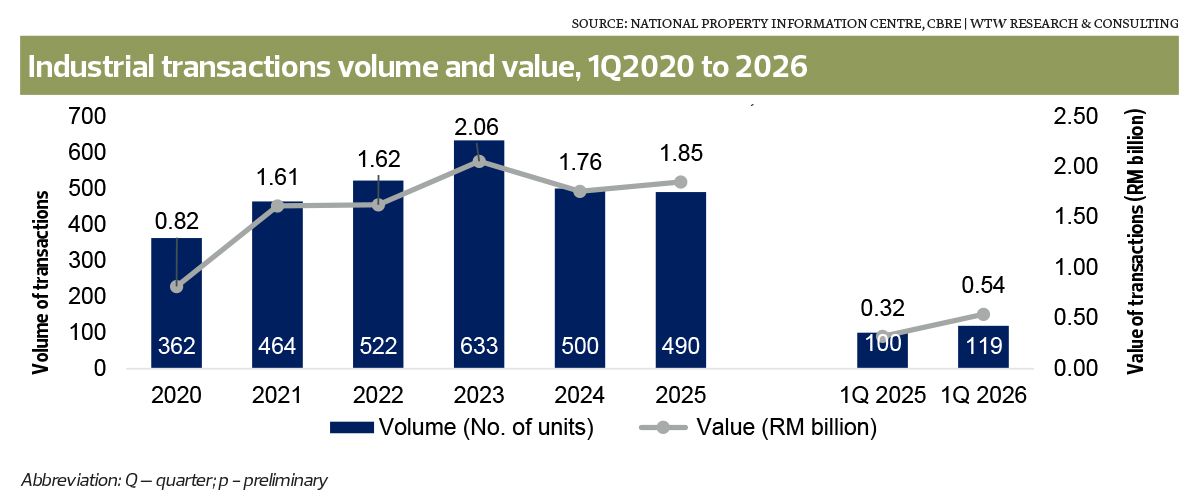
Transaction activity was also evident during the period in review. Penang recorded 490 industrial property transactions worth RM1.85 billion in 2025, compared with 500 transactions valued at RM1.76 billion in 2024. In 1Q2026, there were 119 transactions worth RM540 million, representing a 41% year-on-year increase in transaction value.
The asking prices of industrial land in selected newer parks developed by the Penang Development Corporation in Seberang Perai generally ranged from RM70 to RM105 psf.
Penang Science Park and Penang Science Park North had an asking price of RM70 psf while Batu Kawan Industrial Park fetched RM85 psf. In Batu Kawan Industrial Park 3, the asking prices were between RM85 and RM105 psf, whereas in Bandar Cassia Technology Park, it was RM90 psf.
Rental rates also varied according to location and building specifications. As at 2Q2026, monthly rents ranged from RM2.50 to RM4.50 psf in Bayan Lepas Industrial Park, RM1.80 to RM3.50 psf in Batu Kawan Industrial Park and RM1.30 to RM2.80 psf in Prai Industrial Park.
Expansion shifts towards Seberang Perai
Much of Penang’s future industrial growth is expected to take place on the mainland, where larger parcels of land are available for new industrial parks and manufacturing facilities, says Peh.
The pipeline includes Bandar Cassia Technology Park, which spans 382 acres and is expected to be completed this year, and Penang Technology Park @ Bertam, which spans 880 acres and has asking prices of RM65 to RM95 psf. Other developments include Northern TechValley @ BKE, Batu Kawan Industrial Park 3, Penang Science Park South and the Green Tech Park component of Penang Silicon Island.
S P Setia Bhd (KL:SPSETIA) broke ground on the 509-acre Setia Fontaines Industrial Park in Bertam, Kepala Batas, in June. The project will offer light industrial, medium industrial and commercial lots aimed at SMEs and larger companies.
The concentration of new projects on the mainland reinforces Seberang Perai’s role as Penang’s principal industrial expansion corridor. Greater land availability allows newer parks to accommodate larger-format manufacturing and logistics requirements.
“Market attention has increasingly shifted towards higher-specification logistics and warehousing facilities that support manufacturing supply chains, trade-related activities and associated industrial users,” says Peh.
“Recent completions include Penang Logistics Hub 5, with 0.24 million sq ft in Bayan Lepas Valdor I, with 0.62 million sq ft in the Valdor Industrial Area, and PTT Semicon Logistics Hub, a purpose-built automated facility of about 0.42 million sq ft in Valdor. Several near-term pipeline developments are expected to expand the supply of modern logistics space further.”
The logistics pipeline includes Valdor II, expected in 2026, and the Penang International Logistics Aeropark in Bayan Lepas, which spans 104 acres and is aimed at strengthening the state’s logistics and air cargo infrastructure.
Infrastructure and industrial expansion
Several major infrastructure initiatives are expected to support Penang’s longer-term industrial competitiveness, according to Peh.
Penang Silicon Island covers about 2,300 acres, with about 300 acres, or 13%, reclaimed as at early 2026. Its master developer, Silicon Island Development, has unveiled a 700-acre Green Tech Park.
The Penang International Airport expansion is another relevant development for export-oriented manufacturing and time-sensitive logistics. The RM1.2 billion expansion is intended to almost double the airport’s annual passenger handling capacity from 6.5 million to 12 million, with the new terminal expected to commence operations by 2027 and full completion targeted for 2028.
The Penang LRT project is expected to improve broader urban connectivity and labour mobility over the longer term, although CBRE | WTW notes that it is not a direct industrial market catalyst in the short term.
Taken together, these initiatives are expected to support Penang’s long-term development readiness alongside its established industrial ecosystem.
As for the industrial property market, Peh notes that the outlook remains constructive, but demand is unlikely to be broad-based across all product types. He expects market response to remain selective, favouring well-located industrial parks, modern logistics facilities and higher-specification properties offering infrastructure readiness, connectivity and operational efficiency.
Save by subscribing to us for your print and/or digital copy.
P/S: The Edge is also available on Apple's App Store and Android's Google Play.