

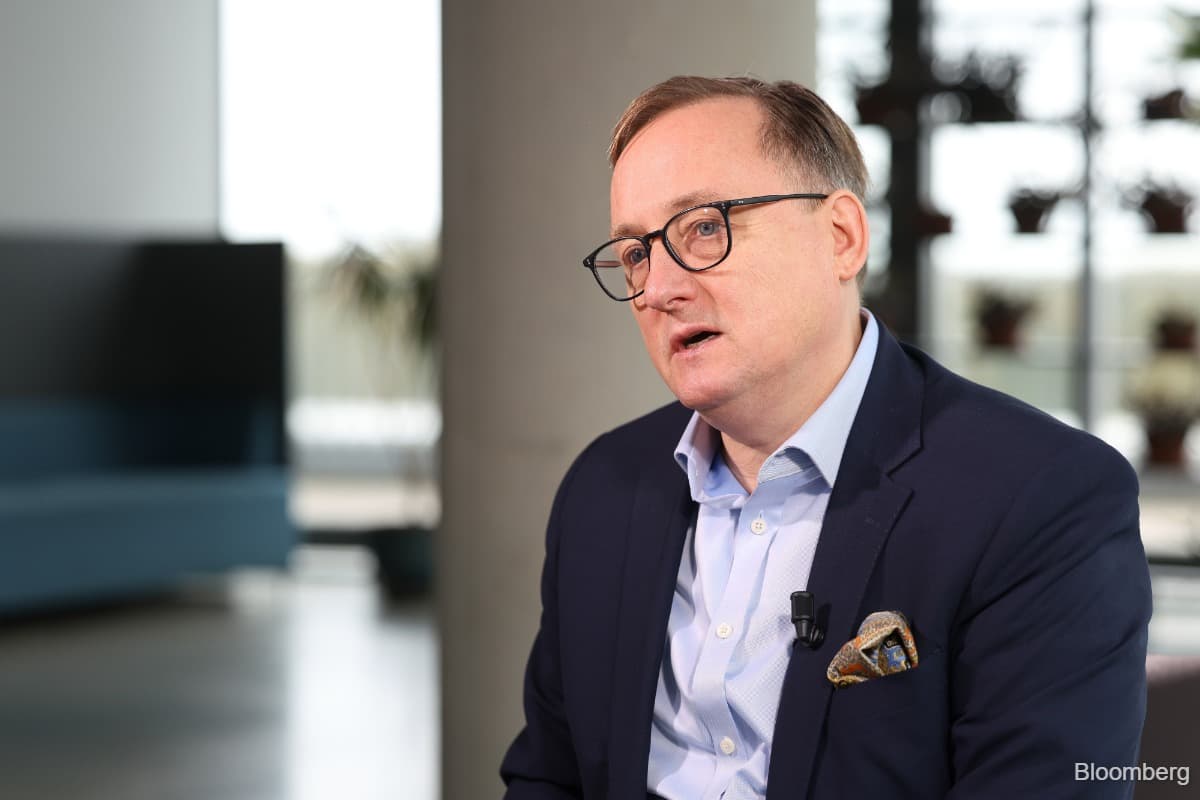
(Oct 15): The European Central Bank can afford to take some time in analysing inflation dynamics that are shaped by opposing forces in the global economy, governing council member Martins Kazaks said.
While the persistent rise in oil and gas prices is set to keep consumer-price growth elevated, the selloff in government debt in recent weeks might start to weigh on economic activity, the Latvian central-bank chief said in an interview.
“My feeling is that the inflationary forces will still be stronger in the immediate future,” Kazaks said in Bangkok, where he’s attending the IMF’s annual meetings. “So the direction of policy is clear, even if there isn’t any immediate need to rush on rates. We’re not behind the curve, so in that sense, we’re well positioned.”
ECB officials are debating what to do next after raising rates twice since the start of the Iran war this year. With inflation approaching 4%, some have said that more tightening might be necessary to return to the 2% target.
Belgian central-bank chief Pierre Wunsch told Bloomberg Television this week that “we are probably going to have to hike again,” even if uncertainty is elevated. His Lithuanian colleague Gediminas Simkus agreed, saying that recent evidence suggests a need for higher borrowing costs.
Kazaks highlighted that risks to inflation on the upside are “still bigger than the risks to growth on the downside.” However, the threats to economic expansion “are at risk of being more nonlinear,” he said.
Against such a complex backdrop, decision-making at the Frankfurt-based institution could become more complicated as rates breach a level above which they’re estimated to restrict the economy, according to Kazaks.
“The tradeoffs for monetary policy are going to get more tricky,” he said. “So far, the decisions have been relatively easy. But there’s a lot of uncertainty and very low visibility.”
Adding to the challenge is France, which has led the recent bond selloff as the government struggles to reduce its budget deficit. Yields in other highly indebted euro nations have risen as well, raising concerns that market moves hamper the transmission of monetary policy and force the ECB to intervene.
“Unwarranted volatility in financial markets would be a worry, but it doesn’t mean that any stress in financial markets becomes our problem,” Kazaks said. “There’s still time to fix the fiscal issue, and I would urge it to be done.”
The French government has presented plans to narrow its deficit and now needs to prove to nervous financial markets that it can implement them. Speculation about possible ECB intervention has grown after the premium investors demand over equivalent German debt rose to the highest level since the euro-area crisis.
But monetary policy shouldn’t get involved by helping lower French borrowing costs, Kazaks said.
“It’d be very shortsighted and counterproductive to make it the solution to all the problems,” he said.
“Of course, transmission of monetary policy is of interest to us and we will follow that,” he added. “If things become disorderly, we will do what is necessary. But we shouldn’t try to solve every possible problem.”
Kazaks also touched on minimum reserve requirements, a topic that’s lingered for a while.
An increase would remove liquidity from circulation and contribute to quantitative tightening. It would also lower central banks’ interest payments, helping them address losses accrued as a result of quantitative easing.
“If we have a policy case to use it, then we should,” Kazaks said. “We explain it to the market so that our reaction function is understandable, and then it’s going to be alright.”
Lithuania’s Simkus said on Wednesday that “there’s nothing wrong with discussing it” and that the current level isn’t “carved in stone.”
Uploaded by Evelyn Chan