


KUALA LUMPUR (Oct 15): Federal funding to states should be driven by development needs and revenue capacity rather than political favouritism, an opposition member of Parliament urged on Thursday, calling for a transparent and formula-based allocation system.
Kemaman MP Datuk Seri Dr Ahmad Samsuri Mokhtar (PN-PAS) proposed a fiscal equalisation framework that takes into account four factors: each state’s spending needs, ability to generate its own revenue, infrastructure gaps, and cost of development and delivering public services.
“Through this approach, allocations can be distributed according to clear criteria, rather than depending solely on the discretion of the federal administration, let alone partisan political considerations or the closeness of relationships,” the Terengganu MB said when debating Budget 2027 in the Dewan Rakyat.
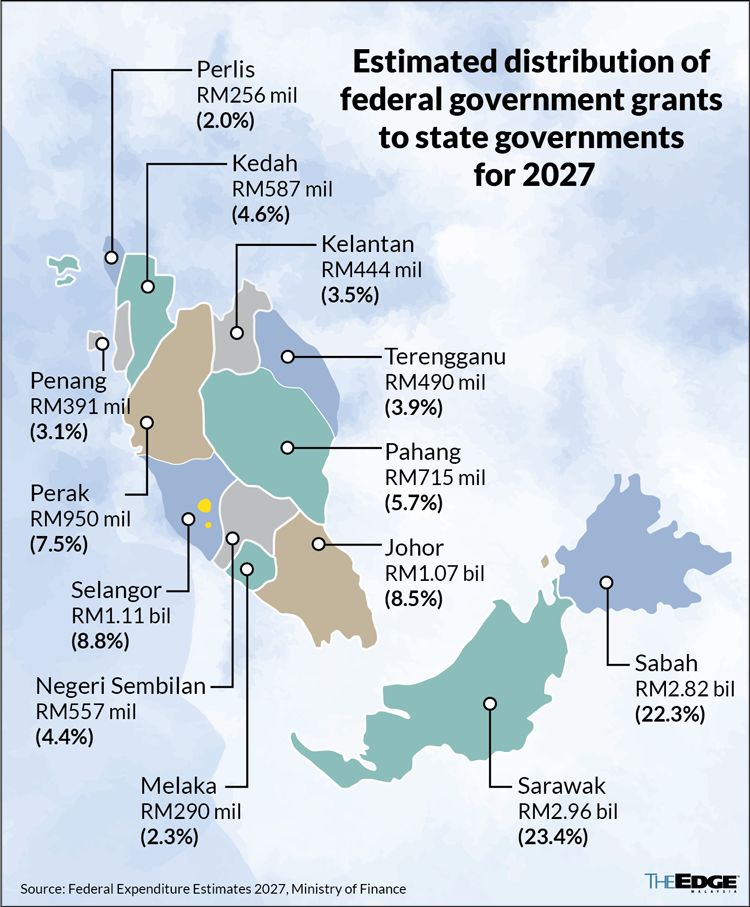
The Ministry of Finance’s Federal Expenditure Estimates 2027 report allocated RM12.63 billion in grants and financial assistance to state governments, up 16.9% from RM10.80 billion in 2026. The funding falls under federal operating expenditure and covers 15 categories of grants and assistance.
Terengganu is estimated to receive RM490 million in federal government grants, accounting for 3.9% of the total allocation to state governments. Sarawak will receive the highest allocation at RM2.955 billion, or 23.4%, followed by Sabah at RM2.816 billion, or 22.3%. Perlis will receive the lowest allocation at RM256 million, or 2%.
Ahmad Samsuri said equal allocations do not necessarily produce equitable outcomes, as states differ in their ability to build infrastructure, attract investment and raise household incomes.
“The size of an allocation alone is insufficient to determine whether a policy is truly fair. What matters more is the extent of the development gap and each state’s capacity to develop its economy,” he said.
While Article 109 of the Federal Constitution already provides a foundation through capitation and state road maintenance grants, Ahmad Samsuri argued that existing mechanisms should respond more closely to differing state needs.
Population alone does not capture the cost of providing basic amenities. Land area, population distribution and existing infrastructure also affect the resources needed to deliver public services, he argued.
Ahmad Samsuri also questioned why the principle of a transparent and equitable funding formula being discussed for Sabah and Sarawak could not also inform efforts to narrow development disparities between peninsular states.
“If the government accepts the importance of a transparent and justice-based formula in fiscal relations with Sabah and Sarawak, why can't the same principle be considered to strengthen development equalisation among the states in the peninsula to ensure greater fairness? I believe that a formula with a clear periodic review mechanism and open reporting is a form of reform or refinement that can be implemented in the future.” he said.
For more Parliament stories, click here.