

PETALING JAYA (Oct 14): Capital investment in technology is surging but workforce readiness remains a challenge, leaving enterprises short of the returns they expect.
According to Coursera global head of enterprise Anthony Salcito, an internal survey found that 79% of Malaysian companies are investing in artificial intelligence (AI) technologies but only 43% of them know whether their teams actually hold the skill sets required to use these tools effectively.
On top of that, 55% of organisations have no formal training plan, jumping into software procurement before preparing their people.
This misalignment is creating widespread inefficiency and excessive spending on AI model tokens. Some companies are "tokenmaxxing", where employees or teams maximise their token usage and treat high consumption as proof of productivity or AI-native status, with no tangible gains to show for it.

Meanwhile, figures from TalentCorp’s Impact Study of AI, Digital and Green Economy on the Malaysian Workforce in June indicate that while automation threatens tasks across 600 existing job roles, more than 120 new job titles are entering the local market with virtually no talent supply.
"There are many examples throughout human history where technology has been the driver and figuring out how people are maximising the technology comes after. Organisations increasingly need to put people first to enable talent to not only understand the foundation of AI but [also] how to apply it to the specific job,” says Salcito.
He adds that while businesses previously concentrated tech capabilities within specialised IT units, representing 5% to 8% of an organisation, generative AI (Gen AI) has shifted expectations.
Today, almost every role requires technology skills, with employees across legal, finance, customer service and management expected to build custom workflows and AI agents.
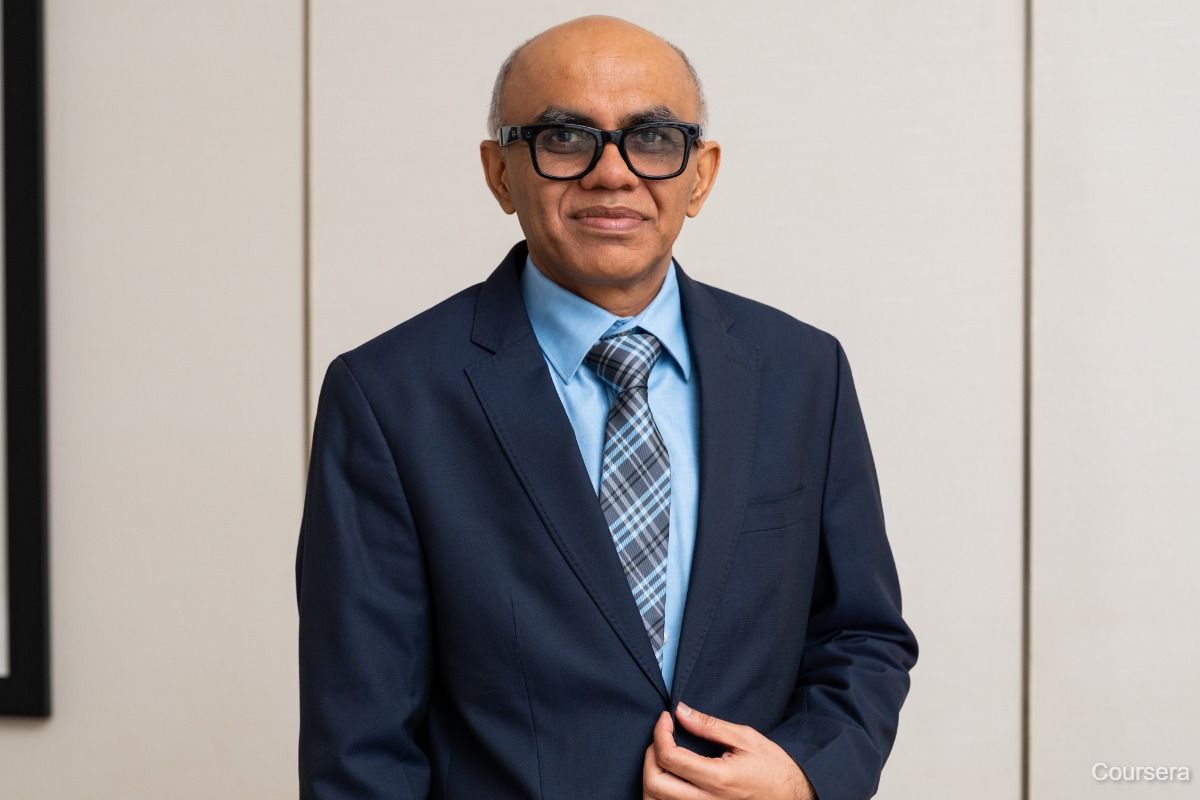
Coursera Asia Pacific managing director Ashutosh Gupta concurs.
"Organisations are realising that spending on AI is important and a lot of them are realising that spending is inefficient. It's not the technology; it's because people who are using the AI are not skilled to use it," explains Gupta.
Salcito cites Maxis as an example. When the telco set out to become an AI-driven organisation, management avoided generic introductory courses.
Instead, they worked backwards from specific workplace challenges, tailoring skilling pathways to what individual employees were trying to achieve on the job.
“That is the right way to get the right impact versus getting everyone [to learn the] fundamentals of AI [to carry out] automation tasks with it, as opposed to deeply thinking about how they can not only think differently but [also] solve problems in new ways,” says Salcito.
Shifting from courses to outcomes
To address this widespread AI inefficiency, Coursera and partner platform Udemy are introducing Project Helix, an AI-powered engine designed to transition enterprise learning from passive content consumption to verified skills and business outcomes.
Rather than requiring human resource directors or employees to search through a catalogue of 335,000 learning objects across Coursera and Udemy, Helix begins with a targeted organisational outcome, such as improving customer response times or operational efficiency.
The platform assesses existing employee skill profiles, constructs personalised learning pathways and reinforces concepts using interactive AI role-plays, hands-on labs and playgrounds.
"We are moving away from the old metrics of 'I have completed a course', which doesn't mean anything. What it means is 'I have acquired a skill, I have verified that skill and here is the verification through a credential'," says Gupta.
Upon completion, learners receive industry-recognised micro-credentials. Coursera’s research indicates that 92% of employers recognise micro-credentials during hiring, viewing them as actionable signals that candidates are job-ready.
“We also have employers tell us that when they hire people who have micro-credentials, they perform better in the early years of their employment, [which means that] they're coming in much more ready for the work,” Salcito says.
Soft skills also in demand
Data from Coursera’s latest Global Skills Report shows both rapid local momentum and areas where Malaysia trails regional peers. In the global AI-Human Skills Synergy Index, Malaysia ranks 36th.
While Malaysia's growth in AI course enrolments (49% year on year, or y-o-y) and AI micro-credential uptake (93%) lag Asia-Pacific averages, some technical areas are growing far faster.
AI security is the fastest-growing skill category, with enrolments up 314% y-o-y, followed by agentic workflows (156%) and Gen AI (114%).
Enrolments in complex problem-solving grew at the same 114% pace, alongside critical thinking (69%) and innovation (41%).
Gupta says human judgement will differentiate us when technical tools become commoditised.
"You and I can both learn AI or [how to use] ChatGPT or any generative AI tool but how we apply it and think about it is going to be the key differentiator," he says, adding that Malaysian users simultaneously pair AI prompting with people leadership, stakeholder alignment and complex problem-solving.
Malaysia’s AI nation ambitions
The imperative to close this national skills gap is tied to government policy. Under the Malaysia Digital Action Plan 2030 (MD2030), the country aims to transform into a fully-fledged "AI Nation" by 2030, targeting a 30% digital economy contribution to national gross domestic product (GDP).
Complementing this is the National AI Action Plan 2026-2030, which coordinates responsible adoption, infrastructure, talent and trust.
To build public sector capability, a national initiative is underway to equip 445,000 civil servants with Gen AI tools and formal learning support. Coursera is expanding its involvement across Malaysia's tripartite ecosystem, which spans citizens, enterprise and universities.
On the public sector front, Coursera collaborates with MyDigital on the Rakyat Learning Pass. One citizen course, Understanding Digital Business, aimed at establishing baseline digital literacy, was built in 15 minutes using Coursera’s AI-driven Course Builder tool.
Coursera is also working with the Human Resource Development Corporation (HRD Corp) to help companies tap into centralised levy funds for structured workforce upskilling.
While multinationals have extensive human resources and learning and development (L&D) departments, small and medium enterprises (SMEs), which make up the bulk of Malaysian businesses, often lack the budget to build internal L&D infrastructure.
Gupta explains that Coursera addresses this through small-team plans (such as five- to 10-member licences) and industry association partnerships.
"SMEs might not have the capex but they have the agility," Gupta says.
"For smaller companies, they don't know 'What should I be learning?' or 'What skills should I be requiring for my employees?' and Helix is going to get them [up to speed] very quickly, giving them the foundation to identify skills, assess people and create a personalised pathway with very little work."
"Small businesses live and die by the impact of their people. Scaling and skilling them up is what you need to do and that's something that Helix will power,” says Gupta.
Re-engineering tertiary education with dual credentials
Bridging the persistent mismatch between academic output and industry demands requires structural changes within higher education. Malaysian institutions are increasingly integrating industry micro-credentials into traditional degree programmes.
Brickfields Asia College was Coursera's first university partner in Malaysia. There, 15% of students' overall grades come from Coursera content, allowing graduates to earn an academic degree alongside professional certificates from global tech leaders such as Google and Microsoft.
At Wawasan Open University, about half of the content and credits for its open degree programmes come from Coursera’s catalogue.
"Faculty members are starting to embrace the opportunity to blend their courses, creating flipped learning environments where students are assigned content and then reflect on it in the classroom," Salcito explains, adding that tools like CourseBuilder allow professors to update outdated curricula in minutes rather than years.
When asked whether micro-credentials will eventually render traditional tertiary degrees obsolete, Salcito says it is not a case of choosing between the two.
"It's an 'and' for me, not an 'or'. Micro-credentials with a degree are certainly a competitive advantage for learners. Students that do both are going to be better positioned for success,” he says.
The same applies to companies facing talent shortages. Gupta says developing existing staff yields far better returns than aggressive external hiring.
"You can go out and hire talent but there are theoretically 100 people and everyone is trying to hire the same 100 people, pushing up costs," Gupta explains.
"A lot of companies are now asking: 'Can we double up our own internal talent?' By auditing skills inventory, companies can identify adjacent capabilities and provide core AI training internally. That saves costs, empowers employees and enhances the employer talent brand."
The pace of change in workplace technology makes continuous learning essential for Malaysia's workforce.
"It's no longer a situation where I'm learning something and then moving on and using it," Salcito says.
"You need to continue to refine and build your skills over time. A student graduating university with a hunger to continue learning is more valuable than what they actually learned in college. That skill value is how employees will be assessed in the future."