

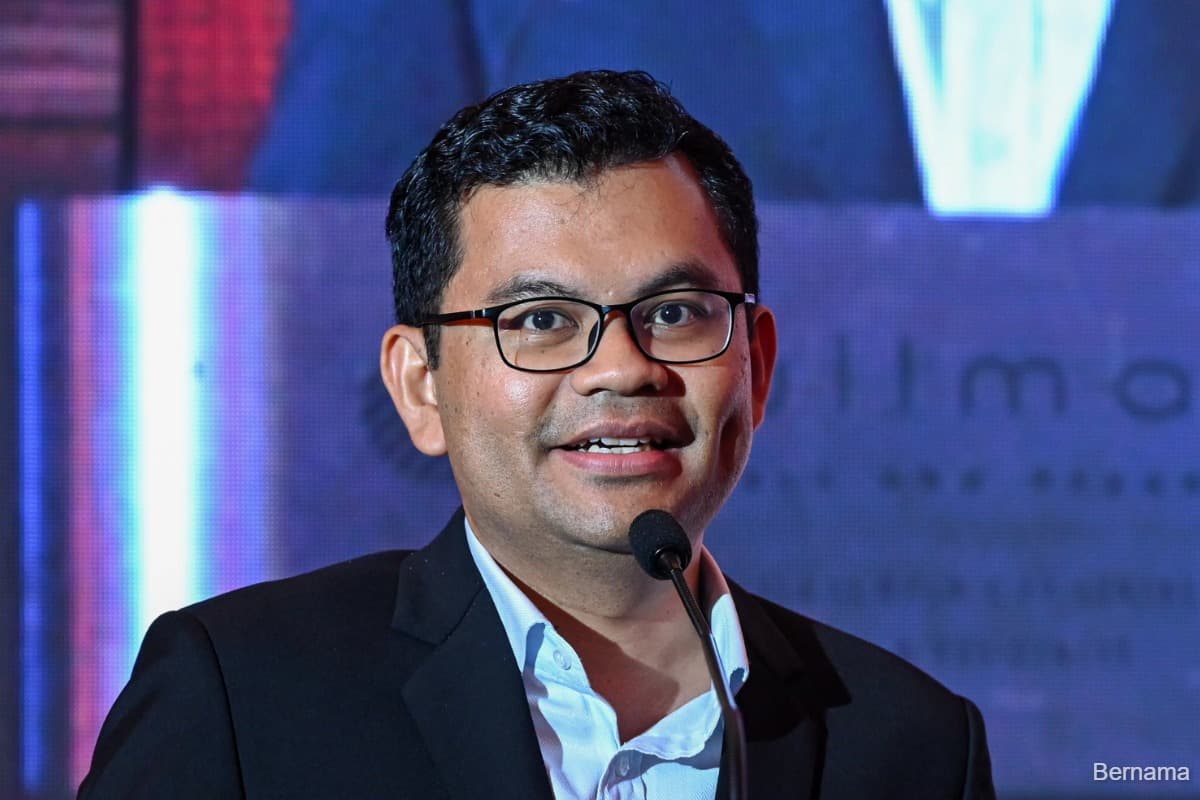
KUALA LUMPUR (Oct 14): The government aims to create 500,000 job opportunities through artificial intelligence (AI)-related plans, in line with efforts to upgrade workforce skills to meet changes in the labour market.
Economy Minister Akmal Nasrullah Mohd Nasir told the Dewan Rakyat on Wednesday that developments in AI, digitalisation and automation should be viewed as opportunities to restructure the economy, particularly by expanding high-growth, high-value (HGHV) industries and other high-impact strategic sectors.
“The challenge is how to increase the adoption of technology to facilitate work or improve workforce efficiency,” he said in reply to a supplementary question from Datuk Awang Hashim (PN-Pendang) on the number of workers affected by AI technology and efforts to upgrade skills to address the challenge.
He said last year, 57% of the workforce were in semi-skilled jobs with another 12.9% were in low-skilled occupations, while a Stanford University study published last month stated that generative AI benefited experienced and highly skilled workers but posed challenges for those in low-skilled jobs.
“Under the 13th Malaysia Plan (13MP), the government aims to increase the proportion of skilled jobs to 35% of the workforce by 2030, from 30.1% in 2025,” he said.
Replying to the original question from Jimmy Puah Wee Tse (PH-Tebrau) on measures to provide a clear workforce transition plan in response to AI, automation and digitalisation, Akmal Nasrullah said national policies and development plans also took into account talent requirements to address technological changes.
These included the 13MP, the New Industrial Master Plan 2030 (NIMP 2030), the National Energy Transition Roadmap (NETR), the National Semiconductor Strategy and the Malaysia Digital Action Plan 2030.
Meanwhile, he said a study by Talent Corporation Malaysia Bhd in November 2024 had found that 90% of existing jobs would remain relevant through skills adaptation, while 10% faced the impact of automation or job functions changes due to AI developments, digitalisation and the green economy.
“To ensure that developments in AI, digitalisation and automation do not lead to large-scale job losses, talent development programmes covering certification, upskilling and reskilling will continue to be strengthened.
“Cooperation between the public sector, industry and academia will be intensified for this purpose, including through the MyMahir Future Skills Talent Council (MyMahir FSTC). A total of 17 MyMahir FSTCs have been established, each chaired by a different industry player,” he said.
For more Parliament stories, click here.
Uploaded by Chng Shear Lane