

(Oct 14): ASML Holding NV boosted its 2026 sales forecast and said soaring artificial intelligence spending meant that it will not be able to fully meet demand for its chip-making machines in the next two years.
The Veldhoven, Netherlands-based firm projected annual sales of between €44 billion (RM200.77 billion) and €45 billion this year, it said in a statement Wednesday. The low end of the range was previously €43 billion.
ASML said its current supply plans mean it will not be able to fully meet demand in 2027 and 2028. “We are investigating ways to increase capacity for 2028 beyond the 30% increase we previously communicated,” CEO Christophe Fouquet said in the statement.
ASML’s results can provide a window into chipmakers’ plans because the company’s advanced tools have a lead time of more than a year between order and delivery. Industry players are increasingly questioning whether the AI boom is sustainable. There was a global selloff in semiconductor stocks this week after Broadcom Inc CEO Hock Tan likened investor sentiment in the industry to a casino.
Investors have flagged concerns about whether ASML can fulfil orders while the market is hot. In July, ASML said it plans to boost capacity by 30% next year for its second-most advanced tool, the low-NA extreme ultraviolet lithography machine, which would take its annual shipment target to about 85 units.
The chip-gear-maker's customers have boosted their equipment demand forecasts based on the “size and duration of AI-related investments", Fouquet said. Some customers “are expressing an interest in placing orders with us for 2029 and even 2030”, he said.
ASML is the only company that makes the cutting-edge lithography machines used to produce semiconductors for the data centres powering the AI boom. Its outlook offers an indication of investment plans by chipmakers like Taiwan Semiconductor Manufacturing Co, Samsung Electronics Co and Intel Corp as spending on AI infrastructure surges.
The company is working to ship tools faster to customers by reducing the cycle time or the period between starting production in its clean rooms and shipping a completed machine. It began construction on its second industrial campus in the Netherlands, the first phase of which is set to be completed in 2029.
The AI spending spree propelled ASML to become Europe’s most valuable company, with its shares up 64% so far this year.
Net sales in the July to September quarter rose to €11.66 billion, ASML said. That compares with the average analyst estimate of €11.7 billion, according to data compiled by Bloomberg.
The company sold 17 EUV machines in the quarter while revenue from the service and upgrades of machines already installed at customers’ sites increased 19% in the quarter as chipmakers looked to be more productive.
“Against the backdrop of an overall 36% increase in 2026 in comparison to 2025, you see that that is largely driven by EUV,” chief financial officer Roger Dassen said in a video accompanying the results. “So the EUV business grows over 45% this year.”
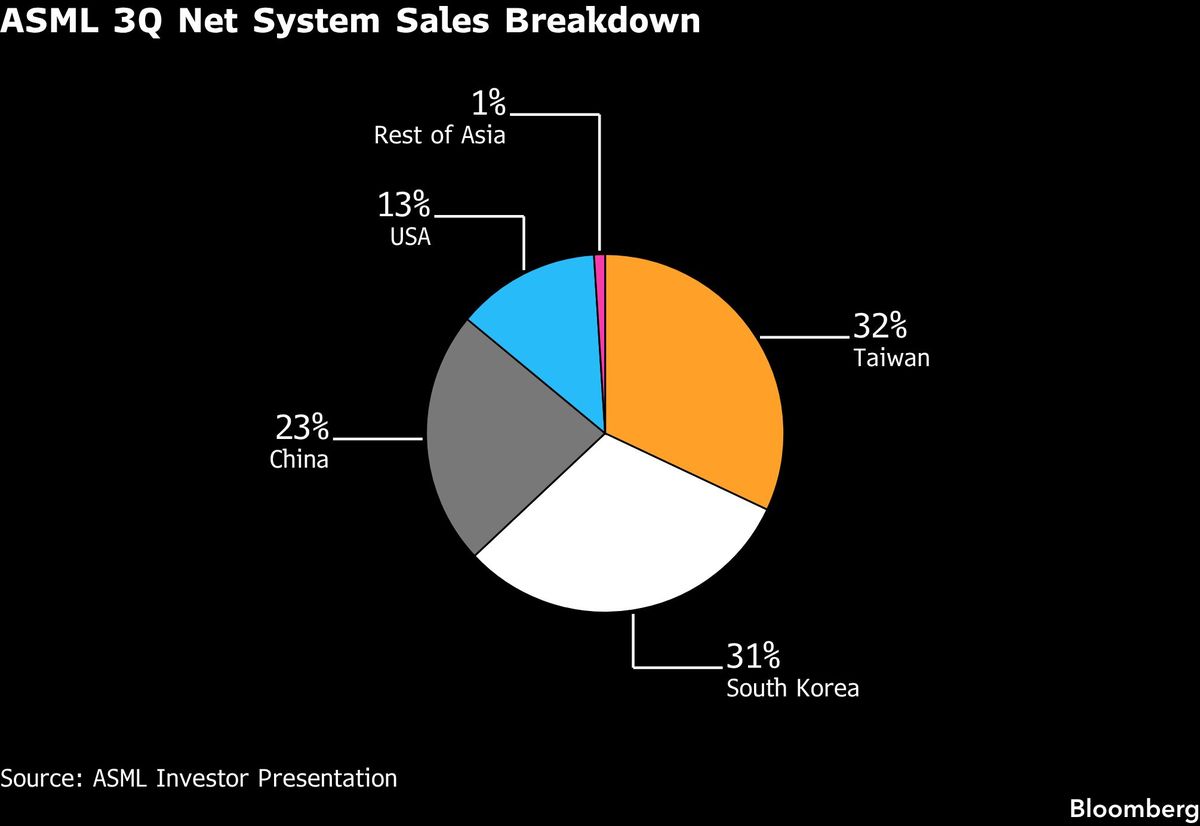
South Korea remained ASML’s largest market for new system tools in the third quarter, followed by Taiwan and China. China is expected to account for about 20% of ASML’s total revenue this year.
Last quarter, top chipmakers announced plans to order ASML’s most sophisticated chipmaking tool, which costs US$400 million (RM1.63 billion) per unit. Samsung and TSMC said they would begin to mass produce chips with high NA EUV tools by 2028 and 2030, respectively. Intel Corp said in September it had already processed more than a million wafers using the technology.
There are also growing concerns over the potential dangers of AI. Companies including OpenAI and Anthropic PBC have revealed a number of incidents in which models behaved in unsanctioned ways. These disclosures have fuelled concerns about AI security risks, prompting talk about slowing or pausing development of cutting-edge AI.
Microsoft Corp CEO Satya Nadella recently called for exercising restraint, adding that those deploying advanced AI shouldn’t only depend on assurances from AI model makers.
Uploaded by Arion Yeow