

(Oct 14): Singapore’s central bank unexpectedly left monetary policy unchanged as it expects both the global energy crunch and the artificial-intelligence (AI) boom to ease up in 2027.
The Monetary Authority of Singapore (MAS), which uses the exchange rate as its main policy tool rather than interest rates, kept the slope, width and centre of its policy band unchanged, it said in a statement on Wednesday. It’s the first pause after consecutive rounds of tightening in its April and July meetings.
Only three of 20 economists surveyed by Bloomberg News predicted the decision, with the majority expecting the MAS to increase the slope of the policy band. A majority of respondents also expected the central bank to retain a hawkish bias. On the same day, Singapore reported its economy grew at its slowest pace in a year in the third quarter.
The Singapore dollar was down 0.1% versus the greenback at 1.28. The benchmark Straits Times Index closed 0.4% lower.
The MAS’ back-to-back moves may still be working their way through the economy, “hence the central bank sees no need to add further to the tightening at this point”, said Khoon Goh, head of Asia research at Australia & New Zealand Banking Group, who was among the few that correctly predicted the hold.
The MAS narrowed its forecast for core inflation to 1.5%-2% for this year, from the previous projection of up to 2.5% at its July meeting. Headline inflation should come in at around 2%, it said.
Both gauges are seen to average 1.5%-2.5% next year, with import costs and supply disruptions to energy and food ebbing, according to the central bank. Domestic price pressures should stay subdued, also aided by government subsidies to health and education.
Core inflation should “remain slightly elevated in the immediate quarters ahead”, before it’s projected to “ease discernibly” from mid-2027, the MAS said. In July, it had said it expected inflation next year to “moderate discernibly”.
The MAS — the first central bank in Asia to tighten monetary policy after the outbreak of the Iran war — may be taking its time to assess how persistent price pressures are after core inflation climbed to a two-year high of 2.2% in August.
The current policy stance can “lean against the anticipated near-term rise in imported inflation, ensuring the gradual easing of inflationary pressures in 2027”, the central bank said. “MAS is well-positioned to respond effectively to any risk to medium-term price stability and will continue to closely monitor economic developments.”
Singapore policymakers sounded less hawkish and “less concerned about the inflation outlook”, according to HSBC Holdings plc’s Yun Liu. Still, they will likely keep the door open in case further tightening is needed later on, she said.
Public transport fares will be hiked in December, following an increase to electricity and gas fees last quarter. The re-escalation of fighting in Iran, as well as the weather disruptions from El Niño, threaten to fan food and fuel costs further.
Slowing momentum
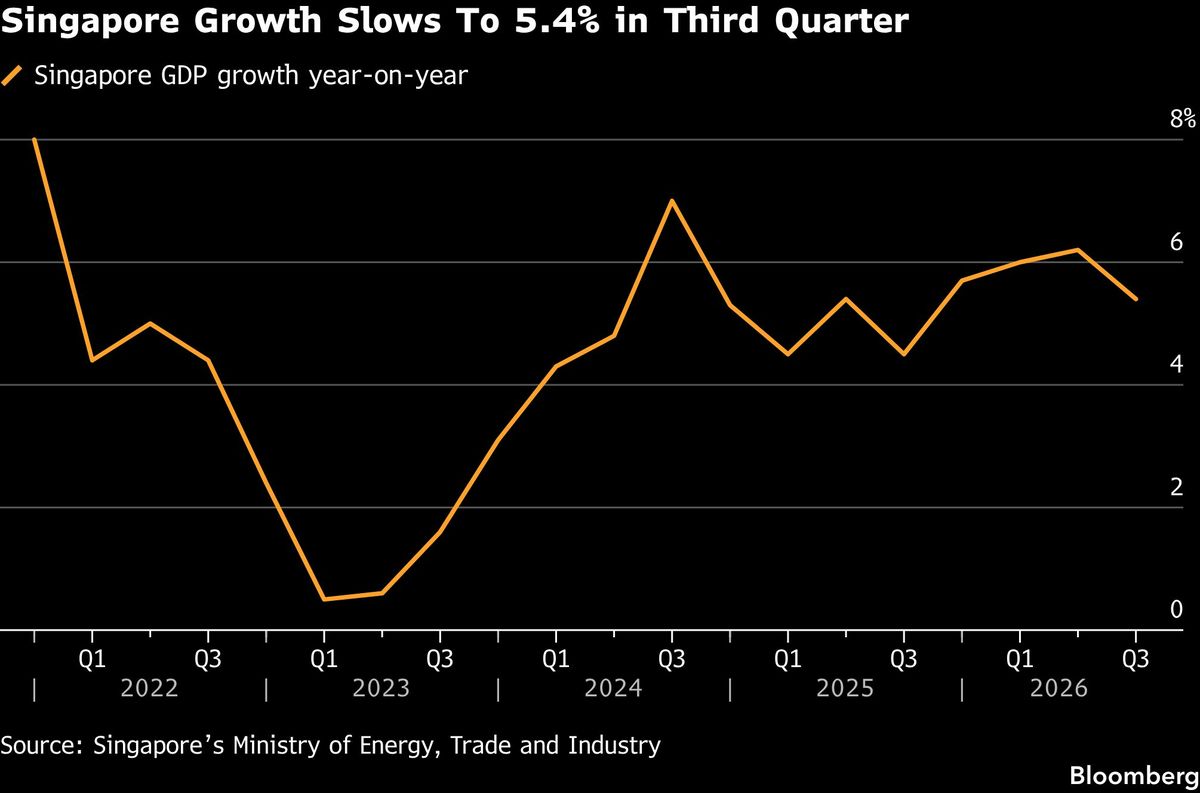
That’s happening against the backdrop of softening economic momentum in Singapore. Gross domestic product expanded 5.4% in the third quarter, according to advance data released by the Ministry of Energy, Trade and Industry on Wednesday.
It slowed compared to the revised 6.2% print in the second quarter, notching Singapore’s weakest outturn in a year. It remains at the upper end of the MAS’ forecast of 4.5%-5.5% growth for this year.
While the global AI boom continued to drive Singapore’s factory activity, services and exports, manufacturing grew 7.5% in the third quarter, from the 12.9% in the April-June period. Construction, as well as wholesale and retail trade, transport and storage, were among the best performers.
“Strong orders for AI products and an increase in production capacity should sustain firm growth in the technology-related sectors in the near term,” the MAS said. “The pace of AI-related activity is then projected to moderate in the latter half of 2027, even as the construction of major infrastructure projects as well as financial services activity continues apace.”
Earlier this month, Singapore’s Prime Minister Lawrence Wong warned that the global tech rally that’s powered the region’s exceptional growth this year will inevitably face a market adjustment. His remarks follow broader concerns from global policymakers about the sustainability of the trillion-dollar investment boom that’s betting on AI developing at breakneck speed.
The Asean+3 Macroeconomic Research Office estimates that a slowdown in AI demand could cut as much as 1.5 percentage points from the region’s economic growth in 2027, currently forecast at 4.1%.
To be sure, a downturn in the global AI cycle “appears less immediate”, the MAS said in its Macroeconomic Review released on Wednesday, citing strong chip orders.
“A materially weaker growth outcome would likely require a financial shock that emanates from a sharp reassessment of expected returns across the AI ecosystem,” the report read.
One such example would be if monetization turns out weaker than expected, leading hyperscalers to curtail expansion and prompting a repricing of debt-funded AI investments.
Uploaded by Chng Shear Lane