

(Oct 13): Johnson & Johnson reported another quarter of anaemic sales in its medical technology division and said it is leaning towards spinning off, rather than selling, its orthopedics business.
Medical technology sales rose just 2.5% in the third quarter, missing estimates and trailing more sizable gains in the company’s larger drug business. Overall revenue was roughly in line with expectations, exceeding analyst estimates by the narrowest margin in years.
“Medtech needs to improve quite frankly,” Chief financial officer Joe Wolk said in an interview. Management are “leaning towards a straight spin” of the orthopedics business as opposed to a sale, he said. “We think that’s the greatest way to create value, and that’s likely the path going forward.”
Bloomberg reported last month that Apollo Global Management Inc was in discussions to buy the division at a valuation close to US$20 billion (RM81.65 billion), though the talks could still end without an agreement.
“This quarter did not materially advance the growth narrative,” RBC Capital Markets analyst Trung Huynh wrote in a note to clients, citing “another lacklustre Medtech quarter.”
J&J’s shares fell 3.7% at 9.32am on Tuesday in New York. They have risen 38% in the past 12 months through Monday’s close, compared with a 19% gain for the S&P 500 Index.
Geopolitical concerns including the conflict in the Middle East and austerity measures in some European countries have hit overseas sales of devices, Wolk said, among other issues. International medtech sales were largely flat, with surgical devices in particular falling 3.4%.
Medical devices results are weak “really across the board,” Mizuho analyst Jared Holz said in a note to clients, noting that’s “the area of most scrutiny today”.
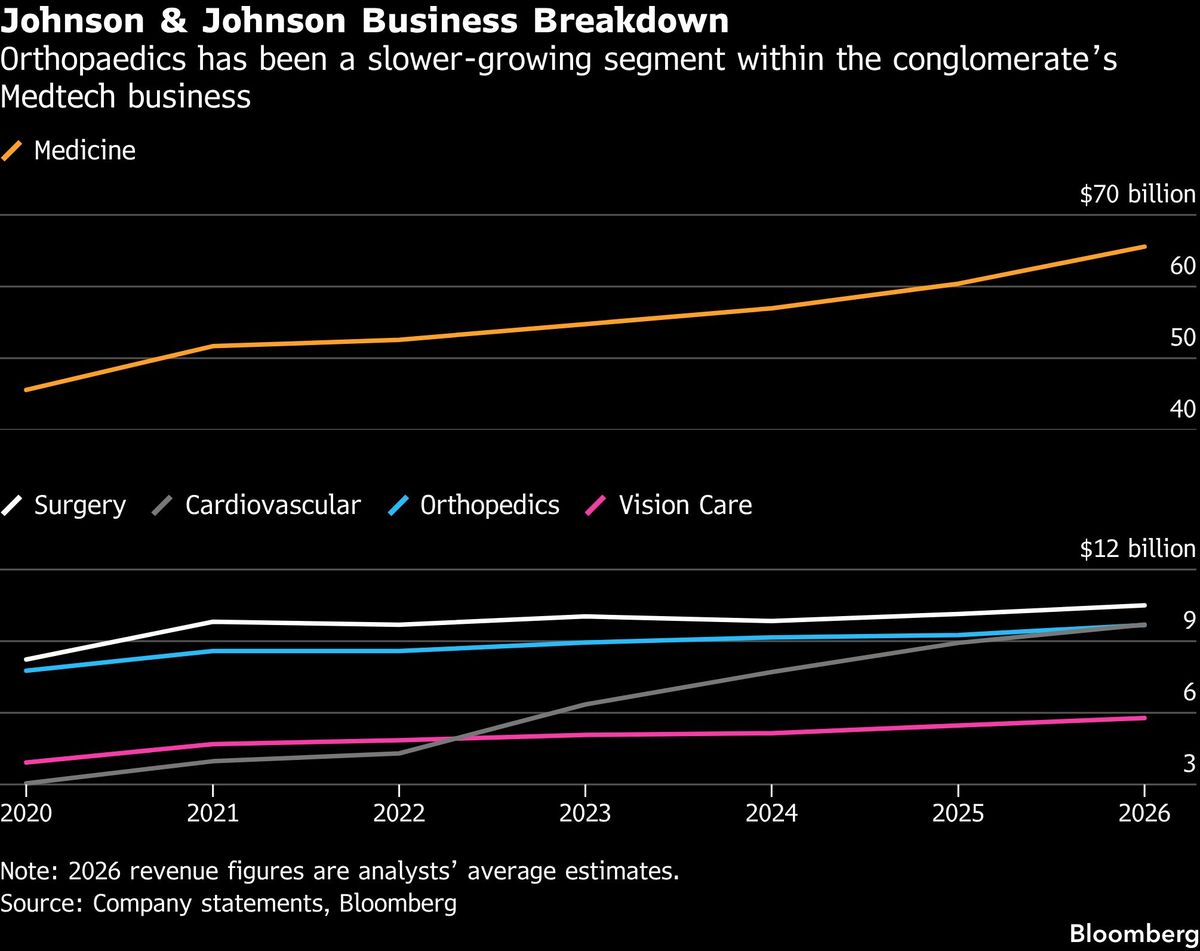
While J&J’s pharmaceutical business is about twice the size of its medtech business in terms of revenue, issues at the latter have preoccupied investors of late. Last quarter, the medical device unit came in slightly below estimates due in part to weakness in the Abiomed heart pump business.
The company raised its profit guidance as demand for newer drugs in cancer and autoimmune diseases overshadowed the disappointment with medical devices. It now expects adjusted earnings for the full year to be in the range of US$11.05 to US$11.15 a share, up from a prior view of US$10.96 to US$11.11. The midpoint of the new range is above analyst projections.
As the first major pharmaceutical company to report each quarter, J&J’s performance is viewed as a harbinger for the sector. Tuesday’s results suggest that drugmakers are successfully navigating changes in federal policy as well as leadership turnover at the US Food and Drug Administration.
Revenue in the pharmaceutical business rose 7.7% from a year earlier, compared with 2.5% gains for the medical device unit.
Highlights in the quarter included 68% sales growth for Tremfya, a newer autoimmune drug that topped analyst estimates. Sales of the psychiatric drug Caplyta soared 66% as prescriptions for newer uses started to kick in, including add-on therapy for depression.
Tecvayli, used to treat the bone marrow cancer multiple myeloma, saw sales rise nearly 77%. J&J’s top-selling Darzalex, also for multiple myeloma, grew at a double-digit clip but fell short of analyst estimates.
Although the company doesn’t yet break out sales for its new psoriasis pill Icotyde, Wolk said that 20,000 people have been prescribed the drug.
In the devices segment, J&J is focusing on faster-growing areas. In July, it got a foothold in the hot robotic surgery market with FDA clearance for its Ottava soft-tissue robotic surgical system.
Uploaded by Felyx Teoh