

This article first appeared in Capital, The Edge Malaysia Weekly on October 12, 2026 - October 18, 2026
ESTABLISHED legacy airlines are likely to outperform low-cost carriers (LCCs) as jet fuel prices remain elevated amid the Iran war, with analysts expecting fuel costs to stay high until at least the second quarter of 2027.
Legacy carriers typically have greater fuel hedging exposure, while LCCs tend to hedge less of their fuel purchases, leaving them more exposed to prolonged price increases.
In the US, analysts particularly favour the three major legacy carriers — Delta Air Lines Inc, United Airlines Holdings Inc and American Airlines Group Inc — citing their diversified ancillary revenues and exposure to the deep domestic market.
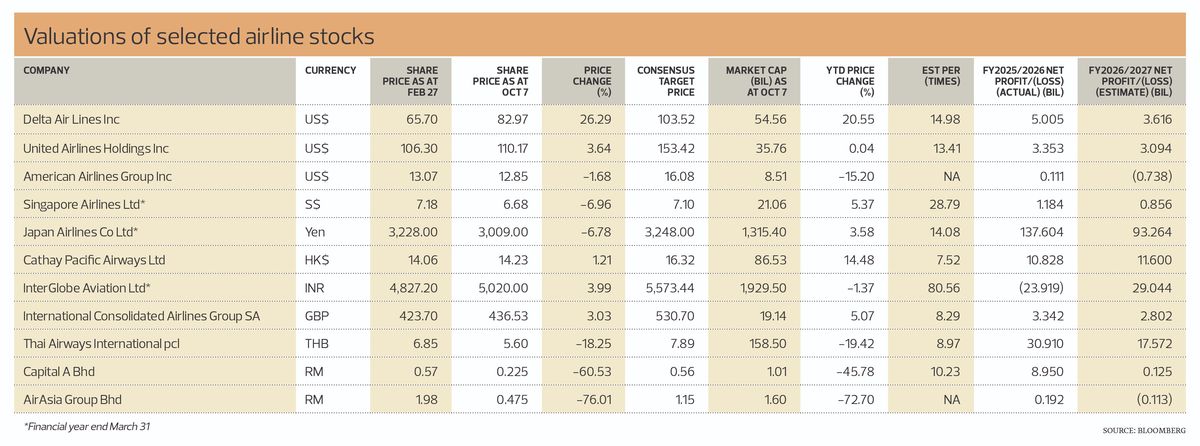
Still, higher fuel costs are expected to weigh on earnings this year. Analysts forecast Delta will post a net profit of US$3.6 billion (RM14.7 billion) for the financial year ending Dec 31, 2026 (FY2026), down from US$5 billion in the previous year.
United Airlines’ net profit is expected to fall to US$3.1 billion from US$3.4 billion, while American Airlines is forecast to swing to a net loss of US$738.5 million from a net profit of US$111 million.
Delta has led major US airline stocks since the Iran war began in February, having gained 26% to close at US$82.97 per share last Wednesday. United Airlines edged up 4% to settle at US$110.17, while American Airlines slipped 2% to US$12.85.
Datuk Captain Izham Ismail, former group managing director of Malaysia Aviation Group Bhd (MAG), says the performance of US airline stocks reflects investor confidence in their premium strategies, diversified revenues and large domestic market.
“Over the last one decade or so, US legacy carriers like Delta, United Airlines and American Airlines have continued to be strong because they leverage simplified, non-sophisticated ancillary revenue streams, co-branded credit card partnerships and exposure to a deep domestic market,” he tells The Edge.
Delta, in particular, has developed a broad range of non-ticket revenues, including its loyalty programme, fuel hedging and oil refining asset, which have helped cushion margins against fuel volatility, he notes.
However, some US carriers, including budget airline Spirit Airlines, Silver Airways and New Pacific Airlines, have succumbed to the rising cost of fuel caused by the Middle East crisis.
Such carriers typically have less diversified revenues and weaker loyalty programmes, and inadequate cost discipline has further squeezed margins, says Izham.
Among Asian carriers, Indian domestic and regional airlines remain relatively well positioned because of strong domestic demand and significant fleet commitments, he points out. Their balance sheets, however, warrant close monitoring.
Nomura Global Markets Research estimates India’s aviation market has grown at a compound annual rate of 6% to 7% over the past decade and sees further room for expansion.
It has identified five factors supporting continued demand: low per capita air traffic penetration, a fast-growing population of upper-income households, government efforts to improve connectivity and airport infrastructure, the lack of an alternative mode of transport offering comparable speed and convenience, and rising international tourism and travel among India’s large diaspora.
In an Oct 5 report, Nomura initiated coverage of InterGlobe Aviation Ltd, the operator of IndiGo, with a “buy” rating and a target price of INR6,000, implying an upside potential of 19.5% from its closing price of INR5,020 last Wednesday. IndiGo has a fleet of 441 aircraft.
“We believe its robust order book pipeline of more than 900 aircraft should enable the company to maintain its domestic market dominance and drive global expansion, while its lean cost structure should allow the company to navigate a price-sensitive India market and a high fuel inflation environment. In an extended high fuel price scenario, we believe IndiGo will outperform its higher-cost-base peers, leading it to gain further market share,” said the research firm.
European airlines are likely to fare better than their Asian counterparts but still lag US carriers, says Izham. “I believe more winners are coming from North America and there’ll be more losers coming from Europe and Asia-Pacific.”
That does not necessarily mean weaker airlines will collapse. Liquidity and the ability to service debt will determine which carriers can withstand prolonged cost pressures, he adds.
“You’ve got to look at how strong their liquidity position is in terms of cost-to-sales ratio. Are they able to manage it over the next one to 1½ years to fulfil their debt obligations and weather the jet fuel spikes and foreign exchange (forex) volatility?”
Operational efficiency will also be critical, particularly the ability of the airlines to maintain high daily aircraft utilisation while avoiding unnecessary aircraft groundings.
“The market favours airlines that demonstrate discipline, matching capacity strictly to demand elasticity rather than chasing top-line market share at the expense of bottom-line yield,” says Izham.
For Asean carriers, that means focusing on high-yield premium and corporate segments and maintaining sufficient liquidity to absorb cost inflation.
Cargo is a silver lining
Cargo is a silver lining for airlines as supply chain constraints keep global cargo load factors elevated, says Izham. International Air Transport Association (IATA) data shows global air cargo demand rose 4.4% year on year in August even as capacity was trimmed by 0.1%.
Strong demand for air cargo space is helping airlines improve yields, while carriers with dedicated cargo operations or robust belly-cargo capabilities can boost overall revenue per available seat kilometre (RASK). RASK is a key indicator of an airline’s ability to generate revenue from its available capacity.
Still, liquidity provides an important buffer against prolonged cost pressures.
“An airline’s debt-to-earnings before interest, taxes, depreciation and amortisation (Ebitda) ratio is important at this time. A strong liquidity position provides a cushion to meet debt obligations, while carriers with a high cash-to-sales ratio are typically better positioned to meet short-term obligations,” says Izham.
For Asean airlines, debt-to-equity ratios are another key metric, he adds.
“Most carriers in the region restructured their balance sheets after the Covid-19 pandemic, but some subsequently took on debt at relatively high interest rates. Those airlines may need to revisit their financing arrangements as borrowing costs and operating pressures remain elevated.”
Izham considers regional operators with cash and bank balances equivalent to about 20% to 25% of annual revenue to be in a relatively healthy position, giving them greater capacity to service debt and absorb fuel price shocks.
Airlines also face forex risks because many of their major costs, such as fuel, aircraft leases and some maintenance expenses, are denominated in the US dollar.
The strength of an airline’s balance sheet also depends on whether it operates an asset-heavy or asset-light model. Premium network carriers tend to operate modern wide-body aircraft, which carry higher depreciation costs, although strong financial backing and lower refinancing costs can offset some of that burden, says Izham.
Passenger yields, meanwhile, remain highly sensitive to macroeconomic conditions, making diversification increasingly important.
“An airline that has a very clear diversification strategy will probably be able to ride out the storm better,” he says, noting that revenue streams from maintenance, repair and overhaul (MRO), ground handling and cargo can help protect margins.
Finding the sweet spot between capacity and aircraft utilisation
Airlines ultimately need to keep costs under control, with cost per available seat kilometre (CASK), excluding fuel, providing a useful measure of their underlying cost structure, says Izham.
Travel demand across Asean remains resilient, with average passenger load factors at above 80%. But supply chain constraints, including engine maintenance delays and spare parts shortages, are pushing up non-fuel CASK at airlines.
The stronger airlines will be those that can maintain RASK while controlling the growth in CASK, allowing higher revenue to offset inflationary cost pressures, he says.
Full-service carriers generally have an advantage on yield because they serve business travellers and premium leisure passengers, while LCCs rely more heavily on volume.
Fuel, however, remains the biggest variable.
Izham expects fuel prices to remain at US$140 to US$150 per barrel until at least the second quarter of 2027. Global average jet fuel price for the week ended Oct 2 reached US$187.34 a barrel, up 108% from a year earlier, according to IATA’s Jet Fuel Price Monitor.
“An airline executive has to find the sweet spot between deploying capacity and grounding capacity,” says Izham, noting that the key is to match aircraft deployment to the strength and characteristics of demand.
“The best approach is airlines should look at their demand elasticity. Where does it make money? For example, a route that has high demand and very high elasticity, I will probably put wide-body aircraft. You don’t ground them,” he points out.
“At the same time, you don’t fly blindly. You sweat your assets smartly.”
BMI, a unit of Fitch Solutions, expects the US-Iran conflict to extend to the first quarter of 2027, when mounting economic pressures could force the two sides towards a deal.
Until then, heavily restricted transit through the Strait of Hormuz and persistent supply tightness are expected to keep Brent crude oil above US$100 a barrel on average in 4Q2026 and above US$110 a barrel in 1Q2027, BMI said in an Oct 2 note.
“Assuming that a preliminary agreement is reached in 1Q2027 and holds in 2027, shipping conditions will gradually normalise and oil prices will fall rapidly towards US$70 per barrel by end-2027, allowing the jump in global inflation and the hit to growth to unwind,” it added.
The outlook for oil prices remains highly uncertain.
“It is going to be bedlam for the bulk of the end of the year and maybe 2027,” Petroliam Nasional Bhd (PETRONAS) CEO Tan Sri Tengku Muhammad Taufik Tengku Aziz said at a conference in London on Oct 5.
Delicate balancing act for rest of 2026
With major currencies weakening against the US dollar, fuel hedging has become more difficult. Airlines that hedged fuel about a year ago are nearing the end of those positions, Izham notes.
He expects geopolitical tensions and the economic fallout to persist.
“Geopolitics will drive macroeconomics. Geopolitical volatility is here to stay for a while and airline executives need to take this as a baseline,” he says.
“The [rest of] 2026 will be a delicate balancing act. While global passenger demand remains structurally resilient, airline operators are navigating severe cost pressures from volatile energy markets driven by regional geopolitical friction.”
Airlines should also brace for the return of Middle Eastern carriers, which have demonstrated their resilience despite sharp capacity cuts caused by airspace disruptions.
“They have strong financial backing. It’s just a matter of when, but they will bring back fiercer competition when they come back,” says Izham.
He expects Middle Eastern airlines such as Emirates and Qatar Airways to focus on fleet efficiency, cost management and premium passengers as they rebuild capacity through their Dubai, Abu Dhabi and Doha hubs.
“They don’t simply fly now to connect East and West. They are focused on driving fleet efficiency. They’re quite good at managing their costs and are very clear on premium passenger proposition and digital personalisation. They’ve been in a ‘valley’ for a while, but they’ll come out of it,” he says.
2027 and beyond: Losers may outnumber winners
Looking beyond 2026, Izham expects airlines to focus less on volume and more on capacity management and yield, particularly through premium, corporate and premium-economy traffic.
“The low-cost model is under pressure because you cannot put aircraft in the air if you don’t make money. But you also cannot afford to put the aircraft on the ground. It’s a double-edged sword,” he says.
US legacy carriers are likely to emerge stronger, supported by margins of about 3% to 3.5%, compared with 1% to 1.5% for many Asian carriers, Izham points out.
Singapore Airlines Ltd (SIA), with its strong premium customer base, is better positioned to command higher yields, he adds.
“I would not be surprised to see many airlines reporting losses for 2026, especially in Asia-Pacific. Only a handful will probably declare profits.”
If high fuel prices and geopolitical instability persist, losers could outnumber winners for both legacy and low-cost carriers, particularly in Asia-Pacific.
Investors should therefore focus not only on profitability but also on how much cash airlines have to carry them through 2027 and beyond, says Izham. “Those who have a strong cost structure and strong liquidity position will come out of this in 2027.”
He points out that airlines with robust debt-to-Ebitda ratios will have a stronger chance of returning to profitability next year.
Shukor Yusof, founder and analyst at aviation consultancy Endau Analytics, also expects the pressure to extend beyond 2026. “The winners will be carriers like SIA and Hong Kong’s Cathay Pacific Airways Ltd, which are well capitalised,” he says.
Carriers with weaker balance sheets face greater risks as prolonged losses erode their cash reserves.
“Money goes very quickly in this business,” says Shukor, noting that MAG, which has about 15,000 employees, also faces a higher cost base. But MAG is backed by sovereign wealth fund Khazanah Nasional Bhd, providing an important source of financial support and credibility, he points out.
For Southeast Asian carriers, currency movements remain another source of pressure as a stronger US dollar raises the cost of dollar-denominated expenses, including fuel and aircraft leases.
Shukor says the US Federal Reserve’s 25-basis-point interest rate hike in September has put further pressure on regional currencies by supporting the greenback. “That pushes the US dollar up. That’s why the ringgit and the rupiah are getting hit. Even the Singapore dollar has weakened slightly.
“The only [beneficiary] is the Hong Kong dollar, which is pegged to the US dollar. So it’s good for Cathay Pacific and its subsidiaries.”
Brendan Sobie, an analyst and consultant at Singapore-based Sobie Aviation, says investors should take a longer-term view and recognise that 2026 has been an unusually difficult year for the industry.
“It’s been a difficult year. MAG is also bleeding, but obviously its overall financial position and balance sheet are much stronger than those of AirAsia Group Bhd (KL:AAGB).”
AirAsia, which is seeking to raise US$1 billion and RM700 million mainly to refinance its debt at lower rates, could save about RM200 million a year in interest costs if it succeeds in lowering its borrowing rate to 7%-8% from 11%-12%, Maybank Investment Bank Research said in a Sept 21 report. The research house estimates that every US$1 per barrel rise in jet fuel prices would cut AirAsia’s earnings by RM75 million.
Analysts forecast AirAsia to post a net loss of RM113 million in FY2026 compared with a net profit of RM191.75 million in the previous year.
Save by subscribing to us for your print and/or digital copy.
P/S: The Edge is also available on Apple's App Store and Android's Google Play.