


This article first appeared in The Edge Malaysia Weekly on October 12, 2026 - October 18, 2026
MALAYSIAN real estate investment trusts (M-REITs) have long been prized for their income-generating qualities. Listed REITs that distribute at least 90% of their total income qualify for a full tax exemption at the trust level, helping make regular distributions a central part of the asset class’ appeal.
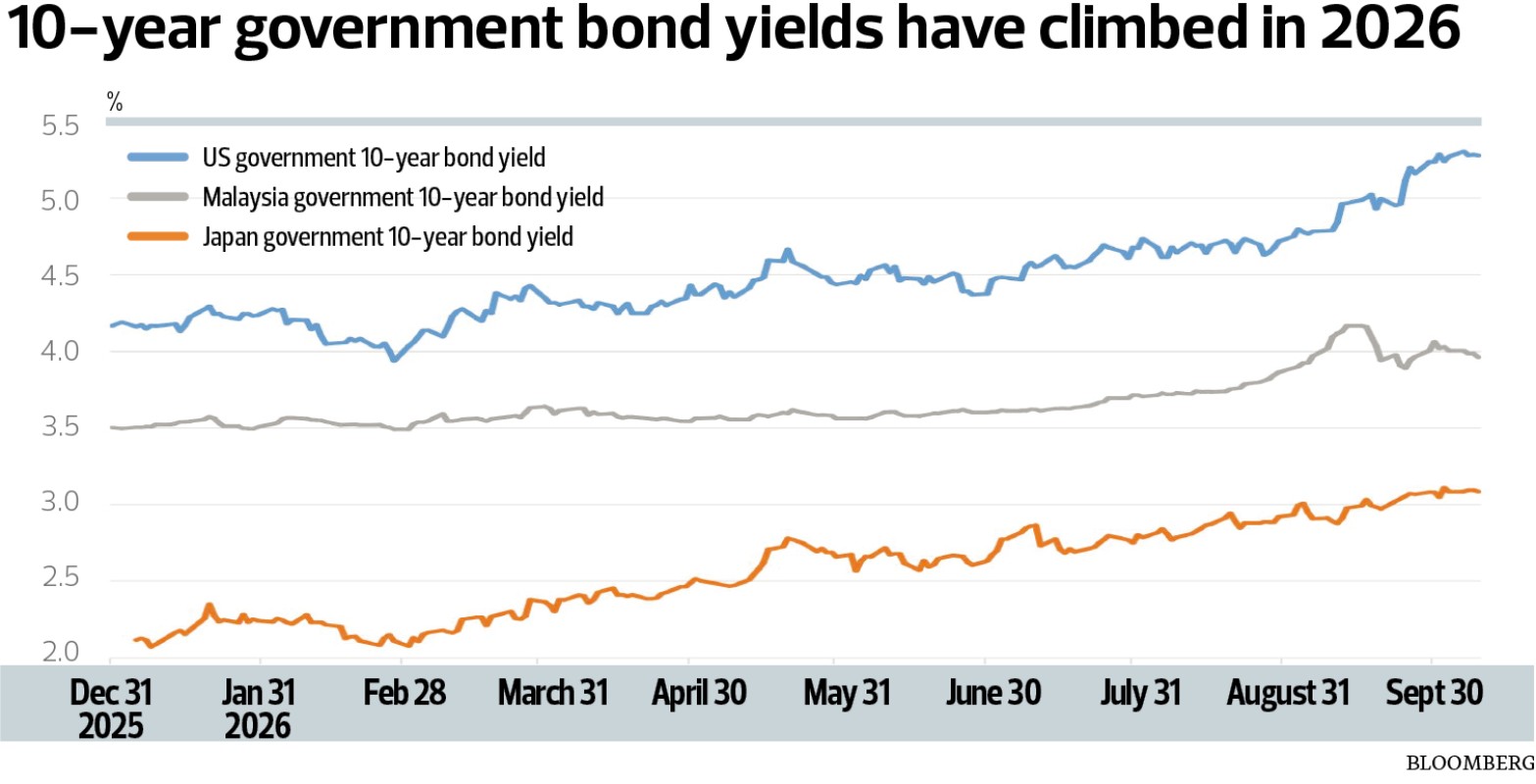
But REIT investors are now demanding a higher yield as competition from government bonds has picked up. Government bond yields have surged worldwide on renewed inflation worries, higher policy rates and heavy debt issuance. The 10-year Japanese government bond yielded 3.08% on Oct 8, hovering close to its highest in three decades, while the US 10-year Treasury was about 5.27%, near levels last seen in 2002.
German, French and UK 10-year bonds have sold off, with yields rising significantly by 62, 131 and 97 basis points (bps) respectively this year.
The sell-off has several causes. Higher oil and energy prices from the prolonged Middle East conflict have revived inflation concerns, while resilient growth has made investors less confident that policy rates will fall soon. Heavy government borrowing has added to bond supply and, some analysts say, artificial intelligence-related corporate borrowing is competing with US Treasuries for fixed-income capital.
Central banks have moved too. The US Federal Reserve raised its benchmark rate by 25bps in September, its first hike since 2023, while the European Central Bank has raised rates twice this year. The Bank of Japan has lifted its policy rate twice in 2026 to 1.25%, while India’s central bank joined the tightening cycle on Oct 7 with a 25bps hike to 5.5%.
Bank Negara Malaysia has yet to follow. It held the Overnight Policy Rate (OPR) at 2.75% on Sept 3 — the seventh straight meeting without a change — and said it would remain vigilant. Governor Datuk Seri Abdul Rasheed Ghaffour said the central bank’s response would depend on what is driving prices: monetary policy is not an effective tool if inflation is driven solely by cost pressures, but has a role if inflation is driven by demand.
For M-REIT investors however, the OPR tells only part of the story. The OPR affects REIT earnings more directly through higher borrowing costs, particularly for trusts with floating-rate debt. The more immediate valuation benchmark is the rising Malaysian Government Securities (MGS) yield, which stood at 3.96% on Oct 8, some 45bps higher year to date (YTD).
The MGS acts as a domestic risk-free benchmark against which investors judge the return offered by longer duration income assets.
Simply put, an investor may be willing to accept a 5%-6% REIT distribution yield when government bonds yield considerably less. But as the risk-free yield approaches 4%, the extra return demanded for accepting property risk, leverage and volatile unit prices also rises.
Research houses are split on where the OPR rate will head next year. Hong Leong Investment Bank (HLIB) expects a hike in the first half of 2027, while RHB expects the OPR to remain at 2.75% into the first half. MBSB meanwhile sees a possible 25bps hike in 2027. CGS International assumes no OPR increases in 2026.
M-REIT performance
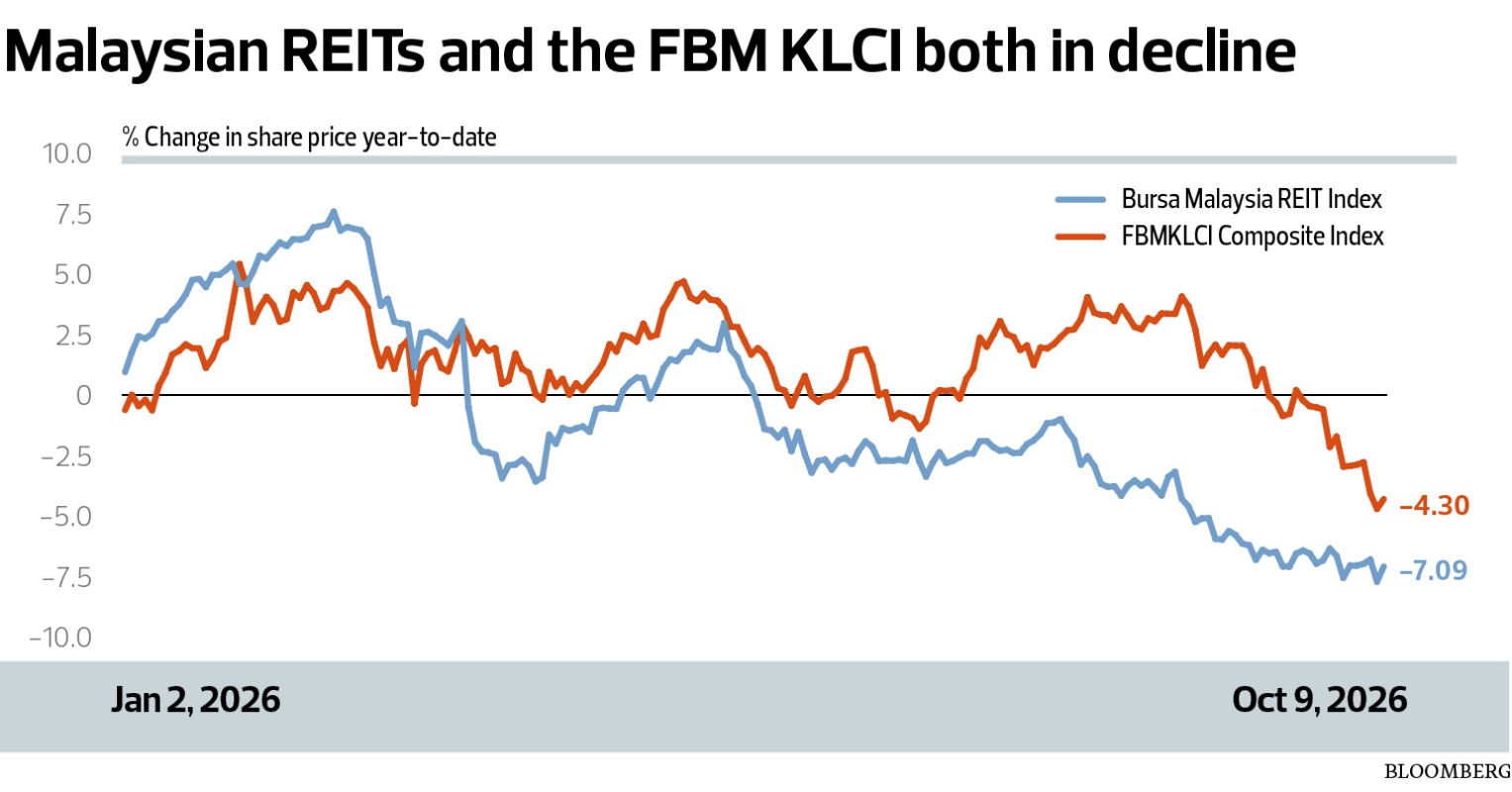
Bursa Malaysia’s REIT Index has taken a hit this year, falling 7.7% compared with the FBM KLCI’s 4.7% decline YTD. AmInvestment Bank said on Sept 10 that the sector was already about 5% lower since end-July, as the 10-year MGS approached 4%. HLIB subsequently put the decline from the late July second-half high at 5.6%.
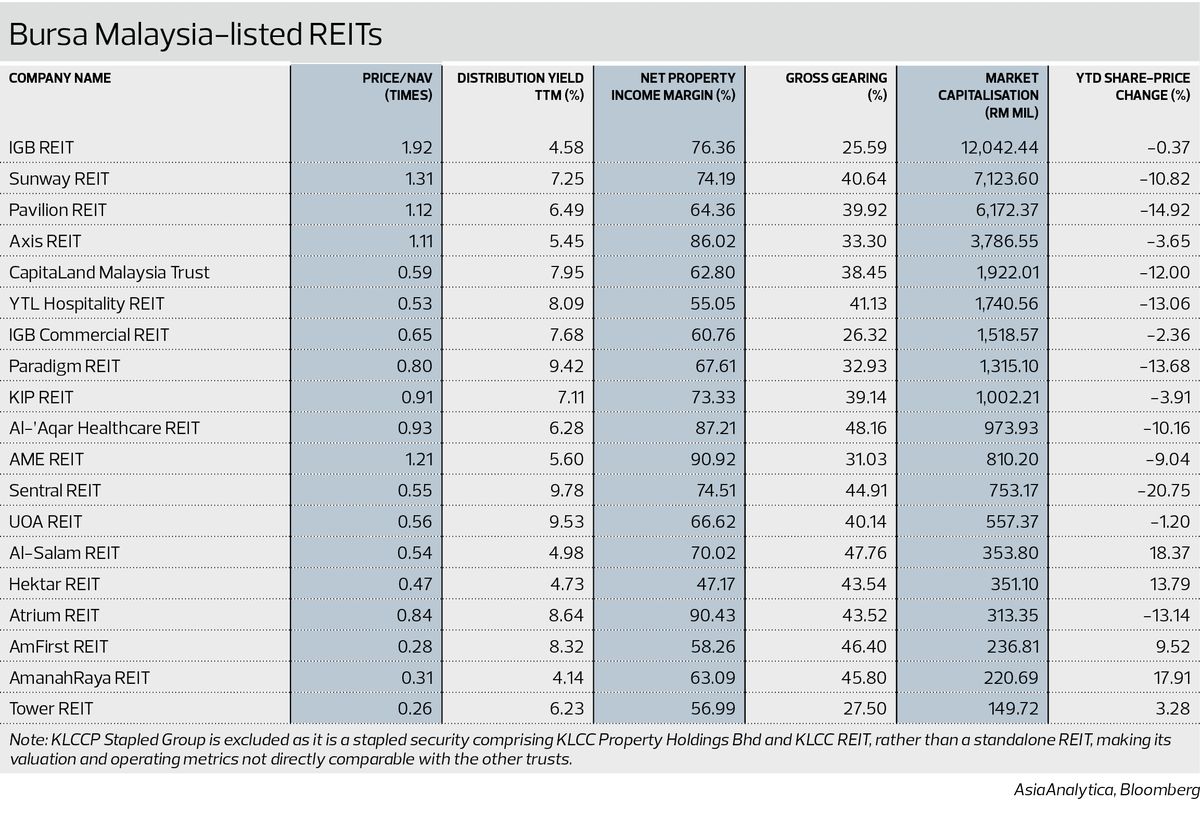
The weakness has been broad, although not uniform. Bloomberg data shows 15 of the 20 REIT and stapled-property counters tracked were lower YTD as at Oct 8, with the median trust down about 5.1%. Sentral REIT (KL:SENTRAL) was the worst performer, falling 20.8%, followed by Pavilion REIT (KL:PAVREIT) at 14.9% and Paradigm REIT (KL:PARADIGM) at 13.7%. At the other end, Al-Salam REIT (KL:ALSREIT) and AmanahRaya REIT (KL:ARREIT) have gained 18.4% and 17.9% YTD.
Underlying operations have not deteriorated to the same degree. RHB said all eight REITs under its coverage met expectations in 2Q2026, with market-cap-weighted revenue and earnings rising 14.5% and 15.6% year on year (y-o-y), respectively, though acquisitions assisted the growth. Occupancy remained broadly stable while rental reversions were positive. Axis REIT was the exception, with first-half core earnings down 4.9% on vacancies, a rental suspension and one-off maintenance costs, RHB said. AmInvestment Bank, meanwhile, puts underlying distributable income growth across Sunway REIT (KL:SUNREIT), IGB REIT (KL:IGBREIT) and Pavilion REIT at 6% excluding acquisitions.
Tax shock
The higher-rate environment is only one reason M-REITs have performed poorly this year. The preferential 10% final withholding-tax treatment for several categories of REIT investors expired from the Year of Assessment 2026. Resident individuals now generally include the distributions in taxable income at their prevailing tax rates, while the treatment also changed for foreign institutional investors.
The Malaysian REIT Managers Association has been lobbying for the 10% rate to return and hopes Budget 2027 will restore it. The government had signalled in February that the sector may no longer need the concession.
Jessica Low, a REITs analyst at MBSB, says the tax change has so far done more damage than higher bond yields. “Tax changes had a greater impact on M-REITs, with the KL REIT Index declining 9% from its February peak to its March low following news of the withholding tax expiry. In comparison, the KL REIT Index has fallen 7% from August to date due to higher bond yields.”
HLIB’s numbers point the same way, with a 10.4% slide for the tax against 5.6% from the late July high as at Sept 23. The comparison is not clean, however. The sell-off began on Feb 19, a month before the Inland Revenue Board’s notice, and AmInvestment Bank also lists the Middle East conflict, which flared in late February, among the factors that have weighed on the sector.
CGS estimates that reinstatement of the old preferential rate would remove a roughly 50bps to 100bps drag on post-tax yields.
Have M-REITs fallen far enough?
The fall in REIT prices has pushed their distribution yields higher, reopening the question of whether the sector has now fallen far enough to compensate investors for the higher risk-free rate.
With the KL REIT Index providing a trailing-12-month dividend yield of 6.26%, and the 10-year MGS yielding 3.96%, the spread is currently 2.3 percentage points, according to Bloomberg data.
That spread is the additional headline yield investors receive for taking on property, leverage and equity market risk rather than holding Malaysian government debt.
To some analysts, that makes M-REITs look attractive. Low puts the spread at 220bps, which she says is “significantly higher than its eight-year average spread of 163bps and the 150bps spread recorded in July 2026”.
“We believe the weakness in M-REITs is excessive,” she says. “The wider-than-average yield spread makes M-REITs attractive from a valuation perspective.”
RHB Research’s average since 2018 is 1.71 percentage points, and HLIB notes the spread averaged 77bps from the second to the fourth quarter of 2022, the last stretch of sustained high MGS yields.
But the benchmark comparison matters. CGS International’s 10-year mean is 3.2 percentage points, which puts today’s level well below it, and another analyst, who asked not to be named, puts the historical trend at two to 2.5 points. The houses also measure the spread differently, with HLIB using trailing yields and AmInvestment Bank forward yields.
A gross spread also overstates what some holders keep. On a simplified calculation that assumes the whole distribution is taxed at the stated rate, and that MGS interest is tax free for non-residents, a non-resident individual taxed at 30% would net about 4.4% from a 6.26% gross yield, about 40bps above the MGS. Under the old 10% rate, the cushion was about 170bps.
Who wins and who loses?
The other pressure is on earnings, but analysts say it is limited unless the OPR rises. “If there is no change in the OPR, the impact on REIT fundamentals should be limited as rental income is largely fixed while the impact on borrowing costs is also relatively small,” Low says.
If rates did rise, she says Al-‘Aqar Healthcare REIT (KL:ALAQAR) would be the most affected, as all its borrowings are on floating rates, while Sunway REIT and Axis REIT (KL:AXREIT) “may also see some impact”, with approximately 40% of their debt exposed to floating interest rates.
Other houses put the exposure of the larger names higher. RHB Research estimates floating-rate debt at 77% of Pavilion REIT’s borrowings, 61% of Sunway REIT’s and 53% of Axis REIT’s, against 9% at IGB REIT. The research house estimates that a 25bps rise could cut FY2027 earnings by 1.6% at Pavilion REIT, 1.4% at Sunway REIT and 1.1% at Axis REIT, against 0.1% at IGB REIT.
Smaller trusts may be more exposed. AmInvestment Bank estimates distributable income would fall 5.1% at Hektar REIT (KL:HEKTAR) 3.8% at Al-‘Aqar Healthcare REIT for each 25bps increase. But the rise in the 10-year MGS may not yet be reflected in borrowing costs. AmInvestment Bank puts Sunway REIT’s funding cost at 3.6% and argues that refinancing would price off the five-year MGS, at about 3.7%, plus a credit spread of about 30bps, or around 4%.
Most houses still lean positive. RHB Research, HLIB and AmInvestment Bank are “overweight” on the sector, with HLIB upgrading from “neutral” on Sept 23. MBSB Research is “positive” while CGS has a “neutral” call. Low favours Pavilion REIT and Sunway REIT, with a gross yield of 6.6% and 6.5% respectively.
“Both REITs provide attractive yields and are supported by quality assets and strong operating fundamentals,” she says. Pavilion REIT, down 14.9% this year, is a top pick at RHB, HLIB and AmInvestment Bank, despite the trust having the largest share of floating-rate debt among the big names. Meanwhile Axis REIT is also a top pick at RHB, HLIB and CGS.
Whether the yield is enough depends on who is asking. An investor who keeps the full distribution still earns about 2.3 percentage points over the MGS. A non-resident individual taxed at 30% has a far thinner cushion. And for valuations, the next move in the 10-year MGS matters more than the OPR. AmInvestment Bank estimates that each 10bps rise in the MGS yield cuts its target prices by about 2.2%, while a 25bps rise in rates would cut sector distributable income by about 2.6%.
Bank Negara will meet next on Nov 5, to determine whether or not to raise rates. Most research houses and economists anticipate a hold at 2.75%.
Save by subscribing to us for your print and/or digital copy.
P/S: The Edge is also available on Apple's App Store and Android's Google Play.