

This article first appeared in The Edge Malaysia Weekly on October 12, 2026 - October 18, 2026
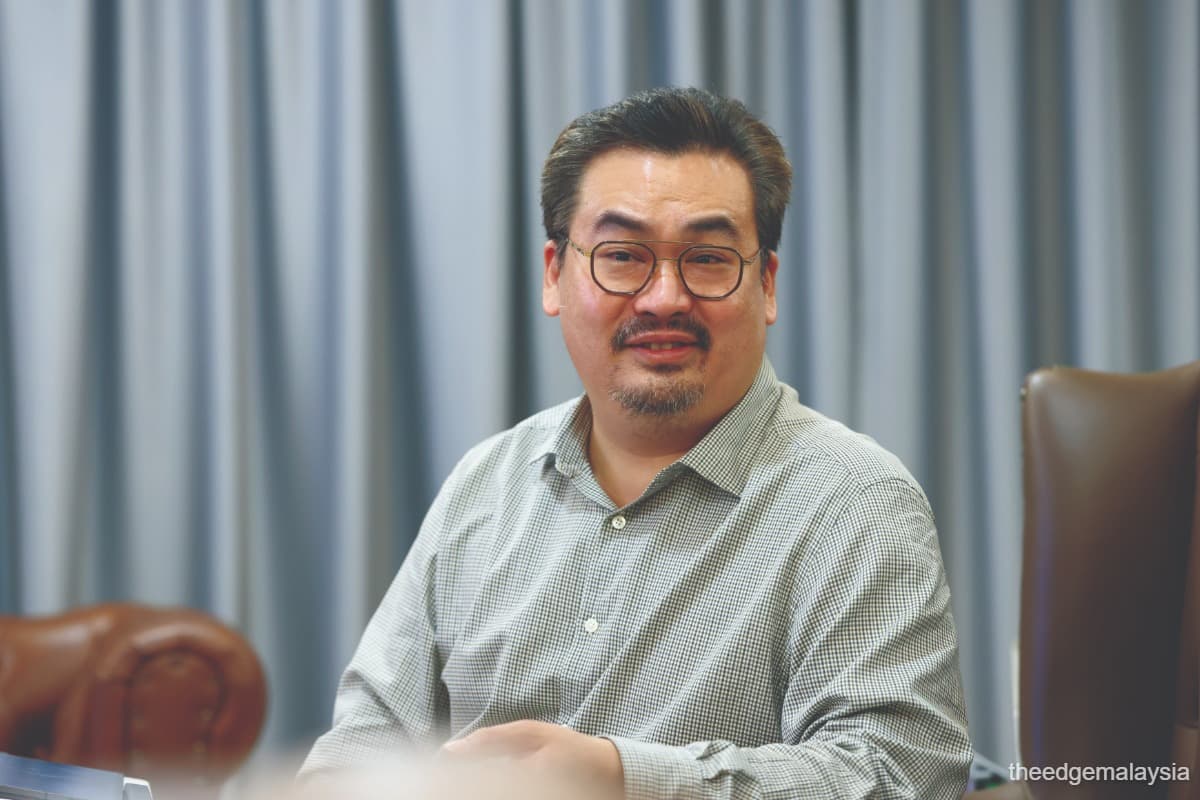
DURING the Covid-19 lockdown, Datuk Seri Andrew Tan Jun Suan, managing director and 53.86% shareholder of Tanco Holdings Bhd (KL:TANCO), was at his beachside resort in Port Dickson, pondering over a long-standing plan to build an integrated resort city that required a large investment.
“Any day, any time of the year, you go to my site (resort), you look out to the sea, this is what you will see — container ships. I used to get frustrated when I saw them (container ships). I would say go somewhere else, don’t block the view,” says Tan, showing us a photo of the Straits of Malacca.
“But when you change the mindset to embrace it, now they look like dollar signs to me. Rather than getting frustrated with them, we’ve embraced them,” he says.
Instead of building a holiday resort, Tan decided to build a seaport — a mega project whose capital requirement is substantially larger.
And that caught the attention of investors, including those from abroad. According to Tan, in February, Tanco was the stock that attracted the highest inflow of foreign money.
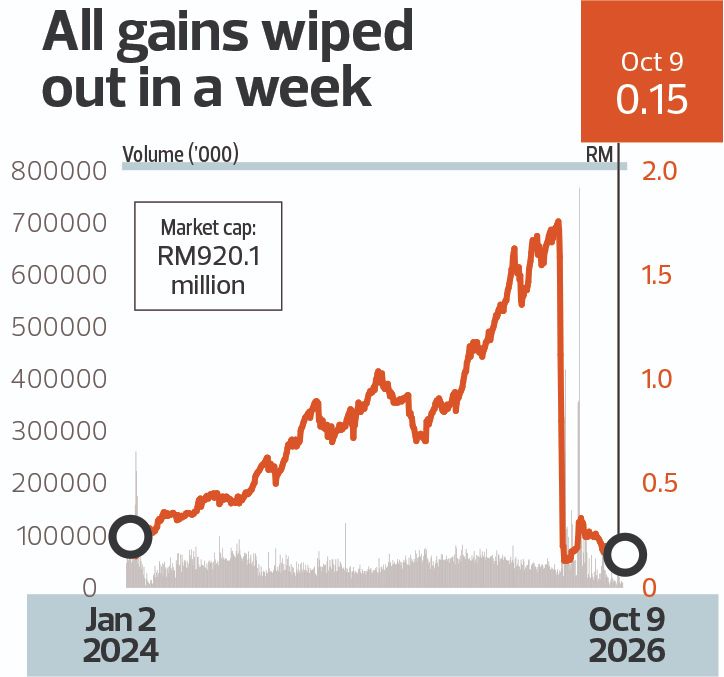
Its share price rocketed from the 20 sen level to RM1.56 within three years, lifting its market capitalisation above RM10 billion. The company was then valued at a price-earnings ratio (PER) of 1,000 times.
The announcements related to the seaport project — involving big names, to boot — came pouring in as Tanco’s share price kept climbing.
In January 2024, the group announced to Bursa Malaysia that its 79%-unit Midports Holdings Sdn Bhd had secured the requisite approvals from the Ministry of Transport to build Midport, a smart artificial intelligence container port in Port Dickson, Negeri Sembilan. The remaining 21% in Midports Holdings is held by Global Marque Logistics Sdn Bhd, the vehicle of Datuk Chuah Lim Leng.
A month later, Tanco announced a joint-venture agreement with Menteri Besar Negeri Sembilan (Pemerbadanan) to develop and operate the 33.66ha port, which would be part of the Port Dickson Free Zone (PDFZ), a massive industrial park also being jointly developed by the two parties.
Subsequently, it was announced that Tanco had signed a slew of memoranda of understanding (MOU) mainly with China-based companies, including China’s CCCC Dredging Group Co Ltd, COSCO Shipping Ports Ltd and China Mobile Ltd.
While Tan denies it, the vast majority of the partnerships are in the form of MOUs, which are not legally binding. And that has raised doubts on the mega project.
Nonetheless, he points out to The Edge in an interview that Tanco also inked memoranda of agreement (MOA), for instance, with CCCC Dredging Southeast Asia Sdn Bhd, a wholly owned unit of CCCC Dredging Group, for conceptual designs, front-end engineering design and detailed engineering aspects for the Midport project.
In October last year, Tanco entered into a consortium framework cooperation agreement with China Civil Engineering Construction Corp (CCECC) to jointly seek engineering, procurement and construction (EPC) contracts and finance transportation infrastructure projects in Malaysia.
Last December, the company also announced a joint venture with CNECC Engineering (M) Sdn Bhd to bid for the construction of logistics warehouse or mega-storage type projects, and the signing of the Midport Smart AI Container Terminal Entrusted Operational Management Agreement with Ocean Bridge International Ports Management Co Ltd.
The meteoric rise in Tanco’s share price also attracted public listed companies, such as Ajiya Bhd (KL:AJIYA), to take up an equity stake, as the capital gains became a strong earnings booster.
Interestingly, Tan had been actively trading Tanco shares on a daily basis since 2024. The rationale is to show confidence in the company and the seaport project, he says.
Based on its existing books, the company does not have much to shout about.
For its financial year ended June 2026, Tanco chalked up net profits of a mere RM897,000 on the back of RM160.81 million in revenue. Its cash and bank balances were at RM4.65 million, while its long-term debt commitments stood at RM34.54 million and its short-term borrowings at RM2.92 million.
Looking at its meagre earnings and limited cash, many were understandably sceptical of Tanco’s foray into the port industry, a sector seen as daunting, with heavy capital expenditure commitments, immense red tape, and various regulations and approvals. Furthermore, some quarters believe only those with an understanding of ports and shipping routes should venture into the seaport business.
Tan acknowledges that he has little experience in seaports but he says he is lucky enough to have Qingdao Port International Co Ltd to operate Midport.
However, like they say, all good things come to an end.
In early June, Tanco’s stock lost its footing. Its share price tanked almost 93% from RM1.76 on June 3 to 13 sen on June 15, enduring four straight days — June 8 to 11 — of limit downs.
It has not recovered. Last Thursday, Tanco’s stock ended trading at 15 sen, giving it a market capitalisation of RM920 million.
Despite the scepticism in the market, Tan tells The Edge during the interview: “But as you can see, the project is real. Things are still on track, the company’s fundamentals are intact.” The market, however, may take more convincing.
Following are excerpts of the interview.
The Edge: How did the port venture come about?
Andrew Tan Jun Suan: Any day, any time of the year, you look out to sea, what you will see are container ships … now they look like dollar signs to me.
Most ports in Malaysia took five to seven years to get a port licence, and I announced in January 2024 this idea, and if it takes five years, it’s 2029 [when I get the port licence]. So it would be reckless for me to go talk about the prospects, one year or two years from the time I announced, when it generally takes five years.
My plan has always been, I will come out and talk when I have got the full approvals in hand … We got the full approval as at July (this year).
What is the cost of building the port?
The agreement that we signed with CCCC (CCCC Dredging Southeast Asia), our EPC contractor, set a ceiling price of below US$850 million. We are confident we can bring that price lower. For example, we signed an agreement with King Well (Hong Kong-based King Well Holdings Ltd), the largest pilling company in the world. We are looking to cast on site so we anticipate huge cost savings … When you cast abroad, each pile is 50 tonnes, (so) logistics costs are very high.
What’s the status of your plan right now?
Well, we are 2½ years ahead of time … I got full approvals in July. So, I am getting the right financing structure and model in place. This will be done at the subsidiary level.
And given all the things that we have today, actually we can list a subsidiary under a few categories. I was told that we can use a business trust like Prolintas Infra Business Trusts (KL:PLINTAS), raise money to build, and go under infrastructure listing, and I think large cap (listing) might be the most convenient way to do it … but we have to decide.
So you are exploring your options to raise capital; it could be via the listing of the unit. What are the other options?
The other option that is available to us is bond issuance for infrastructure projects, which are quite easy to raise.
We’re also exploring the RCCPS (redeemable convertible cumulative preference shares) structure. RCCPS is another instrument other than bonds. So I think in the next one or two months, I will decide. Then I think I’m quite settled unless my team advises me otherwise. I’ll probably start with the bonds and (then) the RCCPS. When the port is 70%-80% complete, then we may look to retire the bonds.
RCCPS, convertible preference shares?
Yeah, convertible, cumulative preference shares. That’s what the Chinese had asked for.
What are they asking for?
Sorry, let me rephrase that. We signed an MOU with Qingdao (SPG Qingdao Port Group Co Ltd). So this was the structure which they suggested that can be a win-win for both parties.
If we base on international prices, assuming US$550 million per berth, we need US$3 billion to US$3.5 billion to complete. Normally, for infra projects like this, we can easily raise 70%, which is over US$2 billion. Today, the bar that I need to achieve is only US$850 million.
Why such a discount?
Because of the efficiency in the design, the existing site conditions — the land is ours; we don’t have to spend on other infrastructure to be built, the roads can be used for the port as well. The other thing that saves us a lot of money is our natural site conditions, there’s a natural 21m depth, we don’t need to dredge, that costs a lot of money. Because we are not facing the rough seas, we do not need a breakwater. A breakwater is basically a sea wall that usually costs about US$1 billion per km.
The whole construction cost is below US$850 million?
Yes, internationally it will be US$3.5 billion … The savings is already more than RM10 billion. Infrastructure projects like this can get 70% funding, so I can do a lot of things, but listing is a question of timing. If I do a listing today, I may not get the valuations I want as it’s still green (greenfield), so my initial thought is if I can get it closer to brownfield, closer to completion, before listing, it will be better.
How long would it take to build the port?
Physical construction will take 42 months.
That will be three years and six months?
Exactly. That’s our estimate.
Do you have a project timeline and milestones to be achieved for the port and the industrial park?
We have our targets. We have our internal targets, but because we are,I mean, we are a private port. I think it’s best that I do what I usually do, I walk first and I announce when it’s done. You know? Because I don’t want to be quoted on ‘I plan this, I plan that’ too much.
For the PDFZ, do you need any different approvals or permits?
Well, the PDFZ is 1,400 acres, that was the original idea with the state. The state government owns 20%. When I moved the idea of building a port, it was very much a chicken and egg situation because there were not enough factories to support a port of this size. So, at that time, I asked the government to give me 5,000 acres to build an industrial park. And it was put on paper. And these 1,400 acres is the first [tranche] of the 5,000 acres that they are to give us. So, they (SD Guthrie Bhd [KL:SDG]) have broken these 1,400 acres into 300 acres first. The balance will come later.
So the port and the industrial park will be developed together?
Yes, same timelines, about three years.
Tanco was trading at 1,000 times PER (price-earnings ratio). Why?
I think one of the reasons why we had 1,000 times PER is this is an infrastructure project. I don’t think there’s any infrastructure company that makes money on or during the construction stage. The reason why we have a positive PER is my other departments (hotels).
Through my checks in my ROD (register of depositors), we had 50-over foreign funds invested in Tanco. It’s just that in different countries, people evaluate things differently. In Malaysia, a lot of people evaluate a company based on PER. In foreign countries, capital markets are designed so that people can invest in ideas, concepts, future earnings, future PER. And I think the main objective is to get returns on your investment.
When we announced a partnership with the number one port builder in the world (CCCC), people appreciated that the best would not be a partner unless you are worth partnering, your fundamentals are there. So I think at the point where the share price went up, it was really due to people who see things differently. These are mainly foreign funds.
There were accusations or rumours that I am churning the shares, but how can I manage (the share price of) a RM10 billion market cap company?
You were buying and selling Tanco shares on a daily basis. What is the rationale of it?
First of all, I think it’s important to show confidence to the foreign funds. They like to see that. I mean, I have confidence in my own company, so I trade (the shares). But I’m not manipulating because I announce. I can announce on T2, but I choose to announce on the same day.
So when you sell, you’re showing confidence?
Basically, you cannot trade without selling, you need to buy and sell, otherwise you’re just increasing your shares. So, showing that you’ve skin in the game, like today let’s say, the share price dropped, I also lost money.
How is it when you buy and sell yourself, you generate confidence?
I believe so, and it’s open. It’s not a secret because I announce every day so the market can see how much of the volume I create. To me it’s the right way to do it, it’s all within the guidelines, within the law and I may be doing things slightly differently, but I think I get the results.
It’s not manipulation?
I don’t think so. It’s within the rules and I think it is only manipulation when you do not disclose.
So the purpose is to demonstrate your confidence, but your shareholding doesn’t change much despite the heavy trading …
There are commercial reasons for me to do it as well. I think I bought more than I sold generally but, of course, when the big crash came, some of my shares were sold.
Your shares were force sold?
Yes, but it was contained to only one (trading) account.
What caused the crash?
Well, I would say I was a victim of rumours or negative narratives because I didn’t give any interviews, the narratives were not controlled. I heard rumours every day, things about me which were not true, but I didn’t come out to correct them.
So the almost RM11 billion in market cap is justified?
All these are driven by investors’ confidence. I mean this is a valuation, it is judged by investors, not by the company’s management. All I can say is that I believe the value the foreign funds see are not unfounded. If research was done into the average cost of building a container port internationally, a modern berth today would roughly be US$550 million per berth. We’re doing it for US$140 million (per berth) and [it’s] for the new type of berth, not the old type. The old ones do about one million TEUs (20-foot equivalent units) a year, the new ones can do two to three million.
Our partner, Qingdao Port (Group Co Ltd) [runs] the fastest port in the world, if I recollect correctly, 67.7 container (moves) per hour. [They have] driverless lorries for transhipment services.
Do the new berths cost a lot more to build?
The piling and the infrastructure, the weight is about three times more than the conventional.
The authorities came after you?
I don’t think so. I mean like Bursa (Malaysia) and SC (Securities Commission), they issued us a couple of UMAs (unusual market activity queries) and we answered on the same day. We just have to accept that authorities in different countries react differently.
You were not churning your stock?
Mathematically not possible.
Why is it not mathematically possible?
We had, I think, 10,000 shareholders at that time, a market capitalisation of more than RM10 billion, so I actually refute [the allegation] that I was churning, because I was actually trading. There’s a lot of foreign participation, I was trading with all the algos (algorithms).
I think in February or March this year, we were the top, number one in terms of foreign fund inflows into the counter. Someone sent me some news on that. I think within a week, foreign funds put in about RM70 million, RM80 million.
Are the foreign investors the reason for the tanking of the share price?
No, I don’t believe so.
Are these investment funds or your strategic partners?
They are just foreign funds. The cost (to build a berth) is US$550 million per berth; we’re doing it for US$140 million (per berth) ... very obvious to some people (to buy into Tanco).
You can build at US$140 million (per berth). Is it because your infrastructure is all in place, and the land is yours?
For various reasons. Yes, the land is mine, the design is efficient, the existing infrastructure can be reused. Because it’s a natural cove. Then we are parallel to the maritime highway along the Straits of Malacca, so it makes it very efficient. We don’t have to go through any canals.
But there’s a lot of scepticism ...
There are negative rumours that this project can’t take off, this project is a dream — but I’d like to emphasise that actually there are a number of things about this site that work in our favour. First, it is very hard to replicate this asset because (there’s) natural deep water. Then there’s 400 acres of land bank owned by the group already with a natural 21m depth, large enough for the world’s largest vessels to berth. Another thing that we have is that we are not only approved by both federal and state governments, we are incorporated as a National Strategic Priority Project under MVV2 (Malaysia Vision Valley 2.0), so it’s a priority project.
And a new port approval of this scope is seldom granted, so this is another reason that I think [we are special]. And the structural demand today … there’s a shortage, we are actually there to meet the shortage.
But Singapore is expanding. Westports Holdings Bhd (KL:WPRTS) is expanding …
Even with their expansions, there’s still a shortage based on reports. Some reports I read — the requirement is 144 (million TEUs). Today, Singapore and Malaysia combined can only do around 75 (million TEUs). So, by 2030, the shortage that is estimated is around 27 million TEUs, after taking into consideration expansions.
Another key pillar of this project is we are not a concession. We own the land, it’s a private port, so this is a very long duration of recurring cash flow for the group. It’s actually 98 years only because of the leasehold title. And then because we are not just Midport, we are also doing PDFZ. We [plan to] bring in factories from abroad.
Being new to the market, we are able to use the latest technology, the latest equipment. This means lower operating costs, increased profit.
Your port capacity, each terminal can handle one million TEUs a year. Your capacity is about six million TEUs a year?
Depends on the equipment. Normally, what we would do is we will cater to the needs of the market at that time. With the latest technology, theoretically we can do up to 18 million TEUs [but] I think eight (million TEUS) is our target. Maybe have three berths doing containers, the other three we let the market decide. To support a free zone, you will need raw materials. If you don’t have the bulk services there, then the factories won’t come.
Based on the information that I have, by 2030, there will be a shortage of (port capacity for) approximately 25 million TEUs to 30 million TEUs. So, when we come into the market, it’s only just meeting the gap. According to maritime news, the economic loss is about US$130 billion a year because of congestion.
Is there a political implication, in that this project can be seen as leaning towards China?
No, I think the bilateral relations between the countries have never been better and I think it’s a good thing for the market, and today it makes economic sense for both countries.
Are there any particular industries that the industrial park will focus on?
My team has approached over 300 factory owners in China. We are choosing which are the best ones, to allow them to come in for the first 300 acres. We will only need to choose 10%. Then it’s in default. That’s why I’m confident the first 300 acres can be done at the same time (as the port). I only need 10% of the interested parties. And I want to choose those that give us a steady stream of containers.
Every day, they say they need 200 containers (of goods). I mean, 1,000 containers a day, one year is 365,000 already. So, at least there’s business for my port.
Do you think having so many ports close to each other, [you] will cannibalise each other?
No, not at all. First of all, there’s a shortage and I always like to use this analogy that a buffet caters for a thousand pax; there are only 600 people eating now, so I’m only there for the leftovers.
To digress a little bit, there were perceptions that you were managing the share prices (given the rapid trading pattern). Warren Buffett once said companies should just manage the business, not the share price. The share price will take care of itself. What do you think about that?
I didn’t read that article about Warren Buffett, but I only have one public listed company. First of all, I don’t think I’m managing the share price. I’m just joining in the daily trades when I have the spare time. Actually, I don’t mind sharing. We also have (a) port — other than the port and the industrial park, we do have a lot of other things as well. That’s why we still have a positive PER.
When we asked Transport Minister Anthony Loke about the approvals, he said, you build, then you get the approval. So how does that work? You tell me you that have the approvals.
No, I think the question is, it’s like you haven’t built a condominium, how [do you] to get a CF (certification of fitness for occupation). It’s the same thing. I have all the requisite approvals to build. But I must build to spec (specifications) before they give me the right to operate [the port].
It’s just like you are building a condominium. They give you the approval to build a condo, but the condo must be fit for … must be certified fit, before you can let people stay. It’s the same thing, you see. So I think the question was the licence to operate. There’s no way you can get a licence to operate when you haven’t built.
So the various licences are basically for …?
Today, we have got all the licences we need to build (first). So after we build, then [we get] the licence to operate.
How do you meet all these powerful personalities and big companies in China?
Some are, of course, new acquaintances that we meet through our extensive travels to China. When you want to do something like this, you get to meet a lot of people. And I think understanding Chinese culture and the way in which they do things helps a lot.
So once you are partnered with one, the second and third come quite naturally. Today, if you go into a cab in China, if you ask about me, the AI will talk about me. There’s a lot of news about me in China, actually. Not like here.
How about them investing in your port?
The port, to be honest, there is a lot of interest, but for long-term reasons, I would like to offer the shares to shipping lines.
Because when shipping lines own shares in my company, they are obliged to come. The circular flow actually derives a lot of value. It’s just like Nvidia, OpenAI, Oracle ... imagine Midport and shipping lines.
But if you have one shipping line as a shareholder, you can’t have others, right?
No.
Do you need special approval from the government when you have foreign investors? After all, the port is a strategic asset.
Well, I have not reached that stage here because I’m not even at the point of looking at selling. But I think there was an announcement to say that we can sell, but only up to 40%. Malaysians must keep. And if I’m not wrong, there was an article written along [those lines].
Even so, I’m not sure that it applies to me because I am a private party. I own the land and I don’t own the concession. No concession, yeah. So I don’t know, to be honest.
Qingdao (Port) is going to give me their technology. Their AI is 10 years old already. I don’t have to develop from scratch. So having partners like that, there are a lot of benefits.
Are listed companies, like Ajiya and Signature International (KL:SIGN), still your shareholders?
Not to my knowledge. I think you all have more [information].
But I’m sure you have access to the latest shareholders’ list?
Yeah. Well, I mean we are a public listed company. People can buy and sell shares as and when they like. So you have no control over who buys our shares or who sells.
Do you know the owners and controlling shareholders of the companies mentioned?
We are in a lot of industries that are similar. So the interest will naturally be there. They do construction, they do data centres, they sell cement, they sell building materials. There are a lot of reasons for them to be interested in us. But I think anything more than that you have to ask them.
When they invested in Tanco, were you aware of it? Did you only realise it when you saw the shareholders’ list?
Malaysia’s corporate circle is very small, especially if you drink, go out, you socialise, you talk. When news comes out, people will ask.
The companies we mentioned came in when you were churning your shares?
Trading shares. It was before June, [it] was quite profitable.
Profitable?
Yeah. So I trade mainly from one account. That account had quite a huge surplus. I use that surplus to buy more shares, so that’s why I was saying I’ve been increasing (my shareholding). Just that it didn’t look so significant.
You made a profit, you made money?
Yeah, of course. I look at the whole thing as if I’m a victim of rumours and negative narratives and to me the reason for that is a mismatch in timing. If I had got my approval two months earlier, maybe I won’t have a problem.
Before I get my full approval, I think as you agreed just now, it would be reckless for me to talk. Because it might take another two years, then it’s premature.
There was also speculation that the share prices plunged at around the same time shortly before the dissolution of the state assembly. So then there’s the worry that any change in the state government may actually affect the Midport project?
Yeah, I heard a lot about that, which actually sounded quite irrelevant or sounded ridiculous to me because for all intents and purposes, we were supported by the unity government. Umno is part of it.
The exco members, everyone was part of it, they supported our project. We had unanimous support all the way. So whoever came on board, to me, it wouldn’t make a difference because they all supported us anyway. I’m laying the golden eggs for the state. Whoever controls it collects it. So it didn’t make sense to me at all for any objection. But rumours, being rumours, are very powerful in this country. We have a lot of people that buy and sell based on rumours and they sell on facts.
Everything I said was recorded? (Tan points at the recorder.)
I’m not doing any monkey business. I mean, I inherited this company from my dad. The company carries my surname.
Some are sceptical about your investment partly because you have only signed MOUs … not legally binding.
No, you have to look at my announcement properly. CCCC is an MOA (memorandum of agreement), It’s not an MOU, it’s (legally) binding. It binds them to a ceiling price in the 42 months.
We announced Ocean Bridge in December last year. Ocean Bridge is actually COSCO and Qingdao, but I’m actually quite happy a new thing is coming out. I told you just now I don’t want to put them in an awkward position. But it’s like MOA, it’s not an MOU. The only MOU that is outstanding today is the China Mobile one. The rest of the MOUs have all been translated into MOAs already.
When you have this MOA, it means it’s a confirmed deal, and CCCC has been appointed as the contractor?
They started work already on phase one. The site clearance was done by them.
Is it with legal standing, like the MOA?
Yes. It (the signing of the MOA) was witnessed by their deputy minister of transport. Five hundred people witnessed my signing ceremony in China. Do you want to see the video?
They (Qingdao Port International) will operate, and manage, just like Hilton operates the hotel. So of course, they also want to eventually have a stake. I mean they have an intention.
As you said, these are Fortune 500 companies, they are not small fries. How did you convince them to partner with you? Did you have connections there prior to this?
Yes, my late father had a lot of friends that I keep in contact with also.
What are things that you have put on the table when talking with them?
A lot of times, all this is just to find the right alignment of interest with parties involved. So a lot of times just to understand what their interests are. I mean, in terms of every business, they want to grow. As long as you can grow, find alignment to grow together, there’s no reason why they don’t work together.
I think timing-wise, it is also right … and also our government has done a good job managing all the bilateral relations. So, the right place at the right time and the right people.
There is a perception that the Chinese companies are trying to gain control of strategic assets around the world. An example that many talk about is the seaport, Hambantota International Port, in Sri Lanka. What is your comment?
Well, I think there are various unique differences, in the sense that 72% of China’s containers go through the Straits of Malacca. But today, other than China, the rest of the world also goes through the Straits of Malacca. So it’s the busiest strait in the world.
Our location is a lot different from those other ports that you mentioned. Unlike those that need to do a lot of marketing, we are there to meet a need. There’s a (supply) gap in the market already.
If our plan is to list, I think that the risk is also mitigated. I think if they had the choice, they probably didn’t want to take over that port.
So, do you understand the scepticism, though?
How can I not understand it now? The narratives are very important. There are negative rumours about us, but I hope that when people evaluate us, they will evaluate us based on what we actually achieve, based on actual facts.
As you can see from the timeline, all these are factual. I can’t fake it.
Save by subscribing to us for your print and/or digital copy.
P/S: The Edge is also available on Apple's App Store and Android's Google Play.