


This article first appeared in The Edge Malaysia Weekly on October 12, 2026 - October 18, 2026
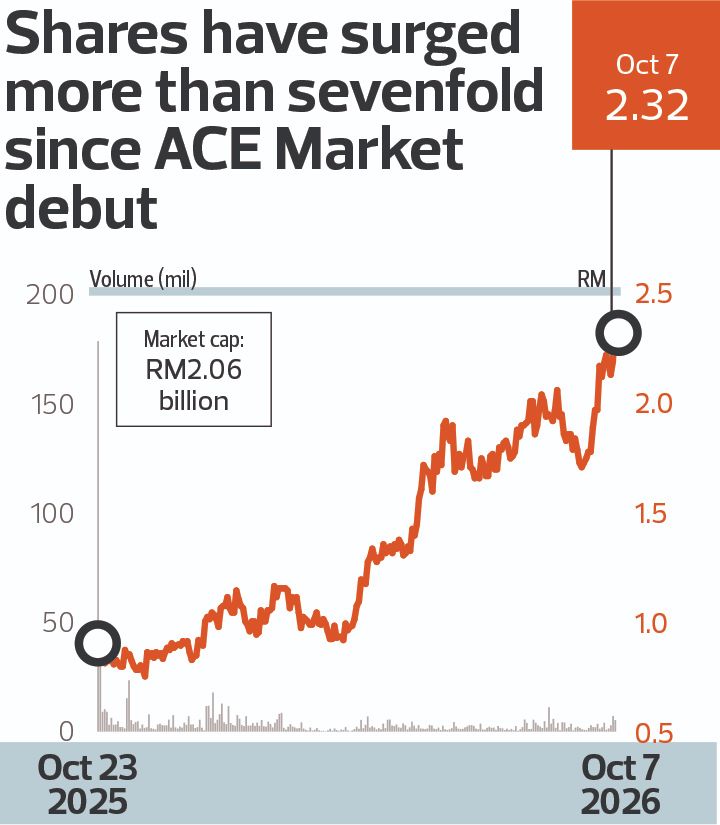
THMY Holdings Bhd (KL:THMY), which made its ACE Market debut on Oct 23 last year at an initial public offering (IPO) price of 31 sen, has seen its shares surge nearly 7.5-fold in slightly less than a year to RM2.32 last Wednesday (Oct 7), giving the automated test solutions provider a market value of RM2.06 billion.
At that price, THMY trades at a trailing price-earnings ratio (PER) of about 123 times. Based on analyst forecasts, the stock is valued at 81 times the company’s earnings for the financial year ended March 31, 2027 (FY2027) and 59 times FY2028 earnings.
So, what is enabling the company to command such a lofty valuation?
The answer, according to CEO Ooi Can Nix, lies in THMY’s growing involvement in the development of increasingly complex products for the artificial intelligence (AI) and data centre industries. This includes working directly with a major US-based hyperscaler that designs its own specialised silicon chips.
“We are in their frontier products. Even [for products that have not been launched], we already work very closely with their design team,” Ooi tells The Edge.
Founded in 2008, THMY provides automated test solutions for electrical and electronic products, including in-circuit and functional circuit testing, as well as turnkey solutions covering design, fabrication, software development and assembly.
But its role is increasingly extending beyond simply supplying test equipment after a product has been developed. THMY is being brought into the development process earlier, working with customers to determine how their next-generation products should be tested and validating the engineering concepts before they enter commercial production.
“Before they come to the real product, we need to prove our design concept validation,” says Ooi. “We [must] have the solution, the engineering capabilities, the data to deploy into the complete test equipment system.”
This is becoming increasingly important as AI chips grow more powerful and generate significantly more heat. THMY can simulate a chip’s size, power requirements and heat generation, and work on solutions such as cold plates to manage the thermal load before the actual product reaches production.
THMY now has about 200 employees, including a sizeable pool of engineers, giving the company the technical capabilities to work alongside customers on increasingly sophisticated products.
For instance, THMY has developed modular systems that allow wear-and-tear components to be replaced more quickly, reducing downtime for customers. The need is becoming more pronounced as higher-power products put greater stress on testing equipment and accelerate component wear.
It is also benefiting from geopolitical shifts, particularly the China-plus-one strategy. Ooi says restrictions surrounding the development and deployment of certain data centre and AI products make Southeast Asia increasingly relevant as an alternative manufacturing and testing base.
“In Southeast Asia, not many companies are in this field. Compared to Western firms, we are better in terms of cost, in terms of efficiency. So that’s why we are in a pretty good position right now to grow,” he says.
Scaling up for what comes next
As AI chips become more powerful, the infrastructure needed to test them is evolving just as quickly.
Ooi says earlier-generation products consumed less than 300W and could be tested using conventional air cooling. About two years ago, power requirements had risen to around 500W, making liquid cooling necessary. THMY is now working with products requiring about 1,500W, while the next generation could reach as much as 2,500W.
The jump in power density means THMY needs to invest not only in more sophisticated testing systems, but also in the power, cooling and other infrastructure needed to support them.
That rising infrastructure requirement is one reason THMY has substantially increased the scale of its second factory.
Initially planned at 88,000 sq ft, the facility has been expanded to about 300,800 sq ft, comprising 222,000 sq ft of factory space, 44,000 sq ft of office space and 34,000 sq ft of utilities.
The facility is designed to accommodate an initial 20 advanced automated test solution assembly lines, primarily for data centre and cloud computing AI products. Construction began in July and is targeted for completion by the second quarter of 2028.
The upsized project carries an estimated cost of about RM172.6 million, nearly six times the roughly RM30 million factory expansion outlined in THMY’s IPO prospectus.
More importantly, the facility is being designed with future product generations in mind, rather than simply to meet current demand.
“When we plan for the facility, we embed the upcoming requirements and long-term growth plans … as such, the floor space and infrastructure for high-capacity power supply,” says Ooi.
He expects the upgraded infrastructure to support at least the next five-year technology cycle.
The investment comes as THMY’s existing operations are already running at full capacity, despite the addition of mezzanine space and machinery.
Rather than turn away orders, however, the company is looking to stretch its capacity through automation, outsourcing, contract workers and Penang’s wider supply chain ecosystem.
“We won’t turn away our customers. In Penang, we’ve got a very strong ecosystem. We can utilise our networks, the supply chain system here, to help scale up [business],” says Ooi.
Automation is also helping THMY reduce its reliance on manual processes, with machines increasingly taking over inspection and other tasks that were previously performed manually.
Focusing on higher-value work
THMY’s strategy is not simply to maximise production volume. Instead, it wants to use its engineering capabilities to capture more complex and higher-value projects.
Its technology, media and telecommunications segment — comprising data centre, AI-computing and telecommunications products — accounts for about 52% of group revenue, according to Ooi. Electrical and electronics and electronics manufacturing services contribute about 19% and 17% respectively.
Ooi says the group deliberately prioritises complex products because lower-value orders can consume substantial production capacity. “If we continue to focus on industrial products, consumer products, yes, the order is big, but the value is low,” he remarks. “That’s why we need to align [business] with our engineering competency and drive advancements on our capability. Then we can capture high-value products.”
That does not mean THMY is walking away from its legacy customers. Instead, it is increasingly outsourcing less complex processes and modularising assembly, allowing the group to preserve those relationships while freeing up internal capacity for more sophisticated work.
“For legacy products, we won’t turn down the customer. So, what we are doing is like in parallel, we outsource,” says Ooi. “For non-complex product assembly, we make it more modular and speed up the process.”
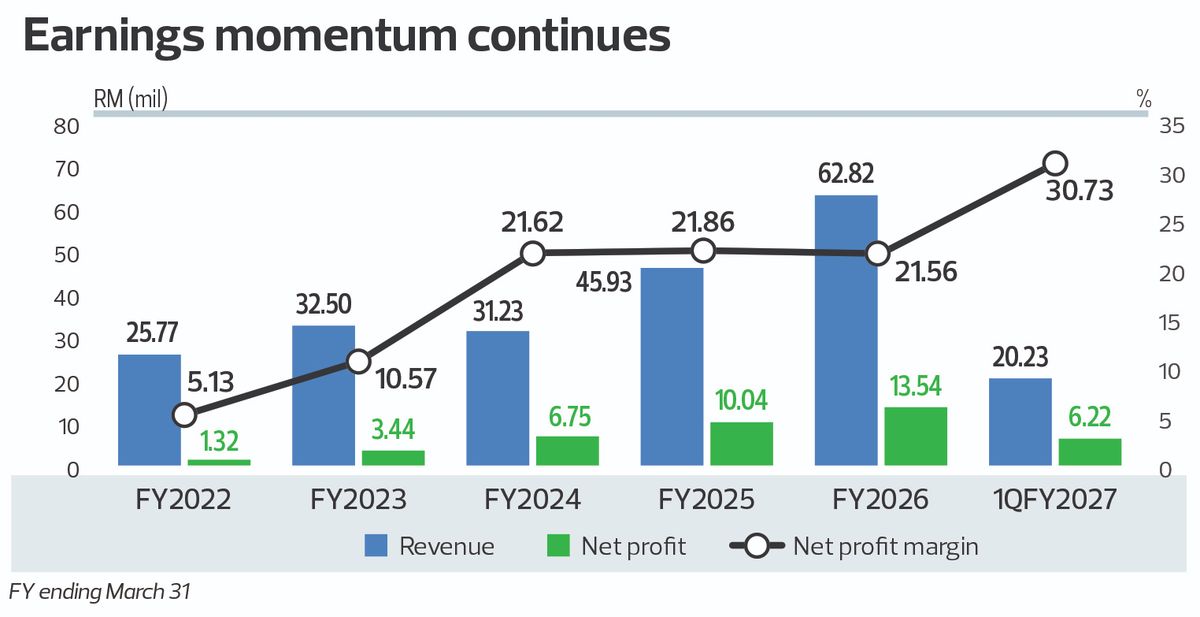
The strategy appears to be translating into higher margins. THMY’s net profit margin has risen steadily over the past five financial years, from 5.13% in FY2022 to 10.57% in FY2023, before rising to about 21% from FY2024 to FY2026.
The momentum has continued into FY2027. In 1QFY2027, revenue rose 42.5% year on year to a record RM20.2 million, while net profit more than doubled to a record RM6.2 million. Net profit margin widened further to a new high of 30.7%.
Ooi believes the shift towards higher-value projects should provide further room for margin expansion. “We look forward to the high-value projects and also selling our engineering competencies.”
Looking beyond AI
While data centres and AI are the immediate growth drivers, THMY is already looking at the next technology wave.
Ooi identifies physical AI, particularly humanoid robots, as a potential new business segment.
THMY is already working with customers on new product introduction and conducting some testing on humanoid-robot components. Volumes are currently small, but Ooi sees potential for significant demand if humanoid robots move into commercial production.
“This is another area we are looking forward [to], how to expand our business sectors,” he says.
The group has historically positioned itself around successive technology cycles, having gained experience in consumer, industrial, networking and cloud computing products before the current AI boom. “We always keep ourselves in pace with the technology,” Ooi says.
The bigger factory will require funding beyond THMY’s remaining IPO proceeds.
As at June 30, 2026, the group had RM54.7 million in cash and bank balances, including other investments, with gearing at 0.35 times. It had RM28.78 million of IPO proceeds yet to be utilised, including RM22.9 million earmarked for the new factory.
Ooi says the remaining proceeds will not be sufficient for the projected capital expenditure. The company is working with several banks on financing facilities and is considering a combination of bank borrowings and equity funding.
THMY nevertheless remains mindful of maintaining a healthy balance sheet as it scales up, including the potential dilution from any equity fundraising.
“We are always mindful of the balance sheet and cash flow and not to stretch ourselves too much. We want to have healthy growth,” Ooi says.
Can growth justify the valuation?
On its market debut last year, THMY’s share price surged nearly three times from its IPO price to close at 91 sen. It then climbed a further 155% to its Oct 7 close of RM2.32.
Ooi says the management is keeping its focus on building the company’s technology capabilities and strengthening its operations, rather than on the share price.
“[We are thankful] to the capital market for believing in the company’s performance and the numbers we deliver,” he says. “For us, we are more looking forward to [growing] the technology-driven business.”
Affin Hwang Investment Bank, the sole research house with coverage of the stock, has a “buy” recommendation and RM3 target price. It forecasts THMY’s net profit to rise 88% from RM13.5 million in FY2026 to RM25.4 million in FY2027, before increasing another 36% to RM34.5 million in FY2028.
The target price is based on a PER of 83 times FY2027 earnings and 77 times FY2028 earnings.
For investors, the key question is whether THMY can deliver earnings growth fast enough to justify a valuation that has already moved far ahead of its IPO price.
As for Ooi, the focus is on staying ahead of the technology curve and preparing for the next generation of products.
Ooi remains THMY’s largest shareholder with a 67.2% stake, while the Employees Provident Fund and AIA Bhd hold 6.2% and 3.7% respectively.
Save by subscribing to us for your print and/or digital copy.
P/S: The Edge is also available on Apple's App Store and Android's Google Play.