

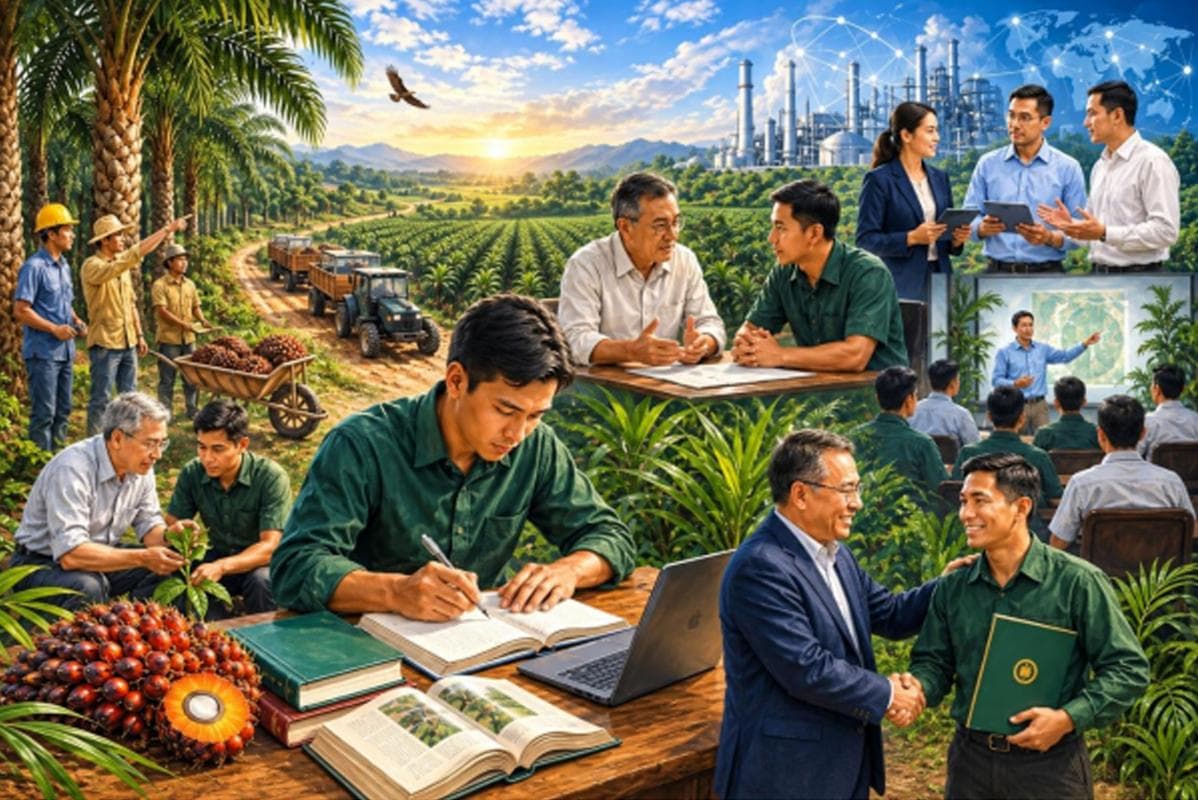
There was a time when a young planter learnt much of his profession simply by following an older planter around an estate.
He learnt to look at the sky before deciding whether fertiliser should go out. He discovered that a road which looked perfectly respectable in January could become something resembling chocolate porridge in December. He learnt to inspect harvesting, read a crop book, understand field standards, listen carefully to a mandore and, occasionally, explain to the manager why something that definitely should not have happened had nevertheless happened.
The estate was his university and some of his finest professors never possessed professorial titles. I still believe strongly in that kind of education. Plantation knowledge cannot be acquired entirely from textbooks, PowerPoint slides or examinations. You have to walk the fields, see how palms respond differently to soil, rainfall and management, experience crop peaks, labour shortages and machinery breakdowns, and discover that agriculture has an irritating habit of treating our carefully prepared spreadsheets merely as suggestions.
Recently, when I saw Ramesh Veloo and Mohamad Fadzil Hitam being accorded Fellowship recognition by the Incorporated Society of Planters, I found myself thinking less about the letters FISP than about what a lifetime in plantations must contain before such recognition carries real meaning.
Their careers followed different routes. Ramesh combined estate experience with scholarship, research and leadership across Malaysia and Indonesia, and continues to serve the profession through ISP. Mohamad Fadzil's career stretched over more than four decades across estate operations, corporate transformation, governance, mechanisation and professional development.
Looking at them, I was reminded that achievement in plantations is seldom one spectacular moment. More often, it is accumulated quietly over decades: one field decision, one difficult problem solved, one mistake remembered, one younger colleague guided, one lesson learnt and then another. An award may mark the summit that others can see but the real climb is made during all those years when nobody is applauding.
Titles, qualifications and awards matter but they are milestones rather than the journey itself. The deeper measure may be whether a planter continues to learn, whether his judgement becomes sounder with experience, whether he remains humble enough to ask about what he does not know and, eventually, whether those who worked with him became better because of that encounter.
After more than three decades around plantations, research and the palm oil industry, I have come to believe something quite strongly: a planter should never graduate from learning.
Better stupid once
I have carried a simple rule through much of my working life: if you don't know, ask. It sounds obvious but in practice it can be surprisingly difficult. Sometimes the question seems embarrassingly basic. Everyone else in the room appears to understand. Heads are nodding knowingly. Acronyms are flying. The presentation has reached Slide 47 and you are still wondering what something on Slide 15 actually meant.
Then pride begins whispering: "Surely I ought to know this. Worse still: If I ask, everyone may think I am stupid." My philosophy has always been simple. Better to be thought stupid once for asking a simple question than to remain stupid for the rest of your life because you were too proud to ask it. Swallow the pride, raise the hand and ask.
Quite often, something amusing happens. Several other people in the room did not understand either. They were simply better at looking as though they did. I have found this rule useful throughout my career because every transition brings us into territory where somebody knows more than we do. A scientist may know agronomy but needs to understand finance. An estate manager may understand operations but suddenly have to grapple with sustainability standards. A corporate leader may understand business but find himself listening to someone half his age explaining artificial intelligence.
There is no shame in not knowing. The danger lies in pretending that we do. Strangely, asking questions can become harder as careers progress. A young assistant is expected to ask. A manager somehow feels he ought to know. A general manager feels he ought to know even more. And once impressive initials begin accumulating before and after our names, admitting ignorance can become uncomfortable.
Yet perhaps the most dangerous point in a professional career is not when we know too little. It is when we become senior enough to believe that we should already know everything.
Experience is valuable until it becomes furniture
Experience is one of the plantation industry's greatest assets. There are things an experienced planter notices that no textbook easily teaches. He can walk into a field and sense that something is not quite right. A seasoned manager can look at a crop pattern and begin asking questions before the monthly figures confirm the problem. Sometimes he can tell from the atmosphere in an estate office that the real issue is not agronomic at all.
Such judgement accumulates slowly and we should treasure it. But experience also carries an occupational hazard. After twenty or thirty years, we become exceptionally good at saying, "Last time we did it like this." I am quite certain I have said it myself. Sometimes “last time” contains wisdom. Sometimes it merely contains history. Knowing the difference is one of the marks of maturity.
Experience can become a comfortable chair. Sit in it long enough and we may stop noticing that the room outside has changed. The young planter has one great advantage over the veteran: he knows that he does not know. The veteran's danger is believing that what he already knows will always be enough. It will not.
The fundamentals remain. Agronomy matters. Harvesting matters. Fertiliser matters. Roads and drains matter. Labour, cost control, productivity and good supervision matter. But around those fundamentals an entirely new landscape has grown: sustainability, certification, traceability, mechanisation, automation, artificial intelligence, data analytics, labour standards, environmental expectations, governance, communication and changing markets.
The planter who once mainly needed to understand how to produce a good crop increasingly has to understand how that crop fits into a much larger economic, technological, environmental and social system. The boundaries keep moving. Machinery becomes more sophisticated. Market requirements change. Sustainability expectations evolve. Workers themselves change. Technology creates new possibilities and new questions.
Nobody graduates from university knowing all that. Nobody finishes a thirty-year career knowing all of it either. The target keeps moving and that is precisely why learning cannot stop.
From knowing how to understanding why
One phrase in ISP's educational material caught my attention. It describes professional development as helping broaden career opportunities from “skill worker to knowledge worker". There is a larger idea inside those few words. Skill teaches us how. Knowledge helps us understand why.
A supervisor may know how to organise harvesting efficiently. Then learning deepens the questions. Why is productivity different between gangs? Why is one block yielding less? Why is a particular piece of mechanisation suitable in one terrain but not another? Why does a sustainability requirement matter beyond satisfying an auditor? Why does one manager inspire initiative while another produces only obedience?
Knowing how gets the work done. Understanding why enables us eventually to improve the work. And then comes perhaps the most useful question of all: What can we do better? That is where the skilled practitioner begins becoming the thinking professional.
Consider someone who starts at the supervisory level. He may already understand harvesting, upkeep and workers extremely well. Now add knowledge of soil and plant biology, estate engineering, bookkeeping, sustainability, good agricultural practices, leadership and communication. Suddenly the same estate looks different.
Those subjects, incidentally, are reflected in the ISP's Certificate in Plantation Management. But what interests me is not the programme brochure. It is the breadth of knowledge now expected of a plantation professional. Agronomy connects with economics. Economics connects with productivity. Productivity connects with labour. Labour connects with mechanisation. Mechanisation connects with capital. Sustainability connects with market access. Communication connects with leadership and leadership connects with almost everything.
Somewhere in the middle stands the planter trying to connect all the dots. Structured learning helps turn fragments of experience into a larger picture.
We sometimes organise life rather too neatly: study, graduate, work, get promoted, retire. The implication is that education belongs at the beginning. Life has other ideas. The profession keeps changing long after the graduation photograph has faded. A first degree may open the estate gate but it does not determine how far someone travels after entering it.
This matters because plantation careers have never followed one standard educational route. There are highly qualified graduates entering the industry but there are also outstanding plantation people who began at operational or supervisory levels and accumulated enormous practical knowledge over many years. For someone who has spent years learning how things work in the field, structured education can provide the why behind that experience.
Field practice begins to make sense in agronomic terms. Expenditure makes sense financially. Sustainability requirements make sense commercially. Management decisions make sense organisationally. Experience gives learning context. Learning gives experience structure. The two should reinforce each other.
Not all classrooms have four walls
Continuous learning does not necessarily mean returning to university. It may involve professional qualifications, short technical courses, online programmes, seminars, conferences, mentoring, reading, research, industry visits or simply spending an afternoon beside somebody who knows something you do not.
ISP provides one home-grown pathway. LISP combines self-study and examinations, with progression possible towards AISP and subsequently more advanced professional work. Fellowship by Thesis provides another route for eligible experienced professionals to undertake original work in plantation-related fields.
CPM, LISP, AISP, FISP: useful milestones, certainly. But let us not collect acronyms merely to lengthen the name card. A qualification should change something: what you understand, how you think, how you decide, how you lead or how effectively you help somebody else grow. Otherwise, it risks becoming a framed piece of paper proving that, once upon a time, we successfully passed an examination.
There is a paradox here. Education sometimes gives people confidence. Good education should also give us humility. The more deeply we understand a subject, the more we begin to see its complexity. That is why I am wary whenever certainty becomes too easy.
The best professionals I have encountered generally remain curious. They ask questions. They listen. They are prepared to change their minds when the evidence changes. There is also a difference between saying, "I have thirty years of experience," and saying, "I have repeated the same year thirty times." Those are not necessarily the same thing. Continuous learning does not disrespect experience. It prevents experience from becoming stale.
And this matters even more as we become senior. A junior executive's blind spot may affect a task. A manager's blind spot may affect an estate. A leader's blind spot can affect an organisation. Leadership itself changes. Early in our careers, we learn to manage work. Then people. Then budgets. Then organisations. Eventually we may have to understand technology, sustainability, regulation, markets, communication and change itself.
Somewhere along that journey comes perhaps the hardest lesson of all: learning to challenge our own assumptions. That requires the willingness to say, "I don't know. Explain this to me. Why are we doing it this way?" And occasionally, "Perhaps the younger fellow knows more about this than I do."
That last one can require considerable professional maturity. But leadership is not diminished by learning from someone junior. It may be strengthened by it.
Keep learning and keep teaching
There is another half to continuous learning. Knowledge should not travel only into the experienced planter. Eventually it must travel out.
An industry loses something whenever a good manager retires, carrying forty years of accumulated judgement entirely inside his head. Some knowledge fits neatly into SOPs. Some do not. Knowing when a crop trend feels wrong. Understanding when a young assistant needs correction and when he simply needs confidence. Recognising which problem requires intervention today and which can wait. Knowing when to insist and knowing when to listen. These are forms of knowledge too.
The senior professional, therefore, has two obligations: keep learning and keep teaching. One prevents stagnation; the other prevents institutional amnesia. Perhaps mentoring should therefore be regarded not as something senior professionals do when they have spare time but as part of the responsibility that comes with accumulated experience. Knowledge acquires greater value when it travels.
Companies have a responsibility here too. Plantation organisations frequently say that people are their greatest asset. If that is true, the asset requires investment. Training should not be measured merely by attendance or by the thickness of the training file when the auditor arrives. A better question is: What can this person now understand, decide or contribute that he or she could not before?
Companies can support professional programmes, provide reasonable study opportunities, encourage mentoring and recognise achievement. More importantly, they must allow employees to apply what they have learnt.
There is little point teaching leadership to a young executive and never allowing him to lead. There is equally little point sending people for innovation training and greeting every new suggestion with, "We have always done it this way." Learning needs somewhere to land.
When learning becomes legacy
Which brings me back to Ramesh Veloo and Mohamad Fadzil Hitam. Their Fellowship recognition can be viewed as one pinnacle of professional achievement, not because an award completes a career but because such recognition represents something accumulated over decades: competence, learning, service, judgement, leadership and contribution.
But they are surely not alone. Across the plantation industry are many others equally deserving: managers who quietly developed generations of assistants; researchers whose work sits behind improvements now taken for granted; supervisors and mandores who transferred practical knowledge from one generation to another; engineers who kept operations going when machines seemed determined otherwise; trainers who discovered that teaching another person can sometimes be harder than doing the job oneself; and leaders whose greatest achievement may never appear in an annual report because it walks around today in the form of the people they once mentored.
Not every contribution receives a trophy. That does not make the contribution smaller. Indeed, perhaps there comes a point in a career when achievement itself needs redefining. Early on, achievement may mean passing an examination. Later, a promotion. Then managing a larger estate or accepting greater responsibility.
But eventually the question changes: What became better because I was here? A field? An estate? A company? A profession? Or perhaps another person?
An award may be the pinnacle that others can see but perhaps the deeper pinnacle of a career is reached when somebody else's career becomes better because yours crossed theirs.
Never graduate
So, I hesitate to tell any planter, supervisor or executive, "You must take this course." That is too easy. I would rather ask three questions: Where do you want to be five or ten years from now and what will you need to know when you get there? What have you deliberately learnt during the past year that you did not know before? And what don't you know today because you have been too embarrassed to ask?
That last question may be worth more than another certificate. Learning may come through ISP, through a university, through technical training, through reading, through a mentor, through a younger colleague, through failure or sometimes through one embarrassingly simple question asked in a crowded room.
The pathway matters less than the habit: ask, learn, apply, share, then begin again. A qualification may tell us what we once learnt. A position may tell others how far our career has progressed. An award may one day recognise what we contributed. But none should convince us that there is nothing left to learn.
The best planter remains, somewhere inside, a student. Perhaps that is the paradox of professional growth: the more we genuinely learn, the more conscious we become of how much remains unknown.
So if you do not know, ask. Swallow the pride. Be stupid once, if necessary, but never choose ignorance simply to look clever.
The palms keep growing. The profession keeps changing. So should we.
Joseph Tek Choon Yee is a former president of the Malaysian Estate Owners’ Association and past chief executive of the Malaysian Palm Oil Association