

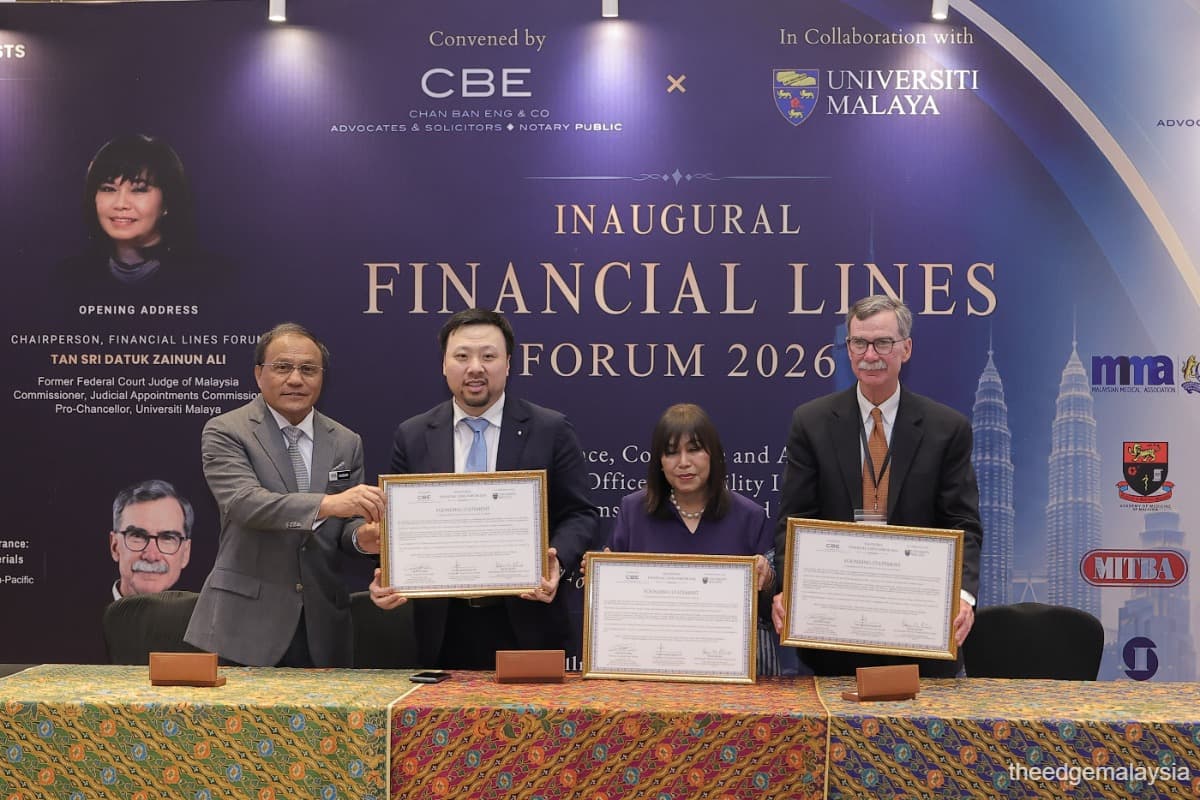
(Oct 9): The inaugural Financial Lines Forum 2026, convened by our law firm Chan Ban Eng & Co (CBE) in collaboration with Universiti Malaya (UM) on Oct 6 in Kuala Lumpur, grew out of conversations with Tan Sri Zainun Ali, former Judge of the Federal Court of Malaysia and pro-chancellor of UM, about pro bono education and nation-building.
Through our pro bono publications, commentaries (including in The Edge) and other public-interest initiatives, we had been exploring how the knowledge acquired in professional life could contribute to stronger institutions and a better-informed community.
It brought several areas into one continuing conversation: medical negligence, corporate and directors’ liability, insurance/reinsurance, and the emerging legal and governance risks arising from artificial intelligence (AI).
A clinical decision may raise questions for a doctor, a hospital, its board and its insurers. A corporate decision may engage directors’ duties, professional advice, technology risks and insurance coverage. Discussing these matters together can help each profession understand what the others need to know.
That breadth was indeed central to the initiative, namely, a place to examine and discuss responsibility from several perspectives before a difficulty becomes a dispute.
This confluence of views and experiences was available to forum participants who comprised members of the judiciary, doctors and hospital leaders, directors and general counsel, insurers, reinsurers and brokers, alongside academia, government, regulators and professional and industry bodies.
There was an international strand to the story, too. Almost ten years ago, while handling a complex directors and officers (D&O) liability insurance matter, I came across a noted US authority in the field, Kevin LaCroix, leading me to cold-call him from Malaysia. Our friendship grew over the years, together with a shared interest in making specialist knowledge accessible to the industry and community.
We eventually decided to address the gap in the literature outside of the US by writing 'Directors & Officers Liability Insurance: Selected Articles, Cases and Materials'. Published by CBE and distributed pro bono, with a foreword by Zainun, it was the first publication of its kind in the Asia-Pacific.
Kevin, a former president of the Professional Liability Underwriting Society (PLUS), subsequently agreed to serve as the Forum’s International Adviser. Our respective backgrounds brought together experience from the Bench, the Bar and the international market.
To our knowledge, the forum is the first professional and educational financial lines forum of its kind in the Asia-Pacific: convened pro bono by a law firm in collaboration with a public university, with that combination of leadership and a focus on financial lines connecting medical negligence, corporate and directors’ liability, AI governance, insurance and reinsurance.
As Zainun put it in her opening address: “No single profession has all the answers.”
For me, that observation captured the purpose of the gathering. A clinician, a hospital administrator, a director and an underwriter may encounter different aspects of the same issue. Understanding those differences can improve the decisions each makes within their own responsibilities.
The Attorney General, Tan Sri Mohd Dusuki Mokhtar, as guest of honour and keynote speaker, placed the forum’s subjects within the wider responsibilities owed to patients, families, businesses and the public.
On medical negligence, he emphasised a fair, evidence-based assessment that recognises both the patient’s experience and the realities of clinical practice. Patients may be seeking answers after serious injury or bereavement; doctors may be defending decisions made under pressure and with incomplete information. An adverse outcome does not by itself establish negligence.
His emphasis on communication, sound records, appropriate supervision and effective institutional processes had immediate relevance for the doctors and hospital leaders in the room. These are matters that institutions can address before a complaint or claim arises, serving patient care as well as the administration of justice.
Tan Sri Abdul Rashid Hussain, founder of RHB Group and chairman of Lembaga Tabung Haji, brought the perspective of institutional leadership in his special address. He observed that the room contained those who make decisions in hospitals and boardrooms, those who insure them and those who judge them. “Usually, when these groups meet, it is in a courtroom, and not by choice.”
His central message was that governance requires judgment and responsibility as well as compliance. Papers can be approved without sufficient scrutiny, assumptions can go unchallenged and concerns can remain outside the boardroom. What matters is whether those responsible asked the necessary questions and considered the consequences.
AI connected the two addresses. Rashid placed it within the board’s governance responsibilities. The attorney general asked who checks a system’s output, when a professional should question its recommendation and how a decision informed by AI should be documented.
These questions arise in the medical consulting room as well as the boardroom. The practical implication, in my view, is that human oversight requires someone with the expertise to recognise a problem and the authority to intervene. Institutions need to establish that responsibility when adopting a system.
Insurance belongs in the same discussion. As the attorney general observed, professional education can help close the gap between what people expect a policy to do and what its terms provide. Rashid offered a reminder of the limits of financial protection: “No insurance product has yet been designed that can buy back a reputation.”
The expert briefings and panels carried these themes into medical negligence, patient safety and clinical AI, alongside corporate governance, directors’ liability and insurance coverage.
For me, the practical connection was clear, namely, a hospital’s safeguards, a board’s oversight and an insurer’s assessment concern different parts of the same risk.
We are also deeply grateful for the support and encouragement of the attorney general who also witnessed Zainun, Kevin and me signing the founding statement in our respective roles as chairperson, international adviser and founder, recording the beginning of a platform intended to continue this work.
The forum’s 25 supporting organisations included the Prime Minister's Department — Attorney General’s Chambers and the Legal Aid Department, IHH Healthcare and KPJ Healthcare. Their support was entirely non-financial.
The Malaysia Book of Records recognised CBE for the 'First Pro Bono Financial Lines Forum' and me personally for 'First to Publish Pro Bono Directors & Officers Liability Insurance Book'. Both recognitions were meaningful because they concerned work undertaken to share specialist knowledge through pro bono education.
We are also preparing a further pro bono publication, with the ambition of producing a work that would be the first of its kind globally. Its details will be announced at the appropriate time.
These initiatives reflect a wider aspiration. We want to help strengthen Malaysian institutions and our country’s international standing in law, professional practice and education. We should be able to originate work of international quality here, collaborate with colleagues around the world and contribute knowledge that others might find useful.
Part of that ambition is to help reverse the brain drain: to give talented Malaysians greater reason to build their futures here, and those abroad greater reason to return and contribute. Pioneering publications and professional platforms can be part of building those opportunities.
The forum’s value will ultimately be measured in what people take back to their hospitals, boardrooms, practices and institutions. If a discussion prompts closer scrutiny of a risk, better communication with a patient or a more informed decision, the work would have served its purpose.
That is the spirit of Malaysia Boleh we hope to advance: confidence in what we can build here, supported by the work, resources and willingness to share that make it possible.
JJ Chan is the founder of the Financial Lines Forum, managing partner of CBE (Chan Ban Eng & Co), barrister-at-law of Gray’s Inn, London, advocate and solicitor of the High Court of Malaya, and an adjunct professor at the faculty of law, Universiti Malaya. He specialises in financial lines, medical negligence, corporate and directors’ liability, insurance/reinsurance, and AI governance risk. He also writes regularly on constitutional and public-interest matters.