

A weekly round-up of tanker and dry bulk market (Oct 9, 2026)
The Baltic Exchange, a wholly-owned subsidiary of Singapore Exchange, is the world's only independent source of maritime market information for the trading and settlement of physical and derivative contracts.
Its international community of over 650 members encompasses the majority of world shipping interests and commits to a code of business conduct overseen by the Baltic.
For daily freight market reports and assessments, please visit www.balticexchange.com.
Capesize
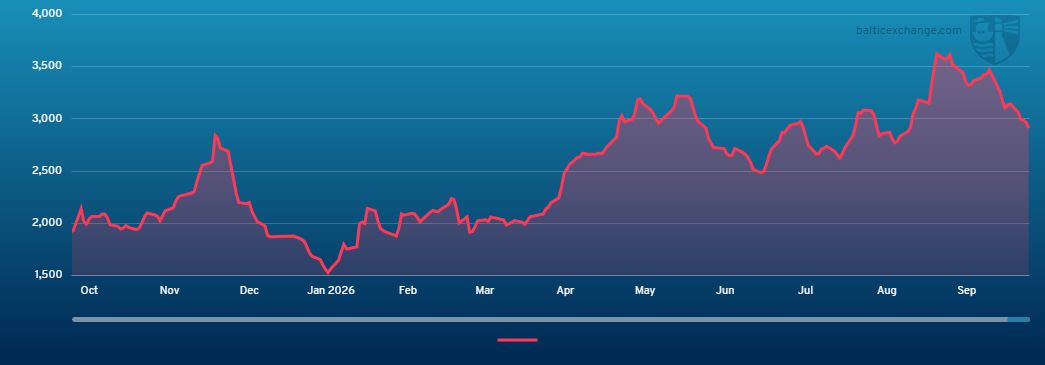
The market remained under pressure through the week, with persistent Atlantic weakness outweighing a gradual recovery in the Pacific. The 5TC continued to edge lower, falling from US$43,833 on Monday to US$39,363 by Friday. The Pacific showed greater resilience as fixing activity gathered pace, with close to 20 vessels reported on Wednesday alone. C5 was particularly busy throughout the week, with fixing activity exceptionally strong, yet the impact on rates remained relatively modest. After starting the week at US$13.95, C5 levels gradually improved into the upper US$14s, although today’s fixtures at US$14.20 and US$14.15 suggested that this upward momentum had yet to establish itself on firmer ground. The Atlantic remained the weaker basin. South Brazil and West Africa to China continued to face downward pressure, with C3 rates falling from the low US$37s at the start of the week to around US$33 by Friday. A lengthy ballaster list added to the imbalance, while demand increasingly centred on November dates. North Atlantic sentiment also softened, with weaker fixtures across both Fronthaul and backhaul business and limited activity weighing on the market.
Panamax-Kamsarmax
Market conditions improved steadily over the week following a quiet and cautious start. The P5TC edged lower early on before recovering those losses and ending the week higher overall. Initial sentiment was shaped by a wide bid-offer spread and uncertainty over market direction, with participants closely monitoring tonnage availability and demand. As the week progressed, activity increased across both basins and confidence gradually returned. The Atlantic strengthened as the week developed, with increased transatlantic demand helping absorb tonnage and improve sentiment. A 76,000-dwt and a 75,000-dwt fixed delivery East Coast South America for transatlantic trips at US$35,000 and US$33,650 respectively. Activity from the US East Coast also increased, with an 81,000-dwt fixing basis delivery North Continent for a trip to South Korea at US$33,500, with the scrubber benefit for the charterer. The North Atlantic was described as particularly active, allowing owners to maintain firmer rate ideas and narrow the bid-offer spread. East Coast South America fronthaul business remained active, with prompt positions attracting the strongest interest, evidenced by an 82,000-dwt fixing delivery East Coast South America end October for a fronthaul trade at US$22,650 plus a US$1,265,000 ballast bonus. The Pacific followed a similar trajectory. Activity was initially subdued due to regional holidays but improved as the week progressed, with Australia and the North Pacific providing most fresh enquiry. A 77,000-dwt fixed an East Coast Australia to Japan trip at US$24,000, while an 83,000-dwt fixed US$24,000 for a North Pacific round voyage and an 81,000-dwt fixed US$21,000 for a similar trade.
Ultramax/Supramax
A largely uneventful week. Activity in the Atlantic slowed, but rates only softened slightly, from the Continent scrap numbers were still very strong with a 63,000-dwt fixed delivery Tyne for scrap to the East Mediterranean at US$38,000. In the US Gulf fronthaul rates dipped below transatlantic levels during the week, but the highlight earlier in the week was a 64,000-dwt fixed for coal to India at US$38,000 basis a minimum guaranteed duration of 60 days. The Mediterranean was busier towards the end of the week, with cargoes having to compete against EC South America which has been enticing Owners to ballast, but rates there also came off compared to last week. A 63,000-dwt fixed from Santos to South Korea with grains at US$19,250 plus US$925,000 ballast bonus, whilst a similar vessel fixed to Southeast Asia at US$19,750 plus US$975,000 ballast bonus. Despite more holiday disruption in Asia, market levels nudged up throughout the week, mainly driven by the North Pacific grains which saw a 61,000-dwt fixed from North China at US$25,000 for a round voyage. Backhaul business was steady and further south Indonesia and Vietnam provided fresh demand and improved rates. South Africa also recorded small improvements with a 64,000-dwt fixed basis Richards Bay delivery for a trip Pakistan/WC India at US$27,000 plus US$300,000 ballast bonus. Spot rates ensured continued period interest, with a 64,000-dwt open North China fixed for minimum 4 to about 6 months period at US$23,500.
Handysize
The Handysize market ended the week on a mixed but broadly steady footing, with regional trends continuing to shape sentiment. The Continent and Mediterranean remained broadly balanced, with rates generally holding near last-done levels despite pockets of fresh demand. A 31,000-dwt vessel was reported fixed for a trip from Casablanca via Morocco to Bangladesh at US$18,500. The South Atlantic strengthened as the week progressed, supported by healthy cargo enquiry and tightening tonnage. By contrast, the US Gulf remained subdued, with rates softening amid limited demand and lengthy vessel availability. A 40,000-dwt vessel was fixed for a trip from Upriver to the Continent in the low US$30,000s, while a 38,000-dwt vessel was fixed for a trip from Savannah to the UK-Continent with wood pellets at US$21,000. In the Pacific, regional holidays restricted activity, although rates remained largely steady and the market was generally well balanced. A 36,000-dwt vessel open Panjin on 7-8 October was fixed for a trip to Southeast Asia at US$17,000.
Clean
LR2
The TC1 75kt MEG/Japan index decreased by only a single point this week to WS928. The corresponding Baltic round-trip TCE fell by US$2,000 to US$267,600/day. For the TC20 90kt MEG/UK-Continent run the index increased by US$1.03 million to US$18.40 million, corresponding to US$281,800/day on Baltic round trip. The TC15 80kt Mediterranean/East index increased by US$4.64 million to US$13.28 million, with the Baltic round-trip TCE rising by US$61,100 to US$133,500/day.
LR1
The TC5 55kt MEG/Japan index also decreased by only 8 points this week to WS940, still translating to US$192,900/day on Baltic round trip. For a trip westward on TC8 65kt MEG/UK-Continent route saw the index up US$49,900 to US$12.35 million and the Baltic round-trip TCE return increasing by US$600 to US$180,800/day.
MR
The TC17 35kt MEG/East Africa index decreased by around 11 points this week to WS893 and the TCE fell by US$2,700 to US$113,400/day. On the UK-Continent, the TC2 37kt ARA/US Atlantic Coast index decreased by 6 points up over WS200 to WS201. Despite this, corresponding Baltic round-trip TCE fell by US$1,400 to US$13,200/day. In the US Gulf, rates came crashing down late in the week. The TC14 38kt US Gulf/UK-Continent index sank by 95 points to WS285 and the round-trip TCE fell by US$19,400 to US$32,600/day. The TC21 38kt US Gulf/Caribbean run index decreased from US$1.40 million to US$932,100 with the corresponding Baltic TCE falling 48% to US$29,900/day. The MR Atlantic Triangulation Basket TCE decreased from US$64,200/day to US$46,300/day.
Handymax
In the Mediterranean, the TC6 30kt Cross-Mediterranean index ultimately increased by only 6 points to WS349 this week after a mid-week jump to WS355. The corresponding Baltic round-trip TCE rose by US$1,900 to US$59,400/day. The TC23 30kt Cross UK-Continent index shed 23 points to WS338 with the route’s TCE falling by US$6,700 to US$53,600/day.
VLCC
The VLCC rates for the Baltic assessed routes continued to climb this week. TD3C (270,000mt Middle East Gulf to China) climbed 115 points to WS1,318.75, which gives a daily round-trip TCE of US$1,412,594 for the standard Baltic VLCC. TD34 (Gulf of Oman/China) rose 62.5 points to WS841.07, giving a round-trip TCE of US$912,660/day.
In the Atlantic market, the rate for the 260,000mt West Africa to China route (TD15) improved by 111 points to WS750.63, giving a round-trip TCE of US$763,031/day, while the US Gulf to China route (TD22) surged by a further US$24.8 million to US$79,611,111, which gives a daily round-trip TCE of US$637,675.
Suezmax
In the Suezmax sector, the market moved sharply higher across all Baltic routes this week. The rate for the 130,000mt Nigeria/UK Continent voyage (TD20) rose another 103 points to WS981.11 (almost 12% up on last Friday), which translates into a daily round-trip TCE of about US$561,600. The TD27 route (Guyana to UK Continent basis 130,000mt) increased by about 129 points to WS961.11 (an increase of over 15% week-on-week), giving a daily round-trip TCE of about US$557,200. The 145,000mt USG/UKC (TD33) rose almost 164 points to WS849.44 (about a 24% increase since last Friday), which gives a round-trip TCE of just under US$581,000/day.
In the Black Sea, available tonnage remains tight. The rate for the TD6 route of 135,000mt CPC/Augusta increased by 87 points to WS1008.33, which shows a daily round-trip TCE of just over US$816,600.
Aframax
In the North Sea, the rate for the 80,000mt Cross-UK Continent route (TD7) strengthened significantly this week, gaining 216 points to WS627.5 (over 50% firmer than a week ago), showing a daily round-trip TCE of just under US$526,900 basis Hound Point to Wilhelmshaven.
In the Mediterranean, the rate for 80,000mt Cross-Mediterranean (TD19) continued higher, climbing over 135 points to WS780 (a 21% increase week-on-week). Basis Ceyhan to Lavera this shows a daily round-trip TCE of almost US$308,200.
Across the Atlantic, rates continued to strengthen this week. The 70,000mt East Coast Mexico/US Gulf route (TD26) climbed steeply by 241 points to close to WS1053 (which is a daily round-trip TCE of over US$394,550). The 70,000mt Covenas/US Gulf route (TD9) rose 238 points to almost WS1030, translating into a daily round-trip TCE of over US$347,800.
The rate for the transatlantic route of 70,000mt US Gulf/UK Continent (TD25) rose by more than 166 points to the WS955 mark, which gives a round-trip TCE basis Houston/Rotterdam of almost US$308,200.
On the Vancouver export routes, rates continued to strengthen. The TD28 route (80,000mt crude oil Vancouver to China) surged over US$6.5 million to US$15,000,000 (giving a round-trip TCE of US$320,700/day) while the TD29 route (80,000mt crude oil Vancouver to Pacific Area Lightering point off the USWC) rose by 300 points to WS814.
LNG
The LNG market softened this week, despite an increase in spot, multi-month and longer-term requirements entering the market. While activity picked up compared to recent weeks, vessel availability continues to outweigh cargo demand, keeping pressure on freight rates across both basins.
On the BLNG1 Australia–Japan route, rates declined by US$2,300 week-on-week to settle at US$34,600/day. The Pacific market remained relatively balanced, although additional cargo activity was insufficient to offset the amount of available tonnage.
The BLNG2 US Gulf–Continent route fell by US$4,900 to close at US$21,200/day. Despite signs of increased enquiry, charterers maintained the upper hand as the Atlantic vessel list continued to exceed the number of cargoes being worked.
Similarly, the BLNG3 US Gulf–Japan route declined US$4,200 week-on-week to settle at US$52,100/day. Following the same softening sentiment as BLNG2.
In the time charter market, sentiment softened across all periods. The six-month rate fell by US$1,600 to US$46,300/day, while the one-year term declined by US$334 to US$52,033/day. Further out the curve, the three-year period eased by US$350 to US$69,950/day.
LPG
The LPG market strengthened this week, with a relatively tight tonnage list and several outstanding cargoes supporting freight rates. The widening arbitrage also added to firmer sentiment.
On the BLPG1 Ras Tanura–Chiba route, rates settled at US$265.00/tonne, with the corresponding TCE at US$258,182/day.
The BLPG2 Houston–Flushing route increased by US$18.00 over the course of the week to close at US$190.83/tonne, while TCE rose by US$25,114 to US$227,905/day. Rates strengthened as the tight position list and outstanding cargoes continued to support sentiment.
Similarly, the BLPG3 Houston–Chiba route gained US$22.00 to settle at US$344.71/tonne, with TCE increasing by US$15,331 to US$214,030/day. The route posted steady gains through the week, supported by improving Eastbound economics and limited vessel availability.
Container
Container freight markets were largely stable this week, with the FBX index ending at 3,344 points on 9 October, little change from 3,348 points at the start of the week. Despite limited movement in the headline index, several individual routes experienced notable volatility.
Transpacific eastbound markets remained at elevated levels. China/East Asia to the US East Coast (FBX03) was unchanged throughout the week at US$9,606/FEU, while China/East Asia to the US West Coast (FBX01) declined sharply early in the week before recovering modestly to finish at US$8,106/FEU, down US$228 week-on-week.
Asia-Europe trades were generally steady. China/East Asia to North Europe (FBX11) held unchanged at US$3,260/FEU throughout the period. China/East Asia to the Mediterranean (FBX13) saw significant volatility, rising by US$387 on 6 October before easing back, ultimately ending the week at US$3,861/FEU, US$320 above last Friday’s level.
Westbound backhaul routes remained under pressure with limited demand support. Europe to China/East Asia (FBX12) finished at US$416/FEU, down US$21 week-on-week, while Mediterranean to China/East Asia (FBX14) remained unchanged at US$170/FEU.
The strongest gain this week was seen on the USA East Coast to Europe route (FBX21), which rose from US$1,074 to US$1,182/FEU following a sharp US$109 increase at the end of the week.
Disclaimer:
While reasonable care has been taken by the Baltic Exchange Information Services Limited (BEISL) and The Baltic Exchange (Asia) Pte. Ltd. (BEA, and together with BEISL being Baltic) in providing this information, all such information is for general use, provided without warranty or representation, is not designed to be used for or relied upon for any specific purpose, and does not infringe upon the legitimate rights and interests of any third party including intellectual property. The Baltic will not accept any liability for any loss incurred in any way whatsoever by any person who seeks to rely on the information contained herein.
All intellectual property and related rights in this information are owned by the Baltic. Any form of copying, distribution, extraction or re-utilisation of this information by any means, whether electronic or otherwise, is expressly prohibited. Persons wishing to do so must first obtain a licence to do so from the Baltic.