


KUALA LUMPUR (Oct 9): The government has called for structured annual wage progression framework that could give workers clearer pathways for pay advancement based on experience, skills, competency, responsibilities and productivity.
It also recommended floating sectoral wage floors in persistently low-paid industries, provided none falls below the national minimum wage, and wider collective agreements to support occupation-specific wage ladders, according to the Economic Outlook 2027 report.
Malaysia's minimum wage was raised to RM2,000 from RM1,700 as recently announced in Budget 2027.
To achieve sustainable wage progression, the report calls for an integrated approach that helps workers move up the wage ladder while building firms' capacity to pay more through productivity growth and a shift to higher-value activities.
Uplifting wages among MSMEs a 'big-push' impact
Overall, the main focus of such reform should be the labour-intensive micro, small and medium enterprises (MSMEs), according to the report.
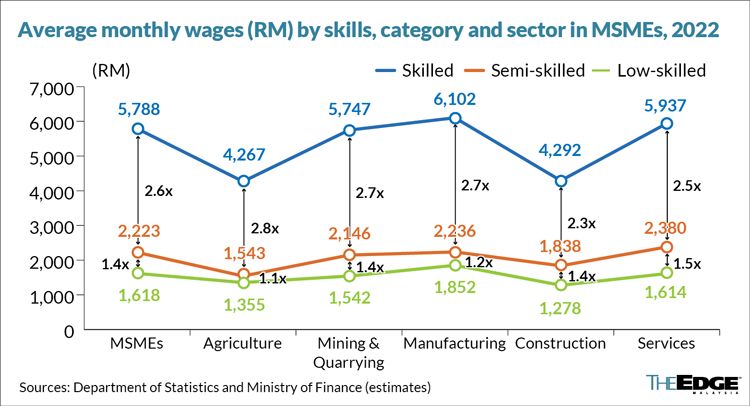
"Uplifting wages in labour-intensive MSMEs must be made the primary focus to generate a broad-based 'big-push' impact in rebuilding the wage ladder, enabling more workers to benefit from higher-value activities and meaningful age progression," the report said.
MSMEs were reported to make up around 93.7% of total establishments but only contributed 51.1% of total wages in 2022. Due to their small size and capacity, MSMEs are limited in how they can compensate their workers, but require more physical labour.
The government’s answer to this is to double down on existing initiatives to accelerate MSME digital transformation through technology adoption and implement policies to support firms to enhance managerial and organisational capabilities.
This will elevate MSMEs into high-value markets, increasing productivity and thus wage progression.
For workers outside of MSMEs, the government is proposing to implement sector-based minimum wages alongside the universal minimum wage. This sector-based wage would be used so that wages of low-skilled labour better reflect the productivity conditions of the sector.
The report also highlighted a need to continue focusing on Technical and Vocational Education and Training (TVET), reskilling and upskilling efforts to ensure that the workforce meets the skill demand of the industry.
Existing initiatives, such as the Progressive Wage Policy and the Academy in Industry, were highlighted as being strong foundations to strengthen this connection between nurturing the right talent and increasing fair wages.
The Progressive Wage Policy is a voluntary incentive for private employers to raise employee wages if they undergo upskilling. Academy in Industry is an on-the-job training initiative. Both were introduced in 2023.