


KUALA LUMPUR (Oct 9): Despite raising the minimum wage and the economy's recovery since the pandemic, wage progression remains weak beyond the minimum wage floor, according to the Economic Outlook 2027 report.
The report highlighted that while many workers are still earning near the statutory minimum, the middle-wage bracket remains narrow and wage gains are concentrated among skilled workers.
Malaysia's minimum wage was raised to RM2,000 from RM1,700 as recently announced in Budget 2027.
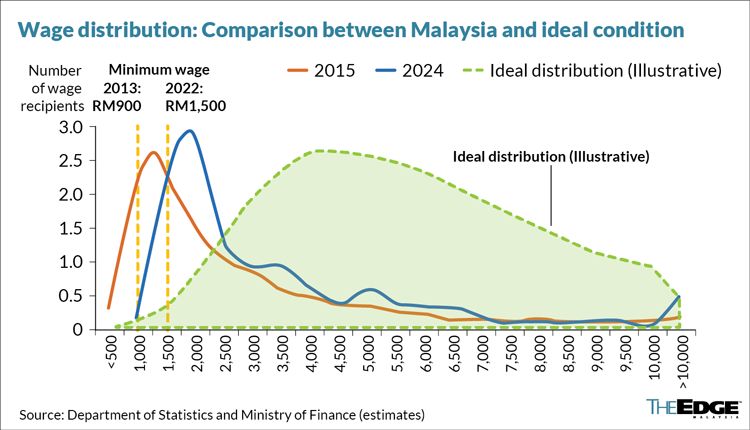
The latest economic outlook report notes that successive minimum wage increases in the past have shifted the wage distribution upward, moving its peak from below RM1,300 in 2015 to about RM1,700 to RM2,000 in 2024.
However, the actual distribution remains skewed to the right, with most workers earning modest wages and a small group of high earners receiving substantially larger pay, a wide gap from the illustrative "ideal" distribution of a mature high-wage economy.
Semi-skilled occupations made up 55.4% of total employment in 2024, compared with 36.5% for skilled and 8.1% for low-skilled workers, so the wage distribution is shaped mainly by the earnings of semi-skilled workers.
"The missing middle is concentrated among semi-skilled workers...Although skills command a wage premium, employment remains concentrated in semi-skilled occupations, reflecting the underlying structure of the economy," the report said.
From 2010 to 2024, skilled workers accounted for an estimated 56.8% of the overall rise in average wages, against 38.1% for semi-skilled and 5.1% for low-skilled workers, and the skilled to semi-skilled wage gap remained substantial at 2.1 times.
The report also points to labour-intensive, low-value-added industries, many paying below the median monthly wage, as a constraint on overall wage levels, and says moving towards a better distribution requires stronger productivity growth, occupational upgrading and more middle- and high-skilled jobs.
The wage gap between skilled workers
According to the economic outlook, the average wages from 2023 to 2024 for skilled workers rose by 81.06% to RM5,582 from RM3,083, while semi-skilled wages increased by 88.15% to RM2,604 from RM1,384 and low-skilled workers by 115.6% to RM987 from RM2,128.
Despite the overall rise in wages, the wage gap between skilled and semi-skilled workers remains at 2.1 times, while the gap between semi-skilled and low-skilled workers is at around 1.2 times.
The report said that this gap shows a lack of a gradual ladder that supports continuous wage progression among semi-skilled workers. Without clear wage intervention, it warns that workers may have limited opportunities to progress, while employers may face more difficulty in talent retention.
This slow growth of wages also applies to many sectors, which shows little progress has been made to narrow the wage gap across lower-wage industries, added the report.
For example, according to data, 81% of industries’ median wages remained unchanged between the years 2015 and 2024.
Further, 35 industries remained below the sectoral median wage, and only eight industries managed to move from below to above that median wage during that same period.
To address this, the government recommended a wage ladder to promote a meaningful career path and a sector-based minimum wages on top of the current universal minimum wage of RM1,700.