


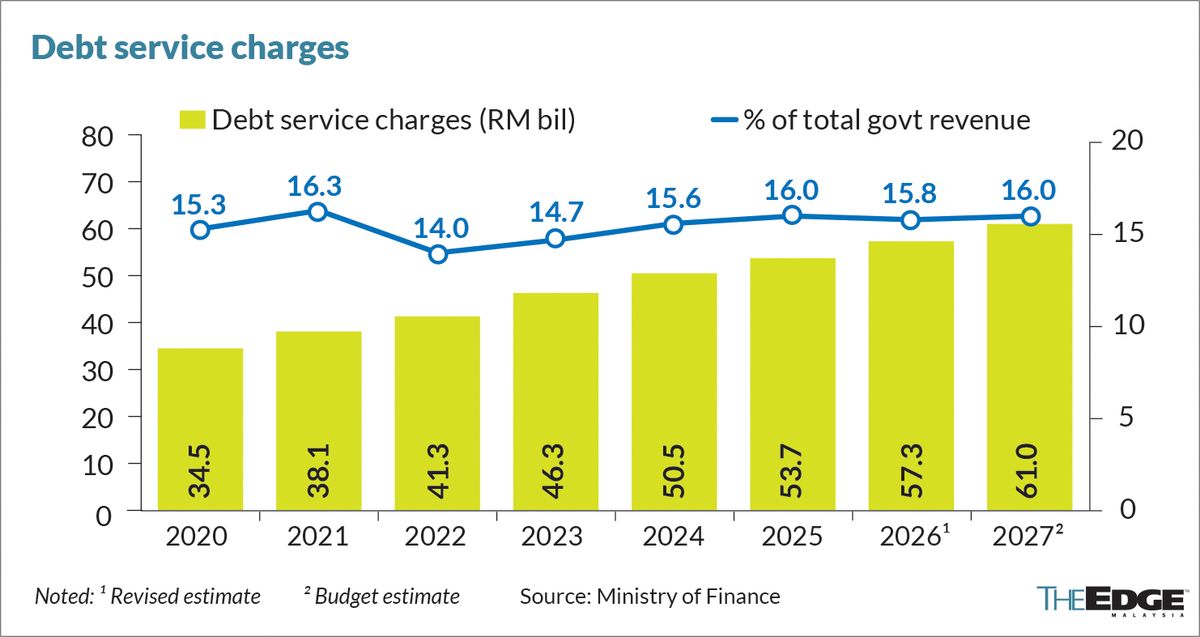
KUALA LUMPUR (Oct 9): Malaysia is expected to pay RM61.01 billion in 2027 to service its debts, up 6.5% from an estimated RM57.3 billion in 2026, according to the Ministry of Finance's (MOF) 2027 Fiscal Outlook and Federal Government Revenue Estimates report.
The higher debt service charges (DSCs) is expected to account for about 16% of federal government revenue in 2027 based on the government’s projected revenue of RM380.82 billion, a slight increase from 15.8% in 2026.
This means that for every RM100 collected in federal revenue next year, RM16 will go towards interest and profit payments on existing government debt.
The growing DSCs reflect Malaysia's increasing federal government debt, which reached RM1.38 trillion as at end-June 2026, up from RM1.32 trillion at end-2025.
Nevertheless, the debt-to-gross domestic product (GDP) ratio — which measures how much the government owes relative to the country’s income — eased to 63.1% from 65.2% over the same period, bringing the government closer to its medium-term target of below 60% under the Public Finance and Fiscal Responsibility Act 2023.
And the government's weighted average cost of outstanding debt — or the average interest rate the government pays on all the money it borrowed — edged down to 4.05% as at end-June 2026 from 4.06% at end-2025.
The estimated DSCs for 2026 is up 6.7% from RM53.7 billion in 2025, though their share of federal government revenue should ease to 15.8% from 16% as revenue is projected to increase by 8.2% to RM363.64 billion from RM336.07 billion in 2025.
Domestic coupon and profit payments account for RM56.6 billion or nearly 99% of the projected DSCs in 2026, while external borrowings account for the remaining RM700 million.
"The government continues to prioritise all debt obligations to be serviced promptly as required under the Federal Constitution and debt-related legislations," the MOF said in the report.
The growing cost of servicing government debt has also come under scrutiny in the US, where net interest payments on federal debt are projected to reach about US$1 trillion in 2026, according to the Congressional Budget Office. Concerns over mounting government debt, persistent fiscal deficits and inflation have contributed to volatility in US Treasuries, pushing longer-term bond yields higher and raising fears of further increases in borrowing costs.
Back in Malaysia, the MOF said the government's weighted average borrowing cost for new issuances stood at 3.71% for the first eight months of 2026, compared with 3.79% for the corresponding period last year, despite higher issuance volumes.
Investor demand for government securities remained supportive, although the average bid-to-cover ratio for medium- and long-term issuances eased to 2.34 times from 2.72 times over the same period. This means that for every RM1 debt the government looked to issue, investors offered to buy RM2.34 worth of it, compared to RM2.72 previously.
The government is projected to make fresh borrowings of RM207.1 billion in 2026, of which RM128.5 billion will be used to refinance maturing debt, leaving estimated net borrowings of RM78.6 billion to finance the fiscal deficit.
Medium- and long-term securities are expected to account for 92.2% of gross borrowings this year, as the government seeks to manage refinancing risks and limit its exposure to short-term interest rate fluctuations.