

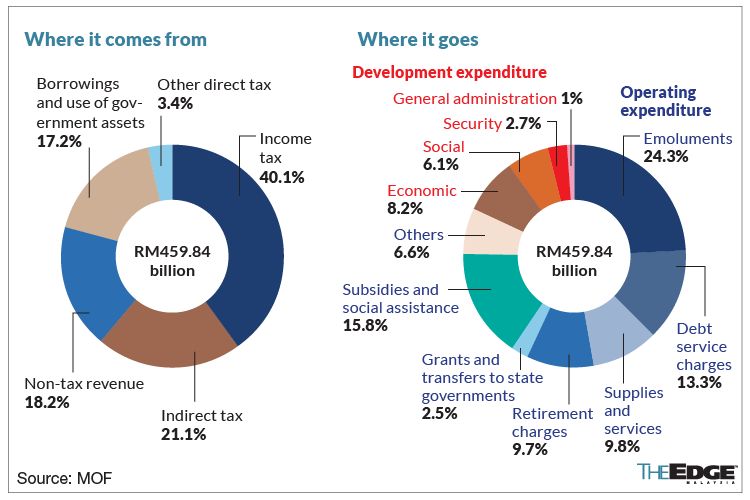
KUALA LUMPUR (Oct 9): Malaysia is expected to spend 82% of its forecasted record RM459.84 billion budget on operating expenditure (opex) in 2027, leaving RM83 billion, or 18%, for development expenditure (devex).
The projected budget for next year is 3.6% higher than 2026's revised spending of RM444.1 billion.
The country's opex is expected to increase by 3.8% to RM376.84 billion from the revised RM363.06 billion in 2026, according to the Ministry of Finance's (MOF) Fiscal Outlook and Federal Government Revenue Estimates report.
Emoluments continue to take up the largest share of opex and is projected to rise 2.9% to RM111.61 billion, accounting for 29.6% of the total. The growth is slower than the 6.9% increase estimated for 2026, which was partly driven by the second phase of the Public Service Remuneration System (SSPA).
The Finance Ministry said the higher allocation for 2027 mainly reflects annual salary increments and additional staffing requirements in the health and education sectors, including the implementation of the two-cohort Year One intake system.
Meanwhile, retirement charges are projected to rise 4.2% to RM44.6 billion (compared to an estimated 11% growth in 2026), accounting for 11.8% of opex, amid a growing number of pensioners and beneficiaries.
Together, emoluments and retirement charges will account for RM156.2 billion, or 41.4% of total opex.
Subsidies and social assistance to stay above RM70 billion
Subsidies and social assistance is expected makes up the second-largest component of opex, and are expected to remain above RM70 billion for the second consecutive year despite a marginal reduction in allocation.
The government is expected to earmark RM72.73 billion for subsidies and social assistance in 2027, down 2.3% from the revised RM74.47 billion for 2026. However, the amount remains considerably higher than the RM55.27 billion recorded in 2025.
Debt service charges, the third-largest component, are forecasted to increase by 6.5% to RM61.01 billion, accounting for 16.2% of opex. The growth is slightly slower than the estimated 6.7% growth in 2026.
Meanwhile, federal spending on supplies and services is expected to grow 8.2% to RM45.05 billion, a reversal from the estimated 1.3% decline in 2026.
The finance ministry said the higher spending is mainly for operational requirements, including maintenance and repairs, raw materials, rental and utilities. Funds have also been set aside for Visit Malaysia 2026-2027 and preparations for the 34th SEA Games and 16th General Election.
More funding for statutory bodies, state govts
Grants to statutory bodies are projected to rise to RM17.09 billion from RM15.04 billion in 2026, mainly for rural development, higher education and socioeconomic programmes. Meanwhile, grants and transfers to state governments, meanwhile, are expected to edge up to RM11.5 billion from RM11.4 billion.
Together, the grants amount to an estimated RM28.6 billion of the opex pool.
To contain spending pressures, the government said it tightened controls on supplies and services, and reviewed grants and transfers to statutory bodies and agencies with sufficient income-generating capacity and reserves.
These measures, alongside other spending adjustments, are estimated to have generated RM5 billion in savings, according to the report.
Development expenditure to rise to RM83b
The government's devex allocation is projected to increase by 2.5% to RM83 billion in 2027, from the revised RM81 billion this year, including funding for about 1,500 newly approved programmes and projects.
Of the total, the economic sector will receive the largest share at RM37.66 billion, followed by the social sector at RM27.98 billion, security at RM12.24 billion and general administration at RM5.12 billion.
Within the economic sector, RM17.56 billion is allocated for transport projects, including the Penang LRT Mutiara Line and the Sabah portion of the Pan Borneo Highway, as well as the construction of a train station at Arena Larkin in Johor.
Under the social sector, RM13.55 billion is earmarked for education and training, RM6.91 billion for healthcare and RM1.68 billion for housing.
For general administration, the allocation includes improvements to government ICT systems and other public infrastructure, said the ministry.