


KUALA LUMPUR (Oct 9): Malaysia will slow the pace of borrowings next year as the government racks up ever-larger debt to finance deficit spending.
The focus for 2027 will be to contain debt accumulation and rebuild fiscal buffers, according to the Ministry of Finance's 2027 Fiscal Outlook and Federal Government Revenue Estimates report. Priority will be given to controlling borrowing costs and mitigating refinancing risks.
“This will ensure borrowing remains affordable, risks are well managed and fiscal space is progressively rebuilt, while directing public resources towards productive and high-impact investments,” the ministry said.
Federal government debt continued to climb to RM1.38 trillion as at end-June 2026, although its ratio to gross domestic product eased to 63.1%, bringing the government closer to its medium-term target of below 60%.
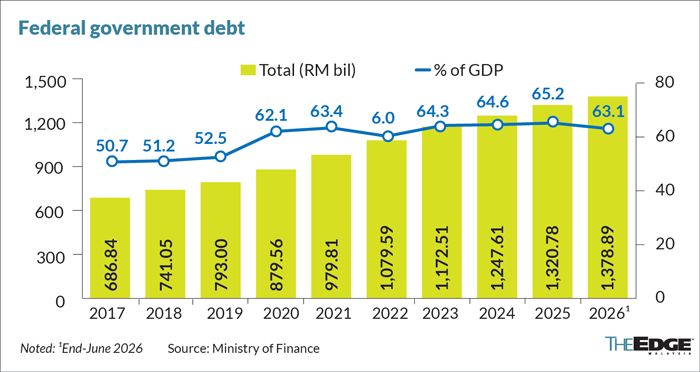
Outstanding debt increased by RM58.1 billion, or 4.4%, though the ratio to GDP declined by 2.1 percentage points from 65.2%, indicating that the economy has grown faster than the debt.
However, the absolute debt pile continues to expand as Putrajaya continues to spend more than it earns.
Under Malaysia’s fiscal laws, any borrowings to plug the shortfall in budget spending are only to finance development expenditure. The government’s operating expenditure, meanwhile, has to be funded by revenue.
New borrowings
By this year's end, new borrowings are projected to gross over RM207 billion, up from RM181.7 billion last year, mainly due to higher refinancing needs as existing debt matures.
Net borrowings are projected to rise to RM78.6 billion from RM75.6 billion last year.
"The core strategy remains heavily weighted toward ringgit-denominated domestic issuances to shield from exchange rate volatility," the ministry said. "In addition, the debt management strategy aims to smooth out maturity profile and mitigate rollover risks by prioritising medium-to-long tenure issuances amid a volatile global interest rate environment.”
As at end-June 2026, 63.9% of outstanding federal government debt had remaining maturities exceeding five years, while the weighted average time to maturity of outstanding debt securities remained unchanged at 9.6 years.
Domestic financing accounted for 98.8% of outstanding federal debt as at end-June 2026. Offshore borrowings made up the rest, limiting the government's exposure to foreign exchange swings.
Resident investors held RM1.08 trillion, or 78.5%, of outstanding federal government debt. The Employees Provident Fund remained the largest holder, accounting for 30.5% of total debt, followed by banking institutions at 28.5%.
Non-resident investors held the remaining 21.5%.