

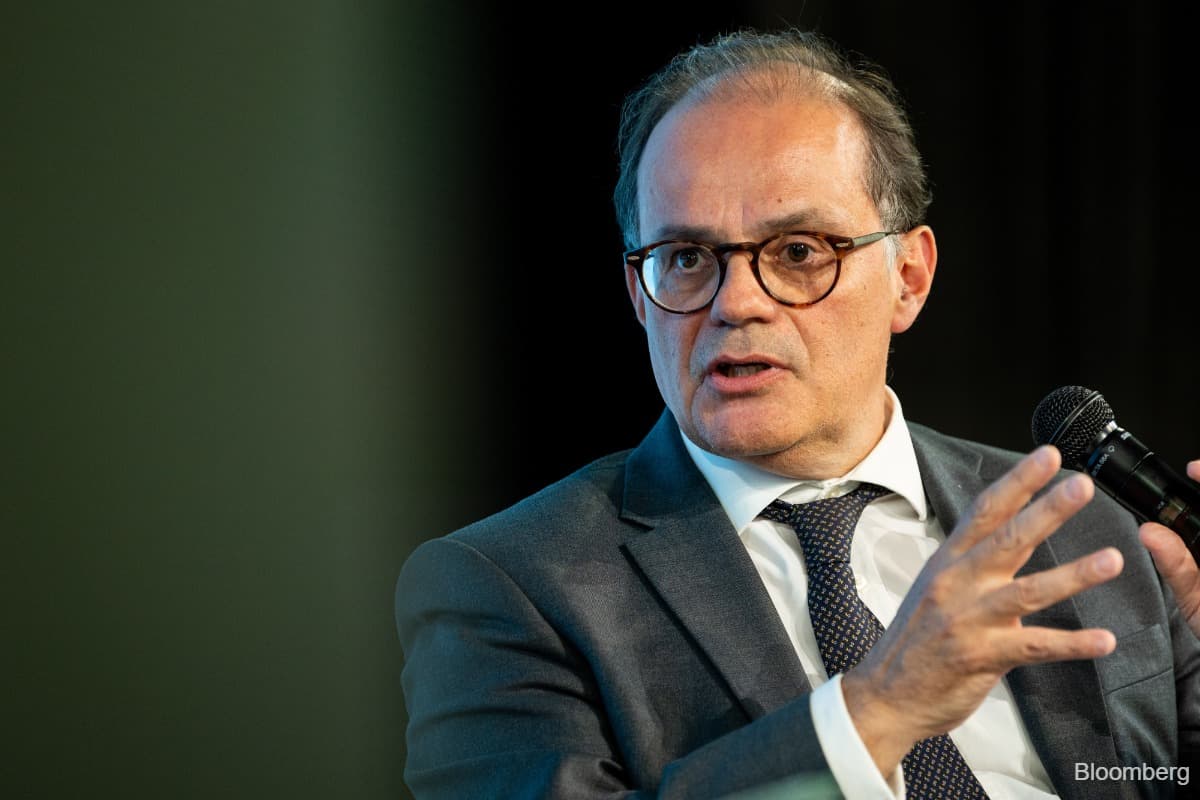
(Oct 8): Bank of France governor Emmanuel Moulin said that the geopolitical shock of the Middle East crisis is hitting all economies, even those with stronger public finances.
A member of the European Central Bank’s Governing Council, he cited the impact of inflation on global bond yields while skirting any immediate reference to the troubles faced by his own country.
“We see that there is a strong correlation between oil, long-term interest rates in the US, and interest rates in Europe,” he said on Thursday in Istanbul. “This increase in interest rates affects all countries, whatever is their fiscal position. Actually some countries with very strong fiscal positions are affected, as countries with weaker fiscal positions.”
Moulin spoke in a month when France has been in the sights of investors over its struggles to pass a budget and narrow its bloated deficit in turbulence that sparked memories of the eurozone debt crisis. Earlier on Thursday, Finance Minister Roland Lescure insisted that the country has no problem selling its bonds.
“What we see is that this geopolitical shock is also transmitting into a financial shock, and this is, I think, an important point to keep in mind,” Moulin said. “Financial conditions have been impacted by the increase in interest rates.”
He also observed that consumer-price growth driven by the oil and gas shock hasn’t spread much beyond that category.
“It’s clearly 100% energy,” Moulin said. “We see very little indirect effect. We see very small impact at this stage, and we don’t see second-round effects.”
Speaking at the same event, his Dutch counterpart, Olaf Sleijpen, echoed that observation, adding that while the energy shock is “quite persistent,” households’ inflation expectations are well anchored.
Uploaded by Felyx Teoh