

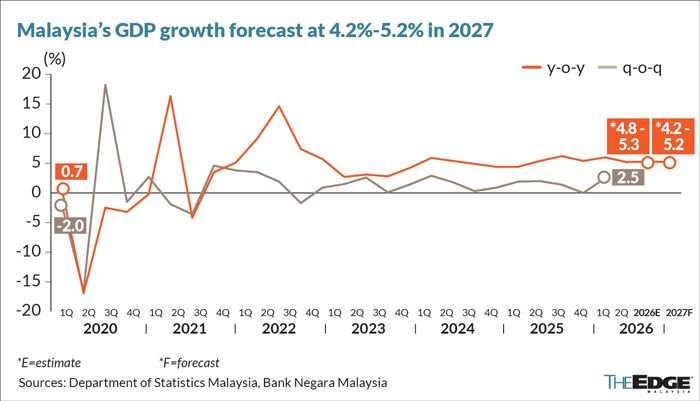
KUALA LUMPUR (Oct 9): Malaysia’s economy is forecasted to moderate to between 4.2% and 5.2% in 2027 amid softer domestic demand and easing of growth in most sectors, according to the Ministry of Finance’s Economic Outlook 2027 report.
This compares with an estimated growth of 4.8% to 5.3% in 2026. For the first half of 2026 (1H2026), gross domestic product (GDP) growth stood at 5.7%.
Moving forward, the nation's economic growth will be supported by steady trade flows, especially from exports of electrical and electronics (E&E) products, a boost in tourism activities, and a healthy job market.
Key policies and events such as Visit Malaysia 2026-2027, the Langkawi International Maritime and Aerospace Exhibition 2027, and the 34th SEA Games are expected to further boost the growth.
Private consumption, Malaysia's main engine of growth, is expected to expand at 4.8%, a slower pace compared with the estimated 5.0% in 2026 and 5.3% in 2025.
Private investment is expected to expand at 7.1% in 2027, easing from an estimated 7.8% in 2026, supported by continued capital expenditure on technology-intensive services and manufacturing sectors.
Key areas of investment include hyperscale data centres, artificial intelligence infrastructure, and advanced manufacturing facilities, as well as semiconductors, chemical and petrochemical activities.
In addition, government spending on civil servant salaries and supplies and services is expected to push public consumption up by 3.2% in 2027, easing slightly from an estimated 3.8% in 2026.
Concurrently, fiscal discipline will be further supported with the commencement of the Government Procurement Act 2026 (Act 882) in 2027 — a law that regulates all government procurement of goods, services, and works to reduce the risk of mismanaged public funds and maintain fiscal discipline.
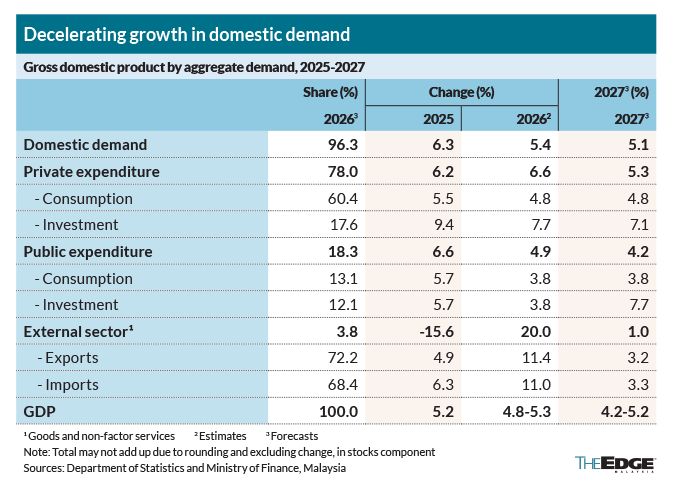
Meanwhile, public investment — government spending on projects and assets that build the country’s long-term capacity — is set to expand by 6.8% in 2027 from an estimated 7.7% in 2026, driven by targeted development spending and capital outlays.
Capital spending by non-financial public corporations will remain concentrated in strategic sectors such as energy, utilities, and transport, supported by commitments from government-linked investment companies (GLICs) under the GEAR-uP initiative programme.
The six GLICs under the GEAR-uP programme — the Employees Provident Fund, Permodalan Nasional Bhd, Retirement Fund (Inc), Khazanah Nasional Bhd, Pilgrims Fund Board and Armed Forces Fund Board — committed to deploying RM120 billion under a five-year programme from 2024 until 2028.
The total domestic direct investment under GEAR-uP reached RM26.9 billion as of 2025. With a RM120 billion investment commitment, RM93.1 billion remains to be invested until 2028.
Investment activity is also supported by ongoing projects, including the Penang LRT Mutiara Line, East Coast Rail Link (ECRL) Phase 2, Sarawak–Sabah Link Road, Pan-Borneo Highway (Sabah Section), and the Klang Valley Double Track Phase 2.
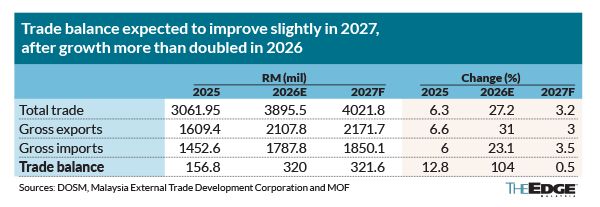
Malaysia’s total trade in 2027 is projected to expand by 3.2% to RM4.02 trillion, from an estimated RM3.90 trillion in 2026, marking a sharp deceleration from the strong 27.2% growth estimation in 2026 following a strong global technology upcycle and a favourable energy sector amid global external uncertainties.
However, the trade balance, or difference between gross export and gross import, is expected to improve slightly to RM321.6 billion in 2027, compared with RM320 billion in 2026, which had more than doubled from 2025.
The growth in exports will be underpinned by sustained demand for E&E products, liquefied natural gas as well as higher shipment of palm oil.
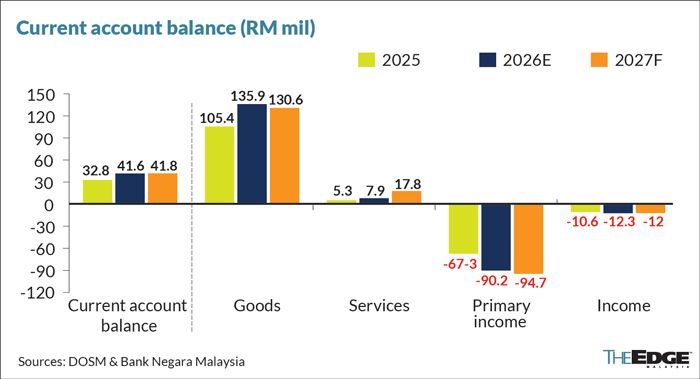
Overall, Malaysia’s current account surplus is forecast to expand slightly to RM41.8 billion in 2027 from an estimated RM41.3 billion in 2026.
Services sector to anchor GDP growth, agriculture to rebound, construction to decelerate
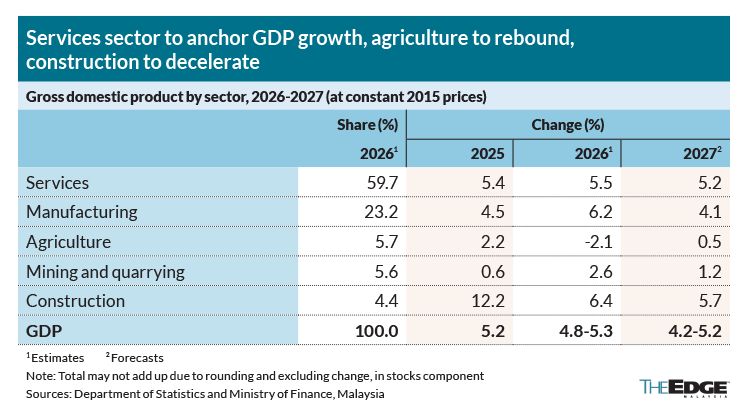
The services sector — which accounts for more than half of Malaysia’s economic output — is forecasted to expand at 5.2% in 2027, a slower pace compared with an estimated 5.5% in 2026 and 5.4% in 2025.
Despite the broader deceleration in the sector, subsectors like information and communications, finance and insurance, real estate and business services as well as other services are expected to outperform their estimated 2026 growth rates.
Growth of manufacturing activities, meanwhile, is projected to decelerate to 4.1% from an estimated 6.2% in 2026, attributed by moderate expansion in export-oriented industries, even as sustained demand continues for semiconductor and artificial intelligence-related products.
Agriculture is expected to rebound 0.5% from an estimated 2.1% contraction in 2026.
Although a marginal drop is anticipated for palm oil yield, crude palm oil prices are expected to remain firm between RM4,450 and RM4,600 per tonne in 2027, outperforming the 2026 estimate of RM4,300 to RM4,500 per tonne.
Mining and quarrying production is projected to expand at 1.2% in 2027 compared with 2.6% in the prior year, supported by both the natural gas and the crude oil and condensate subsectors.
New developments of gas fields in Sabah and Sarawak are expected to boost natural gas output, while Brent crude oil is projected to average US$85 per barrel.
Meanwhile, the construction sector is expected to see decelerating growth of 5.7% in 2027 compared to 6.4% in 2026 and 12.2% in 2025.
New data centre developments and major infrastructure projects are expected to fuel construction activity. Major infrastructure projects include the Gombak-Port Klang section of the ECRL Phase 2, the Elevated Autonomous Rapid Transit system, and the Kuala Lumpur Northern Dispersal Expressway. Other key drivers include the LRT3 Phase 2 and the Juru-Sungai Dua traffic dispersal project.
The National Housing Policy 2026-2035 is set to contribute to the residential subsector by improving affordability and resolving abandoned housing projects.