

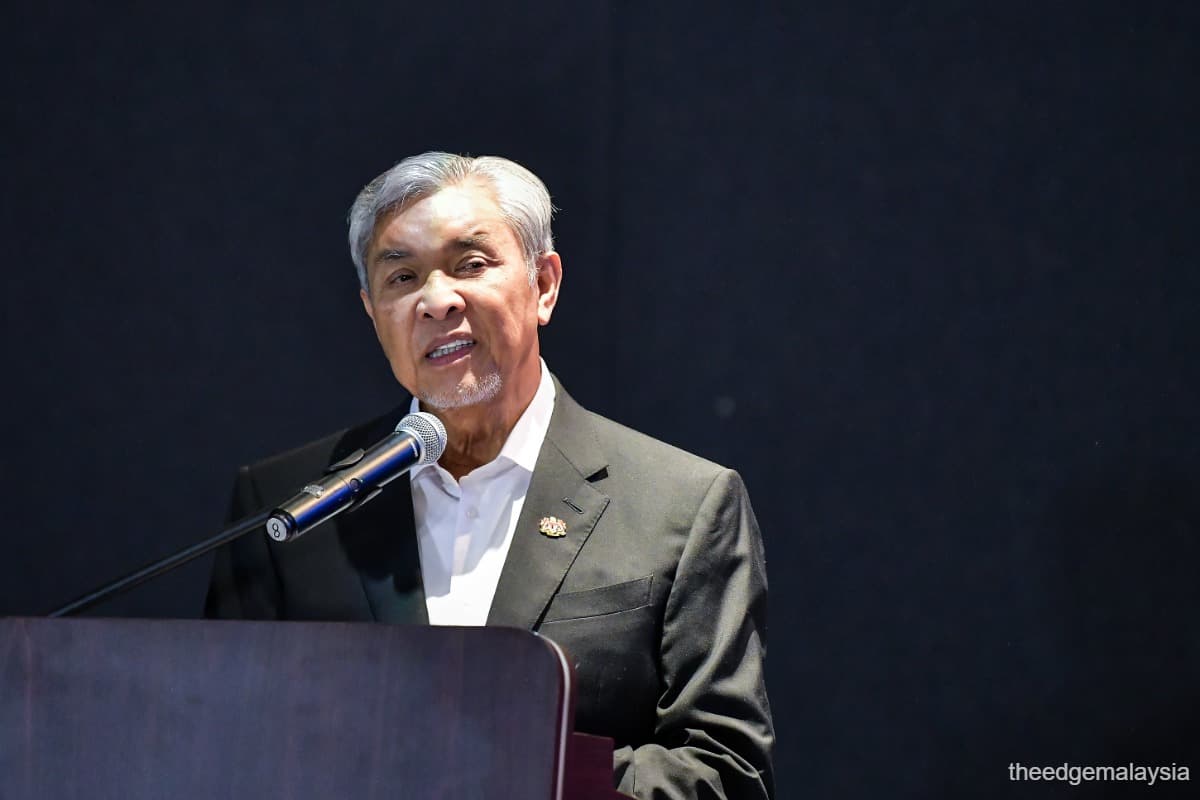
PUTRAJAYA (Oct 8): The Federal Court on Thursday granted permission to the Attorney General’s Chambers (AGC) and Deputy Prime Minister Datuk Seri Dr Ahmad Zahid Hamidi to challenge the Court of Appeal’s decision earlier this year to allow the Malaysian Bar to challenge the Attorney General’s discretion to take no further action (NFA) in Ahmad Zahid's corruption case.
The unanimous decision was made by a three-member bench led by Chief Judge of Malaya Datuk Seri Hashim Hamzah, who sat with Federal Court judges Datuk Nordin Hassan and Datuk Che Mohd Ruzima Ghazali.
Hashim said the bench is granting leave due to a difference in tests applied by the High Court and the Court of Appeal, where the appellate bench allowed the Malaysian Bar to have the merits of their challenge to be heard.
“The bench is of the view that these are novel constitutional questions of law that require final determination.
“The questions posed have met the threshold under Section 96 of the Courts of Judicature Act for the merits (of the questions) to be heard. We allow the application,” he said.
With the decision on Thursday, the Malaysian Bar’s challenge, which is to be heard at the High Court, will likely be paused until the determination by the Federal Court.
The bench allowed all questions from the AGC, who were led by senior federal counsel Ahmad Hanir Hambaly @ Arwi, and the four questions posed by Zahid’s team led by Datuk Hisyam Teh Poh Teik.
In civil cases, unlike in criminal cases, leave (permission) has to be gained from the court based on questions of law to make sure the questions are not frivolous, vexatious, or an abuse of the court process.
The Malaysian Bar, which opposed leave being granted, was represented by Steven Thiru and Datuk Ambiga Sreenevasan. They argued that the merits of their challenge should be allowed to proceed, citing the precedent set in the 2023 Datuk N Sundra Rajoo case, in which the apex court agreed that prosecutorial discretion is not absolute.
In May, a three-member Court of Appeal bench unanimously allowed the Malaysian Bar to proceed with its challenge.
The appellate bench, led by judge Datuk Faizah Jamaludin, ruled that the Malaysian Bar’s application was not frivolous or vexatious. Sitting alongside judges Datuk Dr Lim Hock Leng and Datuk Nadzarin Wok Nordin, Faizah declared that the case — which saw the AGC granting Zahid a discharge not amounting to an acquittal (DNAA) — raised serious arguable issues that warranted a full hearing, sending the matter back to the High Court.
While acknowledging that the legal threshold to challenge prosecutorial discretion is exceptionally high, the appellate court ruled that this case is rare and exceptional.
The AG Chambers and Zahid subsequently filed leave to appeal that led to Thursday proceedings.
AG's questions
The AG Chambers posed two questions to the apex court.
First, whether the prosecutor's decision not to institute or discontinue a prosecution, as allowed under Article 145(3) of the Federal Constitution, can be subject to judicial review, and if so, what should be the threshold to challenge it in court.
Second, whether the two-step threshold established by the Federal Court in Datuk N Sundra Rajoo vs Foreign Minister and others is properly characterised as a legal principle (ratio decidendi).
Zahid’s questions
The DPM’s lawyers, which include Datuk Hamidi Md Noh, posed the following questions to the apex court:
First, whether the two-step threshold must be satisfied before a judicial review against a prosecutorial decision is allowed to proceed or whether the more stringent precedent set in the Sundra Rajoo case is justified.
Second, whether challenging the prosecutor's decision to halt a prosecution mid-trial, which is allowed under Section 254(1) of the Criminal Procedure Code, amounts to usurping the jurisdiction of the criminal court.
Third, whether a discharge not amounting to an acquittal granted by the court can be subject to judicial review.
Fourth, whether Order 53 of the Rules of Court 2012, which regulates the initiation of a judicial review, bars the establishment of a different set of thresholds to challenge the AGC's prosecutorial discretion, which is set out under Article 145(3) of the Federal Constitution.
Zahid’s defence already called when proceedings halted
The Bar's challenge stems from the AGC discontinuing the prosecution of Ahmad Zahid on 47 charges of corruption, criminal breach of trust and money laundering at the defence stage in September 2023.
The presiding High Court judge, Datuk Collin Lawrence Sequerah (now Federal Court judge), granted an application by the prosecution, led by DPP Datuk Mohd Dusuki Mokhtar, for a DNAA in the Yayasan Akalbudi case.
A DNAA means that prosecutors can reinitiate the case.
However, on Jan 12 this year, AG Tan Sri Mohd Dusuki Mokhtar said Ahmad Zahid's case would not be revisited and classified it as NFA.
“No further action, we will not have any other action. Cannot be charged again, already settled once and for all,” he said.
The Malaysian Bar subsequently filed for a judicial review at the High Court to challenge the decision and meanwhile, Ahmad Zahid had filed a separate application at the High Court seeking a full acquittal of the 47 Yayasan Akalbudi case which is still pending following the challenge by the Bar.